
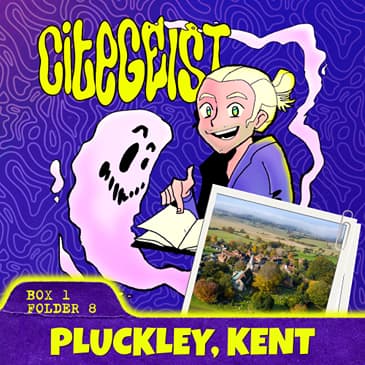

Pluckley, Kent has claimed the title of "most haunted village in Britain" for decades — it even landed a spot in the 1989 Guinness Book of World Records. With at least a dozen named ghosts (the Red Lady of St. Nicholas Church, the White Lady, the Watercress Woman, a highwayman, and more), it's become a full-on pilgrimage site for paranormal enthusiasts.
In this episode, I start with the legends as they're typically told — basically a walking tour through Pluckley's endless hauntings — then turn to the archive: historic newspapers, old guidebooks, and academic research to trace exactly how the village's ghost count exploded over time.
Have a ghost story you want to share? Leave a voice note or send an en email at https://citegeistpod.com/contact
Podcast Instagram: http://instagram.com/citegeistpod
Personal Instagram: http://instagram.com/joshua.spellman
Channel illustration by
GiAnna Ligammari: https://virtualgia.com/
GiAnna's Instagram: https://www.instagram.com/virtualgia.zip
Royalty Free Music: "Behind the Veil" by 8er41
SOURCES
Andrew Green. 1990. Our Haunted Kingdom. With Internet Archive. Fontana. http://archive.org/details/ourhauntedkingdo0000andr.
Bain News Service, publisher. 1910. Walter Winans with Gun and Dead Buffalo. Glass negative. Library of Congress Prints and Photographs Division. https://www.loc.gov/pictures/item/2014694839/.
Bain News Service, publisher. n.d. Walter Winans. Glass negative. Library of Congress Prints and Photographs Division. Accessed February 11, 2026. https://www.loc.gov/pictures/item/2014685406/.
Chris Maynard. 1977. All About Ghosts (The World of the Unknown). With Internet Archive. Usborne Publishing Ltd. http://archive.org/details/allaboutghoststh0000chri.
Daily Herald (United Kingdom). 1939. “On Ghost Hunt At Midnight (B.S.T.).” July 24. British Newspaper Archive. https://www.britishnewspaperarchive.co.uk/viewer/bl/0000681/19390724/028/0003.
“Dering Wood in Pluckley | Atlas Obscura.” n.d. Accessed January 20, 2026. https://www.atlasobscura.com/places/dering-woods.
Faversham News. 1911. “Woman Burnt To Death: Shocking Occurrence Near Pluckley.” August 19. British Newspaper Archive.
Fireside Horror. n.d. “Ghostly Folklore - Britain’s Most Haunted Village. — Fireside Horror’Fireside Horror’ by P A Sheldon, Is a Book Filled with Mystery, Horror and Thrills. These Ghostly and Occult Tales Will Capture You Imagination.” Accessed February 2, 2026. https://www.firesidehorror.co.uk/blog-2/ghostly-folklore-englands-most-haunted-village.
Jones, Richard. n.d. “A GHOST WALK AROUND PLUCKLEY ENGLAND’S MOST HAUNTED VILLAGE.” Accessed January 31, 2026. https://www.london-walking-tours.co.uk/free-tours/haunted-pluckley.htm.
Kentish Gazette. 1772. May 23. British Newspaper Archive. https://www.britishnewspaperarchive.co.uk/viewer/bl/0000235/17720523/010/0004.
“Laying Pluckley’s Ghosts to Rest: New Research Uncovers the Truth about the Most Haunted Village in England | UWE Bristol.” n.d. Accessed January 20, 2026. https://www.uwe.ac.uk/news/research-uncovers-truth-about-pluckleys-ghosts.
Lily. 2021. “Pluckley Circular Walk [Complete Guide & Map].” The Flamingo Hiker, December 8. https://theflamingohiker.com/pluckley-circular-walk/.
Moreton, Simon. 2025. “Laying Pluckley’s Ghosts: Frederick Sanders and the Origins of the ‘Most Haunted Village in England’, 1939–79.” Folklore 136 (1): 39–61. https://doi.org/10.1080/0015587X.2024.2425199.
“Most Haunted Village.” n.d. Accessed January 31, 2026. http://www.real-british-ghosts.com/most-haunted-village.html.
“Most Haunted Village in Britain, Pluckley.” 2011. Ukmythology, March 6. https://ukmythology.wordpress.com/most-haunted-village-in-britain-pluckley/.
Pluckley. n.d.-a. “Ghosts.” Pluckley. Accessed January 20, 2026. https://pluckley.net/village-life/history/ghosts/.
Pluckley. n.d.-b. “History.” Pluckley. Accessed February 1, 2026. https://pluckley.net/village-life/history/.
“Pluckley Brickworks, Ashford, Kent, England, UK.” n.d. Accessed February 1, 2026. https://www.mindat.org/loc-420667.html.
Pluckley Ghost Storytellers: The Men Who Gave Kent Its Hauntings | Spooky Kent. 2025. Ghosts and Hauntings. August 31. https://www.spookykent.com/pluckley-ghost-storytellers/.
“Psychic News, 1971-06-19 (Page 2) Metadata | Digitalcollections.Lib.Umanitoba.Ca.” 1971. Psychic News, June 19, 2.
Shakespeare, William. 1613. English: “The Dering Manuscript” – the Earliest Extant Manuscript of a Shakespearian Play. Folger Shakespeare Library. https://commons.wikimedia.org/wiki/File:The_Dering_Manuscript.jpg.
“Surrenden Dering House | England’s Lost Country Houses.” n.d. Accessed February 1, 2026. https://www.lostheritage.org.uk/houses/lh_kent_surrendendering_info_gallery.html.
“The Derings of Surrenden Dering Manor | Ukmythology.” n.d. Accessed February 1, 2026. https://ukmythology.wordpress.com/the-derings-of-surrenden-dering-manor/.
“The Highway Man.” n.d. Accessed February 7, 2026. https://www.ghostconnections.com/The%20Highway%20Man.htm.
The Independent. 2025. “Secrets of England’s ‘Most Haunted Village’ Revealed in New Research.” April 24. https://www.independent.co.uk/news/uk/home-news/pluckley-kent-ghosts-haunted-study-b2738832.html.
“This Is What Happened When I Visited the Most Haunted Village in Britain | The Independent.” n.d. Accessed January 20, 2026. https://www.the-independent.com/travel/uk/england/pluckley-kent-most-haunted-village-in-britain-b2851150.html.
Underwood, Peter. 1975. A Gazetteer of British Ghosts. With Internet Archive. New York : Walker. http://archive.org/details/gazetteerofbriti0000unde.
Wikipedia. 2026. “Pluckley.” January 4. https://en.wikipedia.org/w/index.php?title=Pluckley&oldid=1331106193.
WATCH on YouTube! https://www.youtube.com/@Joshua.Spellman
https://citegeistpod.com/
Have a ghost story you want to share? Leave a voice note or send an en email at https://citegeistpod.com/contact
Podcast Instagram: http://instagram.com/citegeistpod
Personal Instagram: http://instagram.com/joshua.spellman
Channel illustration by GiAnna Ligammari:
https://virtualgia.com/
https://www.instagram.com/virtualgia.zip
Royalty Free Music: "Behind the Veil" by 8er41
[00:00:00] - [Speaker 0]
The village of Pluckley in Kent is said to be the most haunted village in all of England, with its named ghosts ranging anywhere from 10 to 17 depending on who you ask. But what if you ask a local? What then? Will they recant one of their own experiences with one of the daring dames? The old schoolmaster?
[00:00:20] - [Speaker 0]
Perhaps the highwayman? Or will they tell you the only horror they've experienced is trying to get home from the shops when all the tourists come for Halloween? Hello, and welcome to another episode of Citegeist. I'm your host, Joshua Spellman. We've got another Most Haunted on our hands today.
[00:00:43] - [Speaker 0]
And I'll admit, researching outside of The US can be a little trickier, but I get a little bit tired of our stateside spirits. And since about 20% of the podcast listenership is in The UK, I thought, why not take a little jaunt across the pond? So for 20% of you, you're probably already familiar with Pluckley in Kent, often called the most haunted village in all of England. And I can already hear yourself asking, what about York and Warrington? And that's what we're here to find out today.
[00:01:11] - [Speaker 0]
And yes, I know York and Warrington are not villages. The 20% of you can pipe down. I'm a dumb American. Please come and save me. I'm one of the good ones.
[00:01:22] - [Speaker 0]
I use a kettle. A quick note before we start, one of the stories does use a historical term for the Romani people that is now widely considered a slur. It's not language that I use in my personal life and while it doesn't appear in the earliest historical accounts, it was added later to reinforce stereotypes and social attitudes. And I will be using the word to illustrate that shift. So is Pluckley, as the 1989 Guinness Book of World Records says, the most haunted village in all of Britain?
[00:01:54] - [Speaker 0]
Or is it just the most hyped? We have a laundry list of ghosts to get through. So without further ado, put on your Wellies, and let's get trudging through the mucky alleged history of Pluckley. Located in the county of Kent, roughly five miles northwest of Ashford, lies the quaint village of Pluckley. On the surface, it looks like many other English villages.
[00:02:26] - [Speaker 0]
Small, rural, and unassuming. But Pluckley has been standing over a thousand years, which has given it plenty of time to rack up not only history, but ghosts. Though small, it is not insignificant. It was here that the Deering manuscript was discovered among the papers of sir Edward Deering, containing the earliest known written manuscript copy of a Shakespearean play. The Deering family held influence in Kent for centuries, shaping both the village of Pluckley and the land around it.
[00:03:02] - [Speaker 0]
So it is no surprise that their ghosts still hold sway. We begin our walking tour through Pluckley with the spirit of Lady Dearing, better known as the Red Lady. In life, she was said to be exceptionally beautiful and her death was sudden and deeply tragic. Her husband, completely overwhelmed by grief, was desperate to keep her as beautiful in death as she was in life. When she was buried, he laid a single red rose upon her chest and buried her inside of seven lead coffins, each sealed within the next like a macabre set of nesting dolls.
[00:03:45] - [Speaker 0]
These were then placed inside of a solid oak casket and entombed beneath Saint Nicholas Church in hopes that her beauty would be preserved forever. Today, the red lady is said to walk the churchyard clutching that same red rose tightly to her chest. Witnesses describe faint unintelligible whispers drifting on the wind as she passes between the headstones, seemingly searching for something. Some say she's calling for her dogs that she loved so much in life, while others believe she is searching for the grave of a child that she had lost, unable to move on until she takes her child with her to the other side. Heading east, we'll find another daring spirit, the white lady who haunted the former site of Surrendan Dearing Manor.
[00:04:39] - [Speaker 0]
Though the manor itself burned down in 1952, the haunting predates its destruction. Before the fire, the white lady was said to roam the mansion's halls. According to legend, she was heading upstairs to bid her children goodnight when she slipped and fell to her death at the foot of the nursery staircase. Afterward, her ghost was seen well and often. So much so that she would scare visitors who would rush out of the manor to find new lodging, leaving their suitcases behind.
[00:05:13] - [Speaker 0]
But not all guests were as easily scared. At one point, the manor was leased to the American Olympic shooter Walter Wynens. Late one night, as he sat reading in the library, the white lady appeared before him. And in true American fashion, Winans shot first and asked questions later. Winans fired several rounds at the apparition, but the bullets passed straight through her.
[00:05:42] - [Speaker 0]
Unphased, she simply turned and floated away dissolving into the shelves of the library, leaving Wynen alone in a state of shock with several spent bullets at his feet. The ghost of Rose Court is yet another daring lady. During Tudor times, a member of the daring family built Rose Court for his mistress. However, the situation grew even more scandalous. This mistress seems to have been caught in a love triangle with a monk who lived across the way at Greystones.
[00:06:18] - [Speaker 0]
In the end, it was too much for her to bear. In her distress, she downed a poisonous cocktail made with crushed ivy berries. When her lifeless body was discovered, it was clear she spent her final moments staring out the window towards Greystones. Her spirit is said to appear between four and 05:00 in the afternoon, the very hour of her death. Just across the field from Rose Court is the house called Greystones.
[00:06:48] - [Speaker 0]
Here the ghost of the monk who is believed to be the lover of the woman at Rose Court still lingers. After the lady's death, the monk's only comfort was to walk the fields and forests where he and his lover spent so many joyous afternoons together. He walked and walked wasting away as he slowly died of a broken heart. His ghost can still be seen wandering between the trees retracing the path of a life undone, not knowing that his lover lies only a field away. And though the monk wanders silently, the same cannot be said for the screaming man of the old clay pit.
[00:07:33] - [Speaker 0]
South Of Greystones in Rose Court, just west of the Pluckley Railway Station, a tortured spirit is said to haunt the former Pluckley brick and tile works. He's arguably the most famous spirit in Pluckley, if not only due to the volume of his shrieks. No one knows who this man was in life, but it is believed he was buried alive when a wall of clay collapsed and smothered him where he stood. Just past the clay pit, you can take a shortcut through the infamous Deering Woods or as they're more commonly known, the Screaming Woods. No one ever said that Pluckley's ghosts were quiet.
[00:08:14] - [Speaker 0]
Many passing through the tall trees have reported sudden anguished screams echoing from deep within the forest. Shrieks loud enough to send birds bursting from their nests and leaving even the bravest of travelers shaken. If you survive your hike through the Deering Woods and head north toward Pluckley proper, you'll find yourself at Fright Corner. This crossroads marks the confluence of two spirits. The first is that of the highway man, Robert Dubois.
[00:08:47] - [Speaker 0]
He was a notorious roadside thief who was known to hide in the hollow of an old oak and rob a passerby. While the tales of his demise differ, the premise is more or less the same. One version tells of a traveler who was aware of Robert's games and pierced the oak preventatively with his sword, spearing Robert within it. The second version of events tells that the villagers of Pluckley were so incensed that a mob descended upon him and put an end to his antics once and for all by pinning him to the oak tree with their swords. Though the oak tree is now long gone, visitors claim to see a phantom tree and hanging from it, suspended by the blade of a broadsword, a man run through.
[00:09:38] - [Speaker 0]
The second ghost that wanders fright corner is that of the old Gypsy woman. She's often seen on Crossroads Bridge. In life, she was known throughout the nearby villages for selling watercress that she gathered from nearby streams. On one fateful day, her drunken gin soaked skirts caught fire from an ember of her tobacco pipe and she burst into flames. For many years afterward, her ghost appeared on the bridge on the anniversary of her death, engulfed in fire and screaming in agony.
[00:10:14] - [Speaker 0]
Although, over the years her presence has slowly dimmed to nothing more than a faint pink glow marking the spot where she died. If you continue over Crossroads Bridge and head north, you'll eventually reach a path off the main road leading up to Mill Hill. This path was once known as Dickie Buses Lane. And you'll notice along this path, a small grove of laurel trees. If you walk this lane at just the right time, you may meet a man wearing a long coat and striped trousers.
[00:10:50] - [Speaker 0]
Is he a local? A caretaker? Not quite. This is the spirit of the old schoolmaster. Just after World War two, a schoolmaster from Sardin would regularly walk the three miles to Pluckley to drink at the Black Horse Inn.
[00:11:06] - [Speaker 0]
One night, however, he never returned home. The schoolmaster was missing for several weeks until old Richard Buss, who the lane is named for, was walking through the laurel trees and was kicked in the face by a suspended decaying mass that had once been a man. The schoolmaster had hung himself from one of the laurel trees which immediately became known as the Haunted Laurels. As for a time, his ghostly corpse could be seen swinging from the branches on the breeze. However, today his spirit has been known to walk the lane freely and has even been known to greet passerby.
[00:11:48] - [Speaker 0]
Stepping off of Dickie Buss's lane and continuing up the main road, you'll find the schoolmaster's favorite drinking spot, the Black Horse Inn. Built in 1450, the inn is claimed to be the most haunted pub in all of England, which wouldn't be surprising due to its age, but its primary ghost isn't so old. The main patron of this pub is a poltergeist believed to be the spirit of one miss Jean Spicer. Objects vanish only to reappear elsewhere and items have been hurled across the bar. Miss Spicer was murdered inside the inn in the seventeen hundreds after being bludgeoned with a bowling pin.
[00:12:28] - [Speaker 0]
She has been making her displeasure with her untimely demise known ever since. There are so many more ghosts to find in Pluckley and we've barely scratched the surface. We haven't even touched on the ghostly stagecoach, the old miller, the mysterious mid century modern woman, the old colonel, or the spirits of the deering arms. For those tales and many more, you'll just have to make your way to Pluckley yourself and find out exactly why it's known as England's most haunted village. You never know what you may find waiting for you in the fog.
[00:13:12] - [Speaker 0]
There is so much to unpack with Pluckley. I didn't even list all of the ghosts. It was already getting really difficult not to make the story portion nothing but a laundry list of ghosts, and it still feels like it kind of came out that way. But when you get into the research and the lore, that's still what it is. The accounts of most of Pluckley's spirits are incredibly brief and incredibly vague and seem much more about quantity than about quality.
[00:13:42] - [Speaker 0]
There are probably a few good reasons for the vagueness of these stories and not least because many of them are made up. And that's not me being a skeptic or cynical. That's been confessed to and then later retracted. While the number of named ghosts in Plugley now sits around 17 or so, for a long while, the number was a modest 11. And up until the nineteen thirties, it was one.
[00:14:09] - [Speaker 0]
And while Pluckley has so many ghosts that I have just listed, virtually none of them have ever been seen. Pluckley's ghost stories seem to be built on historic vibes rather than bona fide confirmed sightings. Interestingly enough is that the one story that is the most detailed in its paranormal account is barely mentioned anywhere. I think I maybe found one blog that actually mentioned it very briefly in passing. So I'm gonna save that tale for the end so we don't get totally depressed about the lack of ghostly activity in Pluckley.
[00:14:45] - [Speaker 0]
But before we get to that little treat, we'll obviously have to dig into the history of the ghosts and see what the blogs get wrong. And believe me, they get so much wrong. Story settings jump hundreds of years between sources and many confuse ghosts with the incorrect locations and swap their identities. Between keeping up with 17 ghosts, I spent a lot of time straightening out stories and trying to find my way around on Google Maps to locate some of these rather obscure landmarks. But all that being said, I feel like I could give a really great tour of Pluckley in a pinch.
[00:15:25] - [Speaker 0]
So if you're looking for a tour guide, hire me, pay for my plane ticket, take me to England, let me live there with you, please save me. But aside from trying to keep up with the sheer number of spirits, the research for this episode was also a little difficult since I'm limited to what I can find online and what I can find online in The States. Unfortunately, I was not able to get my hands on any primary sources so everything I have is either secondary or tertiary. However, I must say I'm incredibly indebted to the work of doctor Simon Morton who wrote, Laying Pluckley's Ghosts, Frederick Sanders and the Origins of the Most Haunted Village in England, nineteen thirty nine to '79, which was published in the journal Folklore which is open access by the way. Absolutely love to see it.
[00:16:17] - [Speaker 0]
First, I have to say that reading doctor Morton's article gave me a pang of, ugh, why didn't I get my PhD in anthropology? I could be writing about ghost stories professionally and being called doctor instead of sitting here with a microphone and a camera and a fake fireplace behind me. But, hey, I became an archivist, which is also super cool. My point is is that Morton was a godsend, and all the credit goes to his work for helping me navigate the winding paths of this village's haunted history and leading me directly to the secondary sources, my little archivist fingers crave. His article is very much a scholarly one, but it's actually a very easy read.
[00:17:00] - [Speaker 0]
And I feel like anyone who likes this show would definitely enjoy it. So I do encourage you to go and read his article. It is open access which means it is free to read and it will be in the bibliography in the show notes. But before we get into the history behind the ghosts, I think we first need to look at where they all came from. Before the nineteen fifties, Pluckley did not have a reputation for being haunted at all.
[00:17:27] - [Speaker 0]
Despite ghosts being written about in many nearby locations, Pluckley seemed to be completely void of ghosts. And if you ask locals today, they may be inclined to tell you as much. Though maybe they just want the tourists to leave them alone. However, even seasoned ghost hunters who have visited Pluckley have left with a hollow feeling that there aren't any ghosts there at all. Now nine of the ghosts can be traced back to a single man, Frederick Sanders.
[00:17:58] - [Speaker 0]
And I'm actually gonna stop you right there because I can already hear you thinking to yourself, oh, no. Is this another Gussie Roy situation? And it's not entirely. Like Gussie Roy, Sanders had an interest in history and he wrote books on Kentish cultural history and graveyards. And he also fancied himself to be a psychical researcher frequently conducting his own paranormal investigations and ghost hunts in town.
[00:18:27] - [Speaker 0]
It was actually one of these ghost hunts that led to the first published account of a ghost in Pluckley, but that's a little tease. We're gonna save that for when we revisit the story of the Red Lady. It was in a letter that Sanders wrote to the Kentish Express in 1950 that Sanders introduced nine of the town's core ghosts. And it was also in this letter that Pluckley first called the town the most haunted village in England. And from there on out, the byline stuck.
[00:18:59] - [Speaker 0]
Sanders continued to write letters into newspapers and wrote accounts of the paranormal and his ghost investigations and also self published a memoir called Pluckley Was My Playground in which he reflected on his childhood and included many local ghost stories. So while no written record of these ghosts exist before Sanders, it doesn't appear that he pulled his nine ghosts from thin air or at least not all of them. Several of them likely existed in some form of oral tradition and other stories appear to stem from misremembered tragic events in Pluckley's history. And in fact, much like Gussy Roy in the spirit of ocean born Mary, Sanders said he had never seen any of Pluckley's ghosts himself. And actually, it seems like hardly anyone had.
[00:19:48] - [Speaker 0]
A local in the village was quoted as saying, if you look in prewar guidebooks, there is no mention of it being the most haunted village in England. And this is true. As we established, Sanders created that byline himself. But many guidebooks were published in the twentieth century as the automobile became a lot more accessible to the middle class. And out of this uptick in mobility came the advent of the road trip and visits to small villages like Pluckley that may have otherwise gone unnoticed were popular.
[00:20:19] - [Speaker 0]
Many travel guides came out of this travel boom and there is one that you may be very familiar with which is none other than the Michelin guides which still give out Michelin stars to restaurants each year even though the guidebooks themselves are defunct. But there weren't just guides for restaurants and hotels, there were guidebooks for just about anything you could imagine including ghosts. These specific guides became known as ghost gazetteers. Pluckley was absent from many of these early ghostly guides and didn't show up until 1967. And it was at this point where publications began to include other ghost stories that Sanders did not record.
[00:21:01] - [Speaker 0]
Instead, these ghost gazetteers included three ghosts that were invented by the BBC broadcaster and actor Desmond Carrington. The phantom coach, the monk at Greystones, and the surrendered daring poltergeist all seemed to stem from Carrington's coverage of Pluckley. It's unclear if these stories were all Carrington's doing or if he had some help. There was at least one other village local who went on record to say that there were no ghosts and the stories only started when locals started telling journalists tall tales for free pints at the Black Horse Inn. I feel like that's that's very English village coded.
[00:21:44] - [Speaker 0]
Ironically enough, the most damning quote I found about the lack of ghosts in Pluckley came from an article in Psychic News. Yes. You heard that right. Psychic news. And the quote from this article read, reporter William Rankine told on Sunday how he visited one of the haunted sites mentioned by Underwood.
[00:22:05] - [Speaker 0]
This is Pluckley near Ashford, Kent, generally known as the most haunted place in the county. Note that he says county and not country, which I find interesting, but the article goes on to say, his quest was disappointing. It was more than twenty five years since any locals have seen anything unusual. Even then, they were not sure that they saw a ghost. That is some pretty damning reporting from a source that is so predisposed to want to find some kind of spectral evidence.
[00:22:36] - [Speaker 0]
You know you got it bad when psychic news says they ain't got no ghosts. But regardless of whether or not the ghosts were ever seen, the stories still proliferated and over time they warped and morphed to fit changing cultural attitudes. So now that we know where these stories came from, let's start digging into the history. I constructed the story portion by analyzing a number of free walking tours that are available online and used this map from nineteen seventy seven's All About Ghosts as a guide to find locations on Google Maps. So let's retrace our steps and take a look back in time.
[00:23:15] - [Speaker 0]
Our first stop is Lady Deering or better known as the Red Lady, who is often seen in the graveyard of old Saint Nicholas' Church. There are many sources that mix up the red lady, the lady of Rose Court, and the white lady, so research quite honestly was maddening. It doesn't help that the red lady was buried with a red rose. While the lady at Rose Court didn't have a rose and roses are also red. But I digress.
[00:23:46] - [Speaker 0]
So I pretty much ignored all the Internet sources and stuck with narratives set prior to 1980 since they actually seemed to have their stuff together. In the earliest accounts, the red lady is the woman buried with a rose in, I don't know, what was it, seven lead coffins stacked one inside of another and then put inside of an oak casket with Sanders' original story being that she was buried in a coffin made of seven layers of lead. As mentioned earlier, the first written account of a ghost in Pluckley was in a newspaper article about the Red Lady. In this article, it says that the red lady was actually buried in four lead coffins with no mention of an oak one. That detail is never the same, it seems, even from the very first written account of it.
[00:24:35] - [Speaker 0]
The journalist for this 1939 Daily Herald article accompanied Sanders and his friend Douglas Bennett on a ghost hunt, but the ghosts were a no show. The author of the newspaper article, clearly a skeptic, cheekily wrote, it may be that the ghost hunters would have heard or seen more had they waited longer. For when the church clock struck midnight, it was only 11PM Greenwich Mean Time. And surely, such long established ghosts as that of lady Deering do not observe summertime. And to further twist the knife, the reporter hilariously titled the article ghost hunt at midnight, British summertime.
[00:25:14] - [Speaker 0]
Now Sanders was probably not so happy with this coverage since he failed to mention that a reporter accompanied the investigation when he wrote about it in his self published book, Psychical Research Haunted Kent. There doesn't seem to be any historic basis to the story of the Red Lady, at least not that doctor Morton had shared. However, I may have noticed a small mistake in his paper. As mentioned, Sanders wrote about this ghost hunt in his book where he mentioned lights in the belfry and that his friend Bennett heard a woman's voice in the courtyard. In his paper, Morton says that these details do not appear in the newspaper article produced by the visiting reporter, but they do, or at least the voice does.
[00:25:59] - [Speaker 0]
So perhaps he meant that both didn't appear, but the voice actually takes up a large part of the rather brief article saying, it was Douglas Bennett, excited watcher on his first ghost hunt, who heard the voice. He nudged his friend beside him and whispered, listen. Mister Sanders strained his ears but could hear nothing. It was unmistakably a woman's voice, Douglas told me. Mister Sanders is disappointed that he did not hear the voice, but they are to try again.
[00:26:28] - [Speaker 0]
And now bringing this up isn't too dog on Morton, but it confused me when I read it and I felt like it was a really good reminder to my fellow bibliographers to always double check your citations whenever possible because you'll never know what you find. Now while early sightings of the red lady were of her wandering around the graveyard because she simply could, I guess, later tellings evolved to say that she was looking for the grave of her lost child. This detail was likely to explain why she wandered around the place of her burial instead of elsewhere. But let us move on from the red lady to the white lady of Surinindearing Manor. The manor has been gone since the nineteen fifties and there isn't much of the history of the white lady.
[00:27:13] - [Speaker 0]
Although unlike many of Pluckley's ghosts, it appears that the white lady was an established ghostly figure long before Sanders came along as a story about Walter Winans had circulated in the village of Pluckley for years prior. Now we can move on to the third daring lady, the ghost of Rose Court. You know, the one who lived during Tudor times, drank a poison cocktail because she couldn't stand not being with her monk lover across the street. What's the deal with that? We know part of it was made up by Carrington, but is there any truth to the tale?
[00:27:46] - [Speaker 0]
Well, first off, I'll say it was impossible for the ghost to be from Tudor times if her lover lived at Greystones as that building was not erected until 1863. However, a very similar event matching the story of the lady at Rose Court did occur much later than Tudor times which is likely the basis that the modern story comes from. On 08/08/1862 at Rose Court or Rose Cottage as it was then known, 31 year old Mary Ann Bennett passed away from an opium overdose. Her death certificate and the outcome of the inquest ruled that she died by poisoning herself while in a state of mental derangement. Though I think today we'd be a little bit more gentle and say that she had suffered from depression and mental illness.
[00:28:40] - [Speaker 0]
Her father testified at her inquest saying, she has suffered from disease of the brain for two years past. And went on to say, yesterday morning, a little before 04:00, she came into my bedroom and took from a drawer a bottle containing a small quantity of opium. After that, she continued in a sleepy state until about twenty minutes before three in the afternoon when she died. I believe that this is the event that inspired the ghost story. Earlier mentions of the ghost of Rose Court had none of those details though and it was simply a ghost of a woman who called for her dog so often in her life that she did so in death.
[00:29:20] - [Speaker 0]
It wasn't until much later when Carrington linked the story of Rose Court with his own invention of the monk at Greystones that this romance and talk of poison and love triangles and drama came about. Now from Rose Court, let's go to the brick and tile works where the screaming man is said to be. All of the ghost blogs I read said and I quote, there was no confirmation of who this poor soul is. But that's not quite the truth, Ellen. Doctor Morton reveals that on 01/01/1899, a 35 year old man named Richard Bridgeland died when, just as the story goes, a portion of the clay wall fell on him.
[00:30:06] - [Speaker 0]
Now he wasn't smothered or buried alive as the story says. In fact, he was actually quickly dug out by his coworkers. But unfortunately, the weight of the clay wall falling on him had broken his neck. One could argue that perhaps Richard isn't the ghost referred to in the story, but the newspaper covering the event said that this was the first accident to occur in the twenty three years since the brick and tile works opened. So I think it's probably fair to say that this is our guy.
[00:30:37] - [Speaker 0]
Walking from the brickworks, our story portion walking tour took us from the screaming man through the screaming wood. I don't think we need to dwell on this more than a moment or two. The screams in the woods are likely foxes. Or I'll throw my 2¢ in, maybe they're barn owls. Because barn owls are likely the culprit for my favorite she, the banshee.
[00:31:03] - [Speaker 0]
And I'm saying she as in s I d h e as in the she. We can talk about that another time. Leaving the screaming wood, we then made our way to the highwayman, Robert Dubois. And to me this is very interesting. Sanders doesn't appear to have given the highwayman a name and in his memoir, he never mentioned a ghost associated with the location.
[00:31:29] - [Speaker 0]
The only thing he ever said is that he often played in the hollowed out tree where a highwayman was said to rob passerby. The ghost story came much later which appears to be a pattern for Sanders. He will often seem to ignore ghosts when writing about places at length and then come up with stories later or vice versa. So Sanders didn't come up with the name Robert Dubois and it didn't appear in Morton's paper either. I really only saw it appear in blogs.
[00:31:57] - [Speaker 0]
It didn't appear in any of the old paranormal guidebooks that I looked at either. And its first use seems to be in the 2007 television show, Most Haunted. But the name does make me laugh because it it has to be a joke. Right? No other website or article seems to have caught on to the name or maybe I'm reading a little bit too much into it, but Robert Dubois.
[00:32:23] - [Speaker 0]
Robert. Robber. Dubois. Of the wood. Robber.
[00:32:28] - [Speaker 0]
Of the wood. The dude hidden in a tree to rob people. That's literally what his name is, the robber in the wood. It's gone over a lot of people's heads mainly because it's a very catchy name and it sounds like it's of a certain period. So maybe that's why no one has questioned it, but I clocked it right away.
[00:32:47] - [Speaker 0]
And I think it's genius. I, as you know, love a good pun. The next story is that of the gypsy woman who burned alive after her tobacco pipe lit her skirts on fire at Crossroads Bridge. First off, let me say that I spent ages looking for this damn bridge. I'm sorry for those listening, but for those who are watching, can you tell me where the bridge is in this picture?
[00:33:17] - [Speaker 0]
Well, if you zoom all the way in and look behind those four blades of grass, you can kind of see it. I don't know if the bridge has always been this size, but it makes me mad. I thought there must have been another bridge at one point, but looking at the historic sources, it's actually possible that this story never originally involved a bridge at all. And my guess is that this bridge was an easy landmark for ghost hunters and it became part of the story. The historic account of this woman's death doesn't mention the bridge like I said, but I did read of another woman burning alive on a bridge, but that was not Impluckley.
[00:33:59] - [Speaker 0]
Now the gypsy element of the story also seems to be a later tweak that leaned into negative stereotypes that were not present in the original historic event, namely the gin soaked skirts. I think modern audiences, even those around the mid twentieth century, would have had to have imagined that alcohol and drunkenness would need to be the only way for a woman to light herself on fire and burn to death. However, when researching the story on my own, I actually found a really disturbing amount of stories about women in that era burning alive after a stray cigarette or pipe ember lit their skirts on fire. And none of them were drunk and many of them were high society ladies who were minding their own business when a careless man came along and lit up their heavy flammable skirts. Many early accounts of the gypsy woman, and that's the last time I'm going to say it, she was called the watercress woman.
[00:35:06] - [Speaker 0]
But that name eventually changed to reinforce negative stereotypes about the Romani which is not unlike what we see with many ghosts of color in The States. I think it is kind of cute though that there is a caravan park. That's what Brits call, like, mobile homes and campers right by the site of her death called the Watercrest Farm Campsite. And I think it's a fun little nod to the story. And I I say that because in their marketing, they did not use any bit of her ghost story to promote it or in their about section or anything.
[00:35:40] - [Speaker 0]
And I guess the caravan part of it kind of leans in to that Romani kind of aspect of the story. But it was done respectfully which I really appreciated. Now the original version of the story had no indication that she was Romani at all nor that she was an alcoholic. And she was known simply for the fact that she sold watercress and by her name. And her name was Sarah Sharp.
[00:36:07] - [Speaker 0]
She died on 08/17/1911 and her death is detailed in the 08/19/1911 issue of the Faversham News in an article titled, Woman Burnt to Death, Shocking Occurrence Near Pluckley. A shocking fatality occurred between Smarton and Pluckley on Thursday. The unfortunate victim being an aged watercress seller named Sarah Sharp whose charred body was found by the roadside and whose clothing had been accidentally ignited probably from a smoldering tobacco pipe. William Sharp of Charring, side note, that's if that's how you pronounce that, that's an ironic name, identified several articles found near the body as belonging to his wife, Sarah Sharp, which she had with her when she left home about 09:00 on Thursday morning. She was going to Pluckley And Smarton selling watercress.
[00:36:59] - [Speaker 0]
She was 76 years of age and was in the habit of smoking. He could not recognize the body, but he identified the shoes belonging to his wife and also the perambulator found near the body. Interjecting again because now I finally know where the English pram comes from. But again, moving on. John Max did, a young man, stated that about 01:45 on Thursday, he was riding horseback along the road between Smarton and Pluckley in the direction of Smarton when he saw a woman sitting by the roadside.
[00:37:33] - [Speaker 0]
It appeared to him that her pocket was on fire. She was holding her clothes in her hand and trying to put it out. The woman did not say anything and he did not speak to her. If he had, it might have occurred to him that she was in danger. He rode on about 200 yards to the farm of mister Millen.
[00:37:51] - [Speaker 0]
He reported to mister Millen that there was a woman along the roadside whose clothes were on fire. He then went on his way, but hearing some shouting came back. Mister Millen was coming down to the gate and the witness went back the way he had seen the woman. He also saw missus Weeks and they all three went down to where the woman was. He then saw the body lying on the road.
[00:38:12] - [Speaker 0]
The clothes were all burnt off and he believed that the woman was dead. Mister Millen had taken a bucket of water with him. About a quarter of an hour had elapsed from the time the witness first saw the woman by the roadside. He had heard no cry except the one he had alluded to. After first seeing the woman, he paid no attention to the matter until he told mister Millen.
[00:38:35] - [Speaker 0]
Evidence having been given by Henry Millen, Louisa Weeks, and PC Clark, the jury returned a verdict of accidental death by burning and expressed the view that the witness, John Maxted, showed great thoughtlessness in not going to the aid of the deceased woman when he first saw her. Sadly, this was probably an entirely preventable tragedy had John just stopped to help her. But that's the youth for you. He was probably too busy on his damn phone. Is something that a schoolmaster might say.
[00:39:09] - [Speaker 0]
Well, not the one in Pluckley because he's too busy hanging from a tree or was he? This is another story that comes directly from Sanders. While Sanders was adamant about the 1919 date, some Internet sources now say it happened over a hundred fifty years prior to 1919, but that's neither here nor there. Sanders claimed he knew a man who knew the guy, so we're gonna side with Sanders on this one for now. A historic suicide did happen in 1919 which is likely the event that Sanders references and it follows the events of the ghost story closely but with a few major issues.
[00:39:51] - [Speaker 0]
So what did Sanders get right? The man did die by hanging himself from a tree on Dickie Buss's Lane but that's kind of where it stops. The man's name was Henry Edgar Martin and he was a papermaker, not a schoolmaster. And he lived in a cottage with his wife just north of Pluckley, not in Smarton. However, there was a schoolmaster named Harry Martin who completed suicide by drowning himself in 1923.
[00:40:20] - [Speaker 0]
But this didn't happen in Pluckley. It happened in Smarton. Harry Martin, Henry Martin both died by suicide. It appears that elements of both of these two stories were blended together and honestly likely by mistake. We see this happen very often actually with oral tradition.
[00:40:40] - [Speaker 0]
So the story of the schoolmaster is actually an amalgamation of two different real life tragedies. And last but not least, we'll end our journey at the schoolmaster's or the papermaker's favorite pub at the Black Horse Inn where so many of these tales may have been cooked up just for the press. If you recall, there is the ghost of a woman who is murdered by being bludgeoned to death by a bowling pin. She often throws objects across the bar, and this ghostly woman went unnamed until Sanders wrote into the paper and identified her as miss Jean Spicer. Again, Sanders, so close with the history, but I'm afraid this one's yet another gutter ball.
[00:41:27] - [Speaker 0]
The murder victim was a man named Jesse Spicer, and it wasn't a murder. It was yet another accident. According to the 05/23/1772 issue of the Kentish Gazette, Jesse unfortunately was killed when a rogue ball cracked him on the head while at the nine pin yard at the Black Horse Inn. After he was struck, he got up and seemed to be fine. In fact, he walked all the way home before he collapsed right outside and had to be carried in.
[00:41:58] - [Speaker 0]
And unfortunately, that's where he died in his home later that night. And even though we've reviewed all these ghost stories, we've still only scratched the surface of the ghosts at Pluckley. While Sanders was the source for many of these stories, it's clear that his intent wasn't malicious or to spread lies. He was genuinely passionate about Pluckley's history, the paranormal, and his own writing. And I can't say that he really just made these stories up for the sake of having stories because he even debunked at least one ghost story of Pluckley, that being of the old Miller.
[00:42:38] - [Speaker 0]
When it comes down to it, I think Sanders just kind of was bad at research. I mean, the Black Horse Inn is one example, but so is the Hanging Schoolmaster. These stories likely were urban legends without ghosts and Sanders thought, hey, these really should have some ghosts. And like Gussy Roy in Ocean Born Mary, Sanders never had seen any of the ghosts he wrote about himself even despite being on so many ghost hunting investigations. In fact, the people in the village have never seen these ghosts.
[00:43:18] - [Speaker 0]
Not many of his stories had any confirmed sightings at all. Articles since the beginning of Pluckley's first inkling at being called the most haunted village in England have said as much, and many modern ghost hunters have those same feelings. Morton suggests that Sanders inferred some places were haunted because it felt like the history said that they should be. Interestingly though, there is one location I came across that had confirmed witnesses of paranormal activity, but it didn't make it into the paranormal travel blogs of today, and that is the poltergeist of Elvie Farm. Like most of the ghost stories in Pluckley, this has a small connection to the Deering family as Elvie Farm sits on what was once part of the Deering family estate.
[00:44:09] - [Speaker 0]
In the book Our Haunted Kingdom, the owners of the property, mister and missus Ambrose, describe their haunting in great detail. It's actually the longest blurb of any of the ghosts in Pluckley in this book or any other that I had seen. Their hauntings started out with the strong smell of burning wool which came and went in one of the bedrooms upstairs. But it should probably be noted that this bedroom also contained a large fireplace so that could have been the source of the burning smell right there. Lights in the home would flicker on and off, bolted and latched doors in the farm's outbuildings would be found torn open in the morning with hay bales thrown about.
[00:44:53] - [Speaker 0]
One evening in February 1970, missus Ambrose saw a large illuminated white ball hovering over the floor which glided across the bedroom and disappeared into the chimney. Some say that might be a spirit. But to me, it's very Dan and Phil see ball lightning coated. We've been through some supernatural things before, and you've just been like, it's just science. What?
[00:45:18] - [Speaker 0]
We saw ball lightning. D. Va, that's science. No. It's not.
[00:45:22] - [Speaker 0]
That's kind of a English reference. Right? I don't know. If you know, you know. But ball lightning was never provided as an explanation given by anyone else who has written about this story.
[00:45:34] - [Speaker 0]
But seeing as ball lightning can happen indoors and it usually follows a fixed path a couple of feet off the ground and can disappear into walls, it kind of fits missus Ambrose's description perfectly. An incredibly rare phenomena, but not unheard of. Another night while missus Ambrose was brushing her hair in the bedroom mirror, she saw in the reflection a young man lying on the bed behind her. He was pale and in his early twenties with a short beard and he was propped up on one of the pillows. And when she turned around, he vanished.
[00:46:12] - [Speaker 0]
The very next night, mister Ambrose dreamt of the same man standing before him and trembling. When he awoke from his dream, he went downstairs and found the front door had been unlatched and it was swung wide open and the hallway light was on. But there was no signs of anyone in the house nor were there signs of an intruder. But it wasn't just the Ambroses that were experiencing these things. Numerous visitors to the farm had been awoken in the dead of night by the sounds of doors opening on their own.
[00:46:44] - [Speaker 0]
According to Our Haunted Kingdom, a tenant farmer shot himself in the Old Dairy in the eighteen fifties after losing a battle with depression. However, mister Ambrose felt that the ghost did not have any connection to that particular suicide. And in his article, doctor Morton notes that subsequent owners of the house continued to experience paranormal activity and did believe it to be caused by the suicide, but not one in the eighteen fifties. They believed it to be caused by the suicide of a farmer named Edward John Brett. This man perished in 1900 and it's unclear if this is the man that was mentioned in our Haunted Kingdom but the dates had simply gotten confused.
[00:47:28] - [Speaker 0]
But that's really the only ghost story that has any kind of, like, sustained long term activity with verifiable sightings of an actual ghost. But with that, that's kind of the long and short on Pluckley. Literally, the list of ghosts is long and the lore is short. And to answer the question I posed at the beginning of the episode, if you asked a local if Pluckley was the most haunted village in England, what would they say? I think the answer is a firm no.
[00:48:03] - [Speaker 0]
Do I even think it is the most haunted village in Kent? Likely not. Is it a cute, quaint village that would be nice to patron and support local businesses for a day trip? Sure. As long as you respect private property.
[00:48:18] - [Speaker 0]
And I think the stories do exactly what they were intended to do, to bring tourists to a tiny village to spend their dollars and support the local economy, which I don't think is a bad thing. It helps people engage with local establishments, make new connections, and explore, and then even engage with local history as long as they're not getting their information from Sanders. And with that, thank you everyone for listening. As usual, if you're watching on YouTube, make sure you hit that like button and subscribe. If you're listening on a podcast platform, please leave a review.
[00:48:52] - [Speaker 0]
But most importantly, tell a friend or share the podcast on your socials to entice your friends to join our growing community of bibliographers. But until next time, be wary of strangers chatting you up for a pint. Be very careful when you're bowling, and I'll see you in the stacks.