
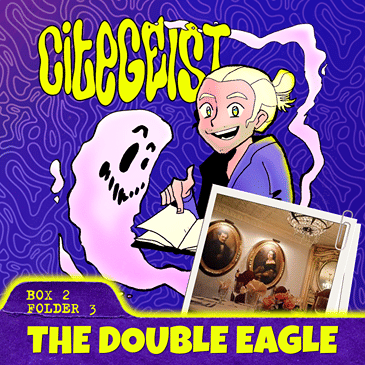

The Double Eagle restaurant in Mesilla, New Mexico, is reportedly haunted by two young lovers whose romance ended in murder. It’s a great ghost story. There’s forbidden romance, a controlling mother, and a tragic confrontation. There are also haunted chairs and ghosts who like to enjoy a romantic date over a bottle of wine. Like a good telenovela, the dramatics are accounted for. The documentation? This history? Well...that's complicated.
In this episode of Citegeist, I investigate the legend of Armando and Inez, the family said to have lived in the house, and the historical records that might help place their story. We’ll look through census records, land claims, old newspapers, and family histories...and find ourselves asking why a tale told with such confidence leaves out so many verifiable details.
The Double Eagle story may be difficult to prove, but the accounts of lavender perfume, a woman in white, and a seemingly emptied wine bottle keep the mystery alive. Listen through and decide for yourself: are these echoes of a real tragedy, or a local legend that grew into a haunting?
Key Topics
[00:00:04] - Hispanic Heritage Month, Halloween, and a trailer for Three Spooked Girls
[00:01:37] - The Double Eagle’s legend of Armando and Inez
[00:05:47] - The forbidden romance and the tragedy in the bedroom
[00:09:20] - The legend’s return and reports of ghosts at the restaurant
[00:11:37] - Investigating the Maese family and the building’s history
[00:16:32] - Mesilla’s shifting borders, growth, and decline
[00:20:24] - Searching newspaper archives and exploring a possible family connection
[00:27:06] - The earliest version of the story—and questions about its origins
[00:32:36] - The wine, the chairs, and other reported paranormal encounters
[00:36:32] - Folklore or hidden history? The host’s open verdict
Sources
“1850 U.S. Census, Macia, Valencia, New Mexico Territory, USA, Entry for V Mase (Dwelling 1660; Family/Household 1673; Line 2).” Census record. Macia, Valencia, New Mexico Territory, USA, 1850. Record Group 29; microfilm M432; roll 470, p. 307a. The National Archives in Washington, DC. https://www.ancestry.com/search/collections/8054/records/11160478.
“1860 United States Federal Census - Ancestry.Com.” Accessed October 1, 2026. https://www.ancestry.com/search/collections/7667/records/54589232?tid=&pid=&queryId=74827565-8bfc-4cbd-8c16-bc3a2142e6f1&usePUBJs=true.
“1860 U.S. Census, Mesilla, Doña Ana, New Mexico Territory, Entry for Valentin Maese (Dwelling 463; Family/Household 468).” Census record. Mesilla, Doña Ana, New Mexico Territory, 1860. Record Group 29; microfilm M653; roll M653_712, p. 52. The National Archives in Washington D.C. https://www.ancestry.com/search/collections/7667/records/54589232.
Aaron Magdaleno Research. “La Mesilla, N.M. Marriage Records.” Accessed September 19, 2026. https://aaron-magdaleno.site123.me/la-mesilla-nm.
“Chihuahua, Mexico, Catholic Church Records, 1632-1958.” Accessed October 1, 2026. https://www.ancestry.com/search/collections/60985/records/15592774.
Daves, Doyle. “Leitensdorfer Men and Women: Santa Fe Trail Travelers and Traders.” Wagon Tracks (Santa Fe, New Mexico) 39, no. 3 (2025): 15–20.
“DOUBLE EAGLE YOUNG LOVER GHOSTS.” Accessed September 17, 2026. https://stampbears.net/thread/1322/double-eagle-young-lover-ghosts.
El Independiente (Las Vegas, New Mexico). “Hombre Muerto.” May 30, 1912.
Flynn, Ken. “Separated in Life, Ghosts Return to Famed Restaurant.” Dining & Entertainment. Newhall Signal & Saugus Enterprise, June 21, 1987.
Ghosts – Double Eagle. n.d. Accessed September 17, 2026. https://www.doubleeagleonline.com/ghosts-read-more/.
History – Double Eagle. n.d. Accessed September 19, 2026. https://www.doubleeagleonline.com/history-2/.
“Mesilla Plaza and Mesilla Historic District (U.S. National Park Service).” Accessed September 19, 2026. https://www.nps.gov/places/mesilla-plaza-and-mesilla-historic-district.htm.
“National Register of Historic Places Inventory Nomination Form.” n.d. https://npgallery.nps.gov/NRHP/GetAsset/NRHP/64000974_text.
“New Mexico. History Records, Miscellaneous Records, Bibliographies, Reference Materials, Archive Records.” Accessed October 1, 2026. https://www.familysearch.org/ark:/61903/3:1:3Q9M-CS9Y-8SNP-9?view=fullText&keywords=Valentin+Maese%2CUnited+States%2CNew+Mexico%2CNEW+MEXICO&searchForm=advanced&lang=en.
“New Mexico. Land Entry Claims 1855–1890.” Accessed October 1, 2026. https://www.familysearch.org/ark:/61903/3:1:3QHV-V386-4L8L?view=fullText&keywords=Valentin+Maese%2CDona+Ana&searchForm=advanced&lang=en.
“New Mexico: Mesilla Plaza and Mesilla Historic District (U.S. National Park Service).” Accessed September 19, 2026. https://www.nps.gov/articles/000/new-mexico-mesilla-plaza-and-mesilla-historic-district.htm.
“New Mexico, U.S., Deaths, 1889-1945 - Ancestry.Com.” Accessed October 1, 2026. https://www.ancestry.com/search/collections/62171/records/175872.
Polston, Cody. Double Eagle Restaurant, Mesilla, NM (Issues with the Ghost Story). November 26, 2021. https://www.codypolston.com/double-eagle-restaurant-mesilla-nm-issues-with-the-ghost-story/.
“Record of Land Claims.” Sante Fe, NM, n.d. New Mexico Spanish Archives Land Grants. Spanish Archives of New Mexico Series I. National Archives Record Group 49: General Land Office Records. Surveyor General of New Mexico. New Mexico State Records Center and Archives. Accessed September 19, 2026. https://www.ancestry.com/search/collections/60892/records/322710?tid=&pid=&queryId=85e4b74b-1eba-4e80-a80d-bf991377fa99&_phsrc=fbE28&_phstart=successSource.
The Colorado Genealogist. Colorado Genealogical Society., 1944.
“The Double Eagle- Mesilla, New Mexico | Facebook.” Accessed October 3, 2026. https://www.facebook.com/groups/203703267504921/posts/1349531929588710/.
“The Hauntings.” Accessed September 17, 2026. https://www.oldmesilla.org/html/the_hauntings.html.
The Octo Files. The Ghosts of Armando and Inez | The Double Eagle Restaurant | The Ghost Room - INTENSE. 2020. 09:57. https://www.youtube.com/watch?v=ivZ9wEY8rAU.
“The Rich History behind the Double Eagle Restaurant.” Accessed September 19, 2026. https://strangestrangestrange.com/paranormal/ghost/double-eagle-restaurant/.
“U.S., Federal Census Mortality Schedules.” Accessed October 2, 2026. https://www.ancestry.com/search/collections/8756/records/372779?tid=&pid=&queryId=50fac891-0ad6-4dce-b7de-3567d7c39a54&usePUBJs=true.
“Valentin Maese (Ancestry Family Tree).” Accessed September 19, 2026. https://www.ancestry.com/family-tree/person/tree/170156543/person/172316452868/facts.
WATCH on YouTube! https://www.youtube.com/@Joshua.Spellman
https://citegeistpod.com/
Have a ghost story you want to share? Leave a voice note or send an en email at https://citegeistpod.com/contact
Podcast Instagram: http://instagram.com/citegeistpod
Personal Instagram: http://instagram.com/joshua.spellman
Channel illustration by GiAnna Ligammari:
https://virtualgia.com/
https://www.instagram.com/virtualgia.zip
Royalty Free Music: "Behind the Veil" by 8er41
[00:00:04] - [Speaker 0]
Hello. And welcome to another episode of Citegeist, the paranormal podcast that puts the ah in bibliography. I'm your librarian host serving up all the historic tea, Joshua Spellman. Not only is it officially Halloween season, but it's the close of Hispanic heritage month. And what a better way to celebrate part of my heritage, as well as the macabre, than a melodramatic tale from Mesilla, Mexico.
[00:00:29] - [Speaker 0]
Well, New Mexico now. Before I get started, I know I've been feeding you all a dense platter of historic haunts, but perhaps you're in the mood for something a little bit lighter. I'm swapping trailers with some fellow paranormal podcasters as a way to support other shows and keep our community of bibliographers growing. So if you're in the mood for something that's a bit of a departure from the buttoned up serious side over here on Zeitgeist, here's three spooked girls. There
[00:01:02] - [Speaker 1]
are stories that keep you up at night.
[00:01:04] - [Speaker 2]
And then there are stories you text your best friend about immediately.
[00:01:07] - [Speaker 1]
Welcome to three spooked girls, where true crime, paranormal, and the downright unexplainable
[00:01:12] - [Speaker 2]
All get the group chat treatment.
[00:01:14] - [Speaker 1]
Every week, we dive into real cases
[00:01:16] - [Speaker 2]
Haunted places
[00:01:17] - [Speaker 1]
Urban legends
[00:01:19] - [Speaker 2]
And over the top creepy Reddit stories.
[00:01:21] - [Speaker 1]
We're talking about all of it, but not in a scary alone in the dark way.
[00:01:25] - [Speaker 2]
More like you're sitting on the couch with your best friends.
[00:01:27] - [Speaker 1]
New episodes air every Thursdays and Sundays everywhere you get your podcasts.
[00:01:32] - [Speaker 2]
And be sure to check out our second show, Social Seance Society airs every Wednesday when we're in season.
[00:01:37] - [Speaker 0]
If you like what you heard, please go ahead and give them a listen and tell them that Psych Guys sent you. For today's episode, we'll be heading to La Masiya or Old Mesilla, a village in current day Dona Ana, and taking a peek into the haunting at the Double Eagle restaurant. The story is straight out of a telenovela, and the ghosts to this day still appear to be just as dramatic. Also, please keep in mind that I'm a No Sabo kid. So don't judge me.
[00:02:11] - [Speaker 0]
I'll probably be flipping between very American accent, an attempt at Spanish pronunciation, and some God awful hybrid of the two. But without further ado, let's take a look at the alleged history of Macia's Double Eagle. While today, the Double Eagle is a grand and lavish restaurant, it had its beginnings as a rich home steeped in tragedy. The Maas family, a powerful dynasty of merchants who ran a freight line based out of Santa Fe, moved to what is now La Mesilla when Santa Fe was being taken over by Americans. It was here that they built their lavish home in 1846.
[00:02:56] - [Speaker 0]
It's evident from the size and opulence of the home, the family was wealthy and planned to become even wealthier. Now everyone in the family was ambitious from the youngest to the eldest, but none more so than the matriarch, Carlotta. She had a grand vision for her family's future and ever since her youngest son Armando was born, she worked tirelessly to form and foster powerful social connections to ensure that her son married into another wealthy family. But Armando, he had other plans. Like any teenage boy, Armando was fueled by impulse, hormones, and a burning desire for independence from his controlling mother.
[00:03:41] - [Speaker 0]
He cared little for duty or for obligation. Therefore, it came as no surprise that Inez, a young servant in the home caught his eye. Her social status presented a thrilling dangerous risk that captured his rebellious spirit. While her long black hair, pale skin, and striking features ignited his adolescent chemistry. And likewise, Inez fell for Armando.
[00:04:09] - [Speaker 0]
He was a handsome wealthy boy who had the potential to pull her and her family from the clutches of poverty. How could she resist? It was a match made in heaven and Armando and Inez fell head over heels for each other. Now how much of that was love or the lust of two attractive teenagers under the same roof? That is hard to say.
[00:04:31] - [Speaker 0]
But perhaps two things can be true. The secrecy of their affair was electrifying and it charged every lingering glance, every secret touch in clandestine meeting with an exhilarating rush. Now as you and I know, these types of romances are never as secret or as subtle as those involved believe them to be. And all of those employed at the house knew of the affair, but they were on Armando and Inez's side. They kept quiet and did everything they could prevent Senora Carlotta from discovering their forbidden tryst.
[00:05:09] - [Speaker 0]
Despite this, it didn't stop the gossip from seeping from the walls of the Maez home into the streets of the village. It wasn't long before all of Mesilla knew of these teens forbidden romance, but they too kept quiet. While Senora Carlotta had a vast network of well-to-do and affluent families, she did herself no favors with the locals who despised her for her arrogance. But despite all of this protection, secrets like these can only be kept for so long. Senora Carlotta may have been a snob, but she was not a fool.
[00:05:47] - [Speaker 0]
She began to notice Armando's lingering glances and his excuses to steal away moments from the family. And when it became too much for her to bear, and it was clear that this was not a passing phase, the signora confronted her son. She forbade Armando from seeing Ines and reminded him of his place in society as well as the girls. She banished Ines from the home and promptly left on a trip to arrange for a proper marriage for Armando with one of her many social connections. The senora's hard work schmoozing did well for her, so it didn't take her long to strike a deal with one of these wealthy families.
[00:06:27] - [Speaker 0]
And she returned home after only a couple of days, much sooner than anyone had anticipated. When she entered the home, she couldn't wait to tell Armando the news. She asked one of her servants to call for him, but they told her that he was out with his brothers. When she asked another, she was told he was in town with his father. These conflicting answers told her everything that she needed to know and she stormed the grand home looking for her son and upon hearing voices in Armando's bedroom, she forced her way inside.
[00:07:00] - [Speaker 0]
And there in the bedroom unfolded a scene that made her shriek. Inez, fully undressed in the arms of her beloved son. Stunned and scandalized, the senora gasped, clutching her chest as she stumbled out of the room, falling onto her sewing basket, sending its contents flying across the floor. And as she pulled herself from the ground, her hand grazed against something cold and metallic. Meanwhile, Armando and Inez were scrambling to make themselves presentable.
[00:07:32] - [Speaker 0]
Inez, clutching her undergarments to her chest, turned around to see Senora Carlotta reentering the room. But before she could even speak, the senora plunged her sewing shears into Inez's breast. And as the senora raised the shears for another go, Armando threw himself between them shouting, no mama. But his mother couldn't react fast enough. The shears were already making their descent and they landed squarely in her son's back.
[00:08:00] - [Speaker 0]
Armando cried out in pain and in hearing her son, the senora's motherly instincts kicked in and roused her from her murderous trance. Once again, this nyora stumbled back, hands over her mouth as she let out a horrid cry. Seeming to see the sight in front of her for the very first time. Her son with a wound in his back cradling the body of Inez stroking her blood covered hair and whispering to comfort her as she bled out from the gaping wound in her chest. Armando bowed his head to kiss Inez and just as he did, her last breath escaped her lips.
[00:08:37] - [Speaker 0]
He let out a ragged sob and pulled her bloodied body close, and then suddenly as if someone had called his name, he looked up into the corner of the room and smiled. He stared transfixed by something that his mother could not see, and when his mother went to reach for him, he collapsed. Inez died in that room and Armando fell into a coma and passed three days later. The Maez family used their social connections and influence to avoid any legal trouble and they prevented the coverage in the papers. The Mayas family quickly packed up and left Mesilla moving into the interior of Mexico, far away from the tragic memory of Armando.
[00:09:20] - [Speaker 0]
La Senora Carlotta never spoke again. Her last word was her son's name. Some say she lived until old age, while others say that she was committed to an asylum and upon her release, she made her way back to Mesilla to her old home which stood abandoned and filled with guilt. She took her own life in that very same room where she committed her violent acts. While the Maez family moved on, the people of Mesilla did not forget the young lovers.
[00:09:52] - [Speaker 0]
For years Armando and Inez were honored during the Dia de los Muertos celebrations and stories about them were passed down through the generations. But eventually, like so many stories, even theirs began to fade. With the advent of the radio and television, children no longer listened to the tales of their elders, and by the early nineteen sixties, Armando and Inez were all but forgotten. But then in the nineteen eighties, the Double Eagle restaurant opened in the old Maez home and people started noticing strange occurrences. But the ghostly activity wasn't threatening.
[00:10:29] - [Speaker 0]
If anything, it was playful like the antics of two teenager who were still carrying on their forbidden romance long after their death. As these ghost stories spread throughout the village, people in Mesilla began remembering what they had heard from their grandparents. The old tale of Armando and Ines began circulating once again, and the restaurant started searching through old records to piece together their story. And during Dia de los Muertos, a special altar is set up in the restaurant in their honor. And Armando and Inez will never be forgotten again.
[00:11:03] - [Speaker 0]
Their presence is unmistakable. Guests and employees at the Double Eagle still report the smell of lavender perfume, whispers on the wind, and the occasional glimpse of a woman in white that vanishes as quickly as she appears. After nearly two hundred years, the Mayaz home is still going strong. And if the stories are to be believed, so are its young lovers. The drama, the romance, the tragedy, it doesn't get much more Latina than that.
[00:11:37] - [Speaker 0]
I love this story, but is it just that? Is it just a good story? Or is there some historic basis at its core? Well, as usual, I've done the archival deep dive to see what I could find. And this is one of those tales that across all the interviews and all the articles about the ghost story, a date or time frame has never really been provided or at least one that makes sense.
[00:12:03] - [Speaker 0]
So trying to place a story of the Maez family is going to require a little bit of historical context for the region, and trust me, it gets complicated. The Maes family or sometimes the Maesae family, the restaurant tends to switch between the two names, but I would say like 80% of the time, they use Maes, were one of the founding families of Maesia. That I can confirm. A Valentin Maese appears in the 1854 land grant as a witness, which demonstrates that the family had been there a long while. And amusingly, some of the English records spell Valentin with a b because that's closer to the Spanish pronunciation of the letter v.
[00:12:43] - [Speaker 0]
But there is more good news. According to the National Register of Historic Places and the National Park Service, Valentin Maiesse constructed what is now the Double Eagle, kind of. While the Double Eagle restaurant's history page states On the Mesilla Plaza, three miles southwest of Las Cruces, is a national registered historical building that is now the site of the Double Eagle and Peppers restaurants. The building was built in 1849. But that isn't quite the truth.
[00:13:14] - [Speaker 0]
A home was built in 1849 by Valentin Maese, but he was not a merchant nor was the house the grand structure that it is now. Valentin Maesse built a small humble Turum Hakal where the double eagle now stands, and he was a farmer and a pioneer, not a wealthy merchant. The large territorial style home that now stands there was constructed at some later date. Now, that doesn't mean that the existing structure wasn't built by someone in the Maiesae family, but there is at the very least clearly some clouding of the facts on behalf of the Double Eagle restaurant. Now, another problem with the story is that the history page on the restaurant does not provide a time period for the story nor do they provide any names beyond an Armando and a Inez.
[00:14:05] - [Speaker 0]
And some websites cite the name of Armando's mother as being Carlotta, and this can be quickly debunked. You see, the room where the couple was allegedly slain is now known as the Carlotta Salon, but it is not named after the Senora. Instead, the Carlotta Salon was named for Marie Charlotte, the daughter of the king of Belgium, and she was known as the empress of Mexico from 1864 to 1867. The room is named for her because a large portrait of her hangs in the room alongside the portraits of the Maes, Signor and Signora, but occasionally those two portraits in the room are referred to as Armando and Ines. So the names have never been made explicit, but I did find videos of one of the employees of the restaurant claiming that the senior in Senora's names were Armando senior and Maria.
[00:14:55] - [Speaker 0]
But it's probably no surprise that I was not able to find records of any Armando Maez or Maezee ever living in the town of Messia until at least after the nineteen twenties. And and from what I could tell, no one in Valentin's line seemed to be anything other than a farmer. In fact, looking at the Catholic church records in the area, almost all of the Maieses in the area were farmers or farm laborers with the exception of one that I found, who was a jailer. Now, you see, I didn't limit my search to Armando because to me, it kind of seemed like a made up name for the story because it's so romantic. But also, let's be real.
[00:15:35] - [Speaker 0]
It's Spanish. It's sexy. Though, I may be biased in that regard. So I expanded my search to similar sounding first names like Alonso and Alfonso, but I ultimately had no luck. And at this point, part of me began wondering if Maez was ever the name of those involved in the story at all, or if the story ever happened.
[00:15:56] - [Speaker 0]
Nothing I found indicated that the Maieses were a wealthy family in the region. So already, there are quite a few things that don't line up, but we will need to examine the history of the region a little bit closer in order to narrow our investigation further by coming up with a possible date range for when this story could have taken place. You see, the town of Mesilla has a complicated history. While it's currently in modern day New Mexico, that wasn't always the case. The first permanent settlement in the area, Dona Ana, was founded by 116 petitioners from Chihuahua, Mexico in 1839.
[00:16:32] - [Speaker 0]
However, when the treaty of Guadalupe Hidalgo moved The US border to include that settlement, a group of 60 families who did not want to be US citizens left Dona Ana in 1848 to found Mesilla, just south of the newly moved border. And Mesilla became an established Mexican colony by 1850, but it was under constant attack by Apache raiders. The settlement was actually laid out in a defensive pattern to withstand these attacks with homes clustered around the central plaza. And the continued attacks in the area led The United States to take action to protect its own people in Dona Ana by building Fort Fillmore in 1851. However, there were ambiguities in the treaty of Guadalupe Hidalgo.
[00:17:18] - [Speaker 0]
So while the settlers in the Mesilla Colony believed themselves to be firmly Mexican, The United States still considered their area to be part of US territory. And this led to a lot of confusion and diplomatic disputes making Mesilla a no man's land until the matter was officially settled in 1853 with the Gadsden Purchase, also known as the Venta Della Mesilla or the Mesilla Sale. The purchase officially made Mesilla part of The United States with the agreement being ratified in 1854. After the signing of this agreement, the town of Mesilla quickly became a cultural hub in the region as it was perfectly situated to facilitate trade along the El Camino Real and the Santa Fe Trails. During the civil war, Confederate troops occupied the village and used it as an indispensable military supply center.
[00:18:08] - [Speaker 0]
This newfound importance transformed Mesilla with the simple log hacals that surrounded the city center, like the one built by the Maieses, were quickly replaced by permanent and elegant single story flat roofed adobe homes. After the civil war, during the period of the Wild West, Mesilla was also known for its cantinas and festivals and was frequented by characters we've talked about on the podcast before, like Billy the Kid and my great great possibly great uncle's alleged amigo, Pancho Villa. Being situated between two major stagecoach lines, mail lines, and tradelines made it the most important city in the region, and it was the largest city at time between San Antonio and San Diego. However, Mesilla's heyday came to a screeching halt in 1881. You see, the Santa Fe Railway was preparing to expand through the region, and naturally, they had their eyes on Mesilla.
[00:19:04] - [Speaker 0]
However, it was said that the landowners in the village asked for compensation for the use of their land, while another landowner, just a little bit north in Las Cruces, offered his land for free. And whether this account is completely accurate or not is debated, but what isn't up for debate is that the railway chose Las Cruces. And this was a nail in the coffin for Messia's dominance of the area as Las Cruces grew exponentially from then on, and it's currently the second largest city in New Mexico. Okay. Time to take a deep breath.
[00:19:39] - [Speaker 0]
I know that was a lot of history. But hey, that's why some of you are here, right? I would hope so. We do a lot of it here. So why did I tell you all of that history?
[00:19:50] - [Speaker 0]
Mesilla's complicated history also makes the research of the area and the story of the Maez family difficult. You see, being a small Mexican settlement and then a small Mexican colony with probably not much documentation being generated or preserved at the time is one thing. But then its governance was contested between two countries, shifting between Mexico and The United States. And on top of all of that, it's also bilingual. Some records are in English, some are in Spanish, and some were a confusing combination of both.
[00:20:24] - [Speaker 0]
So double the languages, double the time spent researching. So all that being said as a little bit of a disclaimer, when might the story of Armando and Inez have taken place? Based on the history of the region and the way that the story is presented as being forgotten or almost forgotten by the nineteen fifties, I would have to assume that this story would have taken place sometime during the town's heyday between 1860 and the early eighteen eighties. But again, I can't say that for a fact. So I did cast my net with quite the buffer, searching mainly, but not exclusively between 1830 and 1920.
[00:21:04] - [Speaker 0]
And so I just started looking through newspapers. First in English, and then in Spanish. For any stories involving the surname Maes or Maesse, and I did find this story titled Hombre from the 05/30/1912 issue of El Independiente, which really made me laugh. It's entirely in Spanish though, so I will save you the pain of listening to my terrible Spanish, and I've translated it to English for you. It reads, last Friday, the case of Wow.
[00:21:36] - [Speaker 0]
I I'm so sorry. That's hard for me in any language to say. Garcia, accused of assault with a deadly weapon against Nieves Mees caused a small wave of amusement in the courtroom. However, judge David j Lehi promptly dispelled any possible desire for laughter that might have entertained the spectators or members of the court staff. The evidence in the case established that Garcia has struck Maes on the head with a revolver causing him to fall to the ground unconscious.
[00:22:05] - [Speaker 0]
At the time, it was believed that Maes was dead and a coroner's jury was appointed to investigate how he had met his death. The jury was already preparing to deliver a verdict accusing Garcia of Maez's murder when Maez regained consciousness and getting to his feet entered the courtroom. This freed Garcia from the more serious accusation. After hearing the evidence, the jury convicted Garcia of assault, which, oh my god, that's amazing. I love being able to find these little treasures in the archive that otherwise might just be lost to time.
[00:22:40] - [Speaker 0]
So while not the Maez I was looking for, it's another great story and at least one that we know is true. After taking the break to take that story in, I continued my hunt and finally came across something that I hoped would crack the case of the Maez family wide open. I stumbled upon a periodical titled Wagon Tracks, which is the quarterly publication of the Santa Fe Trail Association. And in the May 2025 issue, there was an article about the Lietenstorfer family. Don't quote me on that pronunciation.
[00:23:12] - [Speaker 0]
This Lietenstorfer family were prominent traders along the Santa Fe Trail. And you're already asking, okay, what does that have to do with our Hispanic family? Well, let me tell you. The article discusses two of Thomas Lietendorfer's daughters, Josephine and Emilia. But apparently, according to the article, their mother's identity was unknown.
[00:23:33] - [Speaker 0]
But buried in an endnote was something that immediately caught my attention. The endnote source wasn't super reliable, let's say. Okay. It wasn't reliable at all. The source was family memory.
[00:23:47] - [Speaker 0]
And on this podcast, we know how that goes. But it said that their mother's surname was something like Meis, which they spelled m e I s, which is a different surname than our double eagle Meis or Maese, but it did also provide those names as possible alternates. This was curious, and it had my gears turning at full speed because the Double Eagle story says that the Maes family who lived on their property were prominent traders from Santa Fe. Could this end note have some kind of relevance? Maybe the restaurant in telling their story went with the maiden name of the family because it sounded more Hispanic.
[00:24:28] - [Speaker 0]
So I began searching for Josephine and Amelia's mother, and that's when I found a marriage record from Colorado that stated on 10/04/1865, Thomas Lietenstorfer married a woman named Dona Placida Maes in Trinidad, Colorado. And that was really promising. Thomas Lietenstorfer in particular was in several tax records that I found in Santa Fe and Mesilla. Though the maize that he married could have been from Colorado and completely unrelated to Mesilla for all I knew. And a Colorado death record showed that a woman named Placida Luttenstorfer died in July 1869 at just 19 years old.
[00:25:11] - [Speaker 0]
Problematic age of the marriage aside, she was listed as having been born in New Mexico, which brings us a lot closer to Mesilla. Thomas could surely have met her in Mesilla before moving to Colorado. Now, the wagon tracks author believed that Amelia's mother died shortly after childbirth and the death record that I found states that she died of congestion of the lungs. I now had a real nineteenth century woman named Plessy de Maes, who married into the Leitenstorfer family, some of who were actually wealthy traders, but there was a problem. Well, there were several problems.
[00:25:47] - [Speaker 0]
While this would have been a very interesting angle, I don't have anything that actually connects Plessy de Maes to the Maes family, or the Maesae family who actually lived on the property that is the Double Eagle. And while the surnames of Maes and Maes and Maes sound the same, they're different. They're entirely different spellings, and they also have entirely different meanings in Spanish. So they could not just be mistranscriptions, they could actually just be different family names. But it's not uncommon in historic records to have names transcribed in several different ways.
[00:26:24] - [Speaker 0]
I found Lietenstorfer as Lutensdorfer, and that was clearly the same person. But I certainly didn't find anything showing that the Lietenstorfers built the grand house that is now the Double Eagle. So while it was a fun conspiracy theory, I think it's just that. The only thing that this theory really determined was that Thomas Lietenstorfer married someone with the same or a similar surname of the family who built the original haqal that stood where the Double Eagle is now. Regardless, this already conflicts with what the restaurant has said on occasion.
[00:26:58] - [Speaker 0]
Many times, they've been firm in saying that the Double Eagle in its current opulent form was built in 1849 by the Maes family.
[00:27:06] - [Speaker 3]
This building was built in 1848, 1849.
[00:27:10] - [Speaker 0]
So I wanted to go back and see where this story came from. And the oldest version of the Inez and Armando story that I was able to find was from a 1987 article inside United Press International's archives. The ghost story is more or less the same as it's told now, but with the proper spelling of Maiese. And while the article says that records indicate in the eighteen forties, The Double Eagle was a private residence owned by the affluent Maiesse family. It later calls a love story town folklore and the article closes with a quote from a skeptic like me saying, Mary Davis who has lived in La Mesilla for forty years and is writing a book about the town, is skeptical about the Double Eagle ghost stories.
[00:27:56] - [Speaker 0]
I can't say whether they're true or not. We have a lot of ghost stories here. It's part of the charm of the area. There have been a lot of stories of lost gold too, and I haven't found any of that either. But to be a fair researcher and not to steer you in one way or another, it's unclear if Mary is referring solely to the reports of ghostly activity in the restaurant or also the folklore.
[00:28:19] - [Speaker 0]
But again, I found another fellow skeptic who seems to share my views a little bit more explicitly. Ghost hunter and author Cody Polston expressed his own concerns about the story. And interestingly, he recounted an entirely different version of the story that I hadn't seen anywhere else, which is odd because... Well, I'll I'll get to it in a minute. In his version, Armando died from his wound in the home, but Inez managed to escape.
[00:28:47] - [Speaker 0]
And she returned to the town a year later in disguise, but was shot by a cowboy after a brief altercation. Inez's wounded body was brought into the Maas home, and she died inside of Carlotta's bed, which again, also an incredibly dramatic take that I love. But obviously, we already know that the signora's name was not Carlotta if she ever existed. But Polston goes on to say that he also was not able to locate any historical information on the murders nor could he find anything about a wealthy Maiesse family, which obviously has also been my experience. But further, Polston posits an interesting question, noting that in 1984, c w Buddy Ritter bought the private residence that is now the Double Eagle.
[00:29:32] - [Speaker 0]
But Polston says, now c w Buddy Ritter is also associated with the lodge at Cloudcroft, another restaurant that has ghost stories. Is it simply a coincidence? And I don't know. It just may be. But it may not just be.
[00:29:49] - [Speaker 0]
That 1987 version of the story was published not long after the restoration of the restaurant was complete. And the story hasn't really changed at all since its first publication in 1987, which normally you would say, good. That means it's probably true if it's been consistent. However, it's honestly read more like a script than a story. Every interview I've seen of, I believe his name is Jerry, the story is told with the exact same phrasing, the exact same wording.
[00:30:20] - [Speaker 3]
Family, there was a teenage boy named Armando. Family, there was a teenage boy named Armando.
[00:30:25] - [Speaker 4]
Well, teenage boy, teenage girl, same roof.
[00:30:29] - [Speaker 3]
Well, teenage boy, teenage girl, same roof. Fell in love. They fell in love.
[00:30:34] - [Speaker 0]
And it always leaves out verifiable details and again, it's almost always framed as being around 1849.
[00:30:42] - [Speaker 3]
This building was built in 1848, 1849.
[00:30:45] - [Speaker 0]
Though we know that that home didn't resemble anything close to what the Double Eagle is now. So one wonders, is it all made up for publicity? You'll have to let me know what you think. As for me, while the history I've been able to verify hasn't supported the folklore at all, I will not say with absolute certainty that it's untrue at all, or that something at least resembling the story didn't happen in the area. And that's one of the things about digital archival research.
[00:31:16] - [Speaker 0]
While we love to think that the Internet has all the answers hiding somewhere, or that even AI has all the answers if you're into complete cock and of offloading, they just don't. You see, most records and a lot of the world's knowledge, at least the historic knowledge and the record of things that have happened are not digitized. There's so many records out there and proper digitization, not the kind where you're destructively scanning books and feeding them into a machine for the context and the contents to be lost forever and ever is extremely prohibitive when it comes to cost. And that's not only hard for established institutions to fund, but it's especially hard for institutions like the churches in Mesilla and Las Cruces that hold a lot of their community records. Now, there were several collections that I found that I wanted to get my hands on, but quite obviously, I don't have the budget to fly down to New Mexico for a week to investigate them.
[00:32:13] - [Speaker 0]
So while I cannot say for certain if the facts of the story are true, there is one person that can. Hey, double eagle. If you're listening, check your inbox. I sent you an email or two, and I'd love to provide an update to the listeners if you can share your sources with me, if they exist. I'm not saying that they don't, but if they do, I genuinely would love to see them.
[00:32:36] - [Speaker 0]
I'm fascinated by the story. But there is one thing that I can say without a doubt, that the employees and the guests have had paranormal experiences. And before we closed, I wanted to share some of those with you so that we can fulfill our spooky quota. Because while we have the dramatics, we don't really have the spooks with this episode. In 2003, a new assistant manager was hired at the restaurant.
[00:33:01] - [Speaker 0]
And during training, they briefly mentioned the ghost story to them, which the new assistant manager, as you would expect, laughed it off. And about a week into working at the restaurant when he was finally allowed to close by himself, he noticed that two patrons left a bottle of wine with about two glasses left inside of it. And so he took the bottle and some fresh clean glasses because we don't want the ghosts to have dirty glasses. He went and set them into the Carlotta Salon on the table and jokingly told the ghosts, hey, enjoy the night. And he told the fellow staff member that he was closing with as he set the motion alarms in the building.
[00:33:39] - [Speaker 0]
We'll see in the morning if they had a good time. And when they returned in the morning, it appeared they had a good time indeed. Not only did they not set off the emotion alarms because they're ghosts, the wine bottle was turned on its side completely empty and the two wine glasses were shattered in the fireplace. When the assistant manager walked in and saw this, he turned around on his heel and walked out the door, tossing the keys to the chef behind him saying, mail me my check, and he never returned. There are also two master and mistress chairs in the Carlotta room that are said to be, well, a, some people say that they belong to the senior and the seniora of the house, but other people call them Inez and Armando's chairs because they frequently have like teenage shaped prints in the velvet.
[00:34:29] - [Speaker 0]
I I don't know. I'm not gonna ask questions. Now, obviously, these aren't the chairs that belong to anyone in the family because they're not original to the home. The 1987 article talks about how all the things were procured from different collectors and brought into the home when the Double Eagle was renovated. But apparently, the spirits sit there and you are not supposed to.
[00:34:53] - [Speaker 0]
Or you're not supposed to sit in Armando's chair, which based on videos I've watched is actually a completely different chair in the opposite corner of the room. But regardless, the chair lore clearly inconsistent. But Christina s, a staff member said that her husband didn't believe in the ghost stories and he certainly didn't believe that that chair belonged to Armando. Oh, but boy was he proven wrong. This staff member's husband sat in Armando's chair and nothing happened until he went home that night.
[00:35:33] - [Speaker 0]
And he woke up in the middle of the night screaming bloody murder that he had been stabbed in the chest before laying down and falling back asleep. In the morning, he didn't remember any of it. And he continued to have night terrors for a week. And after that, he became a believer of Armando and Inez. Now I don't doubt that this happened, but I would say if you would think that he had sat in Armando's chair, he would have awoken claiming to have been stabbed in the back, not the chest.
[00:36:04] - [Speaker 0]
Cesar Mondo was stabbed in the back. Inez was stabbed in the chest, but I digress. But other encounters by the staff are more or less the same. Seeing a young woman with long dark hair dressed in a white shift moving from room to room, and when you follow her, she's gone. And people have heard their names sometimes after seeing this woman whisper to them in a heavily accented voice.
[00:36:32] - [Speaker 0]
And yeah, I mean, I don't have any explanations for the paranormal experiences. Those are their experiences, and I have no doubt that they've experienced something. But I'll leave this case with you. What do you think? Is this story true, but hidden in an undigitized record that the restaurant has?
[00:36:52] - [Speaker 0]
Or do you think it's town folklore that's been presented as fact to draw interest in the restaurant? I can't say for certain until I hear back from the Double Eagle with their sources. But let me know. What's your verdict? And as always, thank you for listening or for watching.
[00:37:08] - [Speaker 0]
And please make sure you leave a five star review on your favorite podcast platform, or give me a little thumbs up on YouTube. But as always, please make sure you tell your spooky friends about the podcast to keep our community of bibliographers growing. And I'll be back again next week with a devilish tale. But until then, don't sneak around behind your mother's back. It rarely ends well, sometimes with a knife inside of it.
[00:37:34] - [Speaker 0]
Don't sit in chairs reserved for ghosts or for anyone for that matter, and I'll see you in the stacks.