
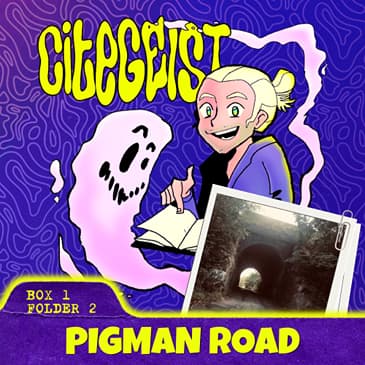

Join me in uncovering the truth behind the legend of Angola's Pigman. This half-man, half-beast specter stalks Holland Road in Angola, New York just outside of Buffalo. In life he was a brutal butcher responsible for murdering teens and countless others, in death he still terrorizes those who dare step foot on his property...or was he? We use archival resources to dissect the legend and discover what really happened.
https://citegeistpod.com/
Have a ghost story you want to share? Leave a voice note or send an en email at https://citegeistpod.com/contact
Podcast Instagram: http://instagram.com/citegeistpod
Personal Instagram: http://instagram.com/joshua.spellman
Channel illustration by GiAnna Ligammari:
https://virtualgia.com/
https://www.instagram.com/virtualgia.zip
Royalty Free Music:
"Behind the Veil" by 8er41
Sources:
Angola Record (Angola, New York). 1919. “Carnegie Hero Medal and $1,000 Cash Awarded Ted Miller for Saving Boy’s Life.” Front Page. May 1.
“Bill Durks | Sideshow Wiki | Fandom.” n.d. Accessed November 7, 2025. https://sideshows.fandom.com/wiki/Bill_Durks.
Buffalo Evening News (Buffalo, New York). 1931. “Angola Butcher Slain; Suspect Held.” July 13.
Carnegie Hero Fund Commission. n.d. “THEODORE MILLER, Angola, New York.” Accessed November 7, 2020. https://mychfc.org/hero.aspx?hero=18422.
Colmerauer, Catherine. 2011. “Misguided Man or Unmerciful Monster: Uncovering the Legend of Pigman.” The Hamburg Sun (Hamburg, NY), October 27.
Evans Journal. 1962. “Theodore Miller Dies, Native Angolan.” Obituaries. April 26.
“Francis Joseph Anselmo (1913-1981) - Find A Grave...” n.d. Accessed November 7, 2020. https://www.findagrave.com/memorial/85844336/francis-joseph-anselmo.
Hageman, M.C. n.d. “Pigman: Angola’s Legend.” Accessed November 7, 2020. https://angolapigman.weebly.com/uploads/3/6/6/0/3660761/pigman.pdf.
Leslie, Frank. 1867. The “Angola Horror.” Leslies’s Weekly. https://commons.wikimedia.org/wiki/File:Angola_Wreck.jpg.
“Prodigies by James G. Mundie - Three-Eyed Man and Child.” n.d. Accessed November 7, 2025. https://www.missioncreep.com/mundie/images/image38.htm.
Shea, Kate. n.d. “Forgotten Crimes: Specter of the Mob Hangs over Angola Butcher’s Slaying.” The Buffalo News. Accessed November 7, 2020. https://buffalonews.com/news/local/history/forgotten-crimes-specter-of-the-mob-hangs-over-angola-butchers-slaying/article_950b17b0-1cd0-599d-8206-87134af0539d.html.
Vogel, Charity. 2013. The Angola Horror: The 1867 Train Wreck That Shocked the Nation and Transformed American Railroads. Cornell University Press.
“WWII Draft Registration Cards for California, 10/16/1940-03/31/1947.” 1947. Record Group: Records of the Selective Service System, 147; Box: 49. The National Archives in St. Louis, Missouri.
https://search.ancestrylibrary.com/cgi-bin/sse.dll?indiv=1&dbid=2238&h=18097660&tid=&pid=&queryId=ea002894c1595865e870374abecb384c&usePUB=true#?_phcmd=u('https://www.ancestrylibrary.com/search/categories/39/?name%3DFRANCIS_ANSELMO%26birth%3D1913%26birth_x%3D0-0-0%26successSource%3DSearch%26queryId%3Dea002894c1595865e870374abecb384c','successSource').
WATCH on YouTube! https://www.youtube.com/@Joshua.Spellman
https://citegeistpod.com/
Have a ghost story you want to share? Leave a voice note or send an en email at https://citegeistpod.com/contact
Podcast Instagram: http://instagram.com/citegeistpod
Personal Instagram: http://instagram.com/joshua.spellman
Channel illustration by GiAnna Ligammari:
https://virtualgia.com/
https://www.instagram.com/virtualgia.zip
Royalty Free Music: "Behind the Veil" by 8er41
[00:00:04] - [Speaker 0]
Hello, and welcome to Citegeist. I'm your host, Joshua Spellman. I'm an academic and a skeptic, but also a practicing pagan. Well, semi practicing pagan? Think like I'm the cafeteria Catholic of pagans, but I digress.
[00:00:21] - [Speaker 0]
On each episode, I'll recant a ghost story as it's typically told. And afterward, we'll have a ghoulish gossip sesh, where we examine historic and archival resources to learn what really happened. Because oftentimes, the real horror is misinformation, and the true stories buried in the archival record are scarier than the ghosts. I started this podcast because I find many paranormal podcasts either very factual but extremely dry, or they're very poorly researched and a little bit detached from reality. But really fun, don't get me wrong, I do love delusion as much as the next ghoul.
[00:00:56] - [Speaker 0]
But with my background, I'm hoping to bring a little archival spice to the typical ghostly gab, and see if we can peer through decades, sometimes centuries, of retellings, and see the truth hiding beyond the veil. But if you are listening, the show has video episodes on YouTube now. So if that is your thing, and you dare wish to lay your eyes upon my wretched form, you can go in the show notes and subscribe on YouTube. But in today's episode, we'll be covering the legend of the pig man. The headline?
[00:01:27] - [Speaker 0]
A crazed butcher with a facial disfigurement slayed a group of innocent teenagers and displayed their heads on spikes in his yard. Now, summoned from the hereafter by demonic rituals and pagan sacrifice, the butcher appears to the living as a half man, half pig hell beast. In this new spectral form, he continues his reign of terror, confronting those unfortunate enough to find themselves in his path. And I did get in his path. As in, I did visit the location for today's episode, but I didn't see him.
[00:02:05] - [Speaker 0]
I did see graffiti of him, but I did not see him. But the myth of the pig man is part of an intricate web of tales, or as I see it, a hopelessly tangled knot haphazardly woven with a common thread by a small town's attempt to make sense of a barrage of tragedy. In order to understand the story behind the pig man, we must begin our tale with a seemingly unconnected but very real and horrific mass casualty event. Wow, this is so peppy. But it's it gets better.
[00:02:37] - [Speaker 0]
Trust me. Sit back, relax, and let's learn about the alleged history of Angola's pig man. Located 30 miles south of Buffalo, New York, on the western edge of Lake Erie, lies a small town plagued by strife. The village of Angola was erected in 1852 on the land around the Evans train line, which serviced both Buffalo and the Stateline railroads. A man named Elisha Darix built his homestead in 1855 on Holland Road, just south of the newly laid tracks.
[00:03:11] - [Speaker 0]
For those of you who don't know, winters in Western New York are unforgiving due to the lake effect snow that blows off of Lake Erie to the West and Lake Ontario to the North. These winter storms are capable of dumping up to eight feet of snow in a single go. In these harsh winter months, Elijah and his teenage sons, Loring and Henry, would scour the railroad tracks in search of coal that had fallen from the passing trains. They would use this coal to fuel their hearth, as it burned longer and hotter than wood. After a particularly powerful storm in 1867, the Derrick's fence had been damaged by the pressure of the snow causing it to lean and buckle.
[00:03:54] - [Speaker 0]
And so the Derricks boys, while collecting coal, removed a couple of the rail ties from the train track to use as braces for this broken fence. But little did they know that this small decision would fix their fence, sure. But it would ruin their lives and absolutely change history forever. On 12/18/1867, a train heading from Cleveland, Ohio to Buffalo, New York was running very, very late. It departed Cleveland's Union Terminal at 06:40 that morning and was due to arrive in Buffalo at 01:30.
[00:04:30] - [Speaker 0]
However, along the way the train lost time and was running over two hours and forty five minutes late. In an attempt to get back on track, the train was traveling at a dangerously high speed. And at 03:11PM, just as it was approaching a truss bridge over Big Sister Creek, tragedy struck. The train heaved from side to side and the conductor applied the brakes. But the train was traveling too fast across the icy bridge.
[00:04:59] - [Speaker 0]
The last two cars detached from the train, with one car careening down into the icy gorge below, while the other car made it safely across the bridge. But it slid 30 feet directly into the embankment. Luckily, only one passenger was killed in that second car. But those in the first were not so lucky. As the last car plunged 40 feet into the gorge below, it came to rest at a dangerous angle, sending the passengers toppling to one end of the train car.
[00:05:29] - [Speaker 0]
And as they lay there in a tangled pile of limbs, the stove that warmed the train car fell on them, releasing hot coals everywhere. And it wasn't long before the train caught fire. The kerosene from the gas lamps exploded and ignited the upholstery and all the dry wood trimmings inside. While some of the passengers died from the smoke, the majority were burned alive. Witnesses to the scene heard the screams of those trapped inside and could smell their burning flesh.
[00:05:59] - [Speaker 0]
For five long agonizing minutes, the horrid scene was filled with the tortured shrieks of those trapped inside. And then, just as suddenly as it started, it stopped. Nothing but silence could be heard over the white snow, now stained with smoke and ash. Forty nine people lost their lives that day, and even more were injured. This accident led to a number of railway reforms, including safer methods of heating and more efficient braking systems.
[00:06:32] - [Speaker 0]
However, the real cause of this tragedy seemed to be the rail ties that were removed by the Derrick's boys. Their role in the event was covered up by the town of Angola for fear of further damage to their reputation. Nevertheless, a clipping from the Buffalo News that detailed the accident was hung in their home like some sick trophy. It sat there either as a grim reminder of their shame, or as some twisted macabre testament to their ghoulish inclinations. The sons continued to live their lives as if nothing had happened.
[00:07:07] - [Speaker 0]
But tragedy followed them both. The older brother, Henry, married and moved into town. But on 03/12/1904, a massive fire broke out on Commercial Street. It was the most destructive fire in the village's history to date. Mysterious in origin, the cause of the fire was never found.
[00:07:28] - [Speaker 0]
But many accused Henry Derricks of starting it. Overwhelmed by the blame and hoping to protect his budding family, Henry left Angola. It was rumored he went to Texas or Alaska to start anew, leaving his brother Loring to bear the brunt of the town's hatred. Loring remained on the homestead on Holland Road and married a woman named Betsy Crabtree who was an outcast in her own hometown due to the fact that her parents were first cousins and because she had a learning disability. This certainly did not help the town's opinion of him and it's cited as one of the reasons why no records of luring can be found.
[00:08:06] - [Speaker 0]
Now luring Derek's hand in tragedy did not end with the Angola horror. In 1911 he volunteered to help ignite the fireworks for Angola's July 4 celebration. But in an unexpected turn of events, falling sparks ignited the store of fireworks launching them directly into the crowd, with one rogue rocket piercing the arm of a young boy, leaving many others severely burned. After this incident, Loring became more or less a recluse, rarely leaving the homestead on Holland Road. But despite their isolation, on 04/13/1913, Loring and Betsy had a son, William Derricks.
[00:08:46] - [Speaker 0]
However, this would be joyful event was marred by misfortune as the boy was born with a facial difference, and at the time would be considered horribly disfigured. William was born with a cleft lip and an upturned nose that split down the center like a pig's. Perhaps William's physical abnormalities were simply due to the nature of Betsy's parentage. But Lorin couldn't help believe it was divine retribution for his misdeeds. After the birth of their son, ashamed to let anyone ever see the boy, the agoraphobia of the derricks only worsened.
[00:09:20] - [Speaker 0]
However, in 1919, the six year old derricks boy wandered onto the train tracks, completely unaware that a speeding train was barreling quickly towards him. Luckily, he was spotted by the one armed crossing watchman, Theodore Miller, who ran to his rescue, pushing him out of the path of the oncoming train just in time. Before this event, Theodore Miller was already regarded as somewhat of a local celebrity. In his heyday, he was actually a skilled one armed boxer. He used to travel the country demonstrating his skills for captive audiences.
[00:09:51] - [Speaker 0]
Now Miller could add one more accomplishment to his resume as he was awarded the Carnegie Hero Medal for his heroic act in saving poor William. While Theodore was showered in accolades, William Derricks received no attention. In fact, he was never even mentioned in the press as he was deemed too horrific to even identify. Despite this though, Theodore Miller felt bad for the boy, botting over their disabilities and the way they were treated by society at large. As William grew older, he worked as an apprentice for a butcher shop not far from the homestead.
[00:10:22] - [Speaker 0]
Though it turns out William wasn't very good at butchering. Well, at least not yet. And he was mainly relegated to cleaning up the messes in the shop, sweeping up entrails and scrubbing dried blood from the floors. Eventually, Theodore Miller, having once been a traveling oddity himself, used his connections in the circus to gain William Derricks a gig in a freak show. Most may have been off put by being objectified and displayed like a monster, but William jumped at the chance to be able to travel the country, earn a decent wage, and escape the ridicule and shame of his family.
[00:10:57] - [Speaker 0]
For William, this was a welcome escape. After a few years of traveling with P. T. Barnum and Ripley, Darks retired of the unsanitary conditions and transient nature of his circus work and yearned for some stability. He eventually returned to his family home on Holland Road where he married a woman by the name of Mildred Crabtree.
[00:11:18] - [Speaker 0]
Which perhaps that name sounds a bit familiar, as it was his first cousin and William was following directly in the footsteps of his mother. Turns out the crabapple doesn't fall far from the tree. During William's time at the circus, Ed Ball Sanitation had opened a landfill next to the Derrick's family homestead. Now most people would not be pleased about living next to a garbage dump, but William gladly took up a position of a night watchman and morning gatekeeper at the facility. Wearing a hood to hide his face, overnight William would conduct bi hourly checks of the landfill to ensure that there was no trespassing or illegal dumping.
[00:11:55] - [Speaker 0]
And then in the morning, he would open the gates to allow trucks inside and hand off his duties to his daytime counterpart. Although the job was fine, there was one aspect that William absolutely loved. He had first dibs on any items coming into the landfill. He took full advantage of this perk, filling his home with items he considered to be valuable. This innocent collecting soon evolved into a hoarding obsession, and he eventually ran out of space inside the house, and so began scattering his spoils about his property.
[00:12:30] - [Speaker 0]
Paranoid, William acquired animal heads from the butcher he used to apprentice for and placed them on sticks around his property as a gruesome deterrent to would be thieves looking to steal his precious treasures. Despite this behavior, in 1962, William and Mildred had a son, William Junior, and later a set of twin girls at an unknown date. In 1966, Mildred passed away. And like all the trinkets that William loved so much, he buried her on his land in an unmarked grave. William Junior was sent away to a boarding school and no one really knows what happened to the twins.
[00:13:12] - [Speaker 0]
Word-of-mouth says they went to live with a crabtree relative in Pennsylvania, but no one really knows for certain. Eventually, Edball sanitation left the Angola area, leaving Holland Road destitute and nearly abandoned. The road fell into a state of disrepair, so eroded and full of potholes that it was nearly impassable by car. However, nestled between the two tunnel bridges, the derrick's homestead still stood. William left to reign over his kingdom of refuse, now truly and utterly alone.
[00:13:44] - [Speaker 0]
Local teenagers began to use Holland Road as both a party spot and a lover's lane since it was rarely patrolled by police due to the poor condition of the road. But it wasn't law enforcement the teens should have been worrying about. Young lovers spending quality time together in their cars would be startled by loud poundings, not their own, on the car's hood. And through the thick fog laid by their breath on the windshield, they could see the monstrous face of a pig man leering at them, striking their vehicle in an animalistic rage. Reports of encounters like these continued without serious threat or injury until 1972 when things really caught fire.
[00:14:30] - [Speaker 0]
Jacob Nesbitt and Melissa Mallory had pulled over on the side of Holland Road because they were, as they say, lost and needing to read the map. Sure, we all know what you're doing. When all of a sudden flames surrounded their vehicle and smoke flooded into the cabin of the car. Choking back smoke hastily, the couple pulled back onto the road and headed west toward Route 5 in Lake Erie to escape the flames. Now would probably be a good time to note that while Holland Road is a two way street, the bridge underpasses are only wide enough for one car to fit through at a time.
[00:15:08] - [Speaker 0]
And to top it off, both tunnels are positioned at hairpin turns. You can't see what's coming on the other side. Speeding now and blinded by smoke, Jacob and Melissa came to the bridge, but their way was blocked by an old black Ford pickup. It was aggressively revving its engine. Its blinding headlights, were practically falling off the vehicle, shook violently, making them appear to strobe.
[00:15:36] - [Speaker 0]
And then flames shot from the exhaust stacks, like a car straight from hell. Fearing for their lives, Jacob and Melissa turned around as quickly as they could, but the old truck was in quick pursuit. It tailed them closely, nearly running them off the road. And now they were approaching the second narrow underpass. They didn't even think twice about the possibility that another car was making its way through the other side.
[00:16:02] - [Speaker 0]
They pressed hard on the gas, accelerating faster, plummeting into the darkness of the tunnel. And before they could even register it, they made it safely to the other side. The old truck didn't dare cross the threshold. And they, very smartly, made their way directly to the police station. The police sent two officers to the area, but they never saw any sign of a truck.
[00:16:28] - [Speaker 0]
But what they did find was a patch of scorched earth, smoking in the night, exactly where the teens said their car had been parked. The officers went to William's house and knocked, but the lights were out and there was no answer. Since no one was hurt in this incident, they wrote it off and no action was pursued. However, maybe they should have because the next nefarious incident happened later that same year when a utility worker by the name of Harris Tompkins went missing while conducting door to door surveys. He was last seen around Route 5 not far from Holland Road.
[00:17:06] - [Speaker 0]
Is it possible he knocked on the door of William Derricks and suffered an ill fate at his hands, now buried amongst William's hoard as a gruesome trophy? Luckily this time law enforcement followed up on the tips they received, and with a warrant they searched William's property. They did not find William's, nor did they find poor Harry Tompkins, but the sight that they did see was almost as gruesome as happening upon a corpse. Williams' home was not only filled to the brim with trash, but it was crowded with old newspapers, rotting food, animals, and feces. But most horrifically, amongst the squalor, they found a small child, a boy of about 11 years old, which they presumed to be William Junior.
[00:17:57] - [Speaker 0]
He was supposedly sent to boarding school years prior. William Senior, however, was never located. Before any legal action could be taken to remove William Junior from the property, on the night of 10/31/1973, the home was set ablaze. The smoke could be seen from miles around, but nothing could be done. The road was not easily accessible and the water level of the nearby Delaware Creek was so low it couldn't be used as a source to extinguish the blaze, let alone a candle.
[00:18:30] - [Speaker 0]
The house burned hot, fueled by the kindling of garbage and refuse inside, leaving nothing but its foundation behind. Investigators couldn't discover a source for the fire and bodies were never recovered from the rubble. However, William and his son were presumed to be dead. Nevertheless, the sightings of the pig man continued. Strange guests began visiting the area, stealing from local shops, and then camping in the woods.
[00:18:57] - [Speaker 0]
Many thought they were members of the Derrick's family, or perhaps comrades from William's circus days. Then on Halloween of nineteen seventy eight, exactly five years since William's house went up in flames, The last home that stood on Holland Road was burned to the ground. The owner had been away on vacation at the time, and so he escaped a fiery fate. Although upon his return, he discovered all his belongings from inside were scattered around the woods in neat little piles. The road was repaved in 1980 making it accessible by car once more.
[00:19:38] - [Speaker 0]
Fishermen and hunters reported finding makeshift huts in the woods and inside of caves. Piles of trash or treasure would be found along the side of the road, and animal carcasses could be seen hanging from the tunnel bridges that bookended the property. To this day, sightings occur to those foolish enough to pass through the tunnels on Holland Road. Or as it's become known, as he's made it clear the land is strictly his, Pig Man's Road. Wow.
[00:20:12] - [Speaker 0]
What a long ride. I hope you stayed with me for it because this is where the fun starts. How much of this legend is true and what ghost sightings are actually seen around there, if any. So what do we know is true? I can tell you for certain the Angola horror itself.
[00:20:30] - [Speaker 0]
Everything detailed there was very real, and it had a lasting impact on the history of railway safety and the area at large. But did the Derricks boys have any part in it whatsoever? Probably not. There's a fantastic book by Charity Vogtle titled The The 1867 Train Wreck That Shocked the Nation and Transformed American Railroads, which is a mouthful of a title, but as you would expect, it's also meticulously researched and it covers the events leading up to and after the accident. And no boys or track tampering or cover ups were ever mentioned.
[00:21:09] - [Speaker 0]
And sure, if you're conspiracy minded, you'll say, Yeah, that's because it's a cover up. Which I would say, Sure, why not? Also, meticulously researched would be the most prolific source of the Pigman legend. It actually looks quite legitimate at first glance if you can at least cast aside its early two thousands aesthetics. It's a document compiled by, but not authored by, and he really wants you to know that, an M.
[00:21:38] - [Speaker 0]
C. Hagman called Angola's Legend. The first capture by the Wayback Machine was from 2013 on his website. And this document is very rich with historic events, dates, photographs, and uses primary sources quite extensively. And most people would be fooled.
[00:21:57] - [Speaker 0]
But most people don't actually verify the sources that documents cite. And there are several red flags. The first red flag I noticed was a conflict in the reason why we can't find a trace of the Derricks. At the beginning of the document Hagman states that names were changed for privacy reasons, but then he later states that their records actually don't exist because they're erased from the town due to shame. Very convenient, and a little conflicting.
[00:22:27] - [Speaker 0]
So giving Hagman the benefit of the doubt because his document is so detailed, maybe it's possible the family did exist, but their names and birth dates were changed. So what could I verify to uncover their identities? I searched for the botched July 4 fireworks display first using microfilm scans of the Angola Sun, which is the town newspaper, and I couldn't find any mention of it. And I didn't limit it to that year either. I searched a couple years later and before, and then eventually all years, and I found nothing.
[00:22:59] - [Speaker 0]
An event like that would have been very newsworthy in such a small town. If someone not only launched a whole bunch of fireworks into a crowd, but also pierced the arm of a little boy. Anyway, nothing came of that. So what else? Theodore's heroic act.
[00:23:17] - [Speaker 0]
It was mentioned that Theodore Miller received a Carnegie Medal. Most organizations, especially those as long standing and prestigious as the Carnegie Hero Fund Commission, keep databases of their awards going back to their inception. So this was the jackpot. So I searched. Angola 1919.
[00:23:38] - [Speaker 0]
Nothing. Theodore Miller 1919. Nothing. Theodore and Angola, and bingo, we got a hit. It turns out the incident actually occurred in 1917, not 1919 as Hagman claims.
[00:23:54] - [Speaker 0]
But there is a perfectly valid explanation for this discrepancy, and I can let that slide. The Angola Sun published the story when the award was granted and not when the event happened, which was a little over a year later. And even better, and a great surprise, is that both the Carnegie Foundation's records and the Angola Sun mention the name of the little boy who was rescued. And it's mentioned quite prominently. You know, the boy who was allegedly never identified because he was such a horrific sight.
[00:24:25] - [Speaker 0]
Was this little boy that was rescued William Derricks, the pig man? Well, no, because that would be too easy. The name of the boy that was rescued on the train tracks was Francis J. Anselmo. And while not William Derricks, I thought, well, if his name was changed, then perhaps little old Francis was the name of the pig man.
[00:24:47] - [Speaker 0]
So I looked up his birth records and yes, he was born in the spring of nineteen thirteen, which aligns perfectly with the stated birth date of William Derricks. Well, so the dates don't match perfectly, as Francis was born in May and not April like William. But hey, close enough. The kid was the same age, and he could have been the same man with the facial difference that eventually the pig man was based off of. But again, too easy.
[00:25:18] - [Speaker 0]
That would be too easy. I investigated a little further. Another dead end. I found Francis' military registration records. It turns out Francis moved to California and was then drafted into the Second World War.
[00:25:31] - [Speaker 0]
But good news though, don't worry. He survived the war and lived to be 68, dying in California in 1981. Which means he couldn't possibly have been the Pig Man since he lived out his life in sunny California during the Pig Man's alleged reign of terror. However, finding out that the boy was real and that Theodore Miller was real, I was like, okay, what about Theodore Miller? At least give me something.
[00:25:57] - [Speaker 0]
Is it true? Was he really a one armed boxer? And yes. Of all the things, that turns out to be absolutely true. Once again proving that history is stranger than fiction.
[00:26:12] - [Speaker 0]
It was probably the most joyous discovery that I found his obituary. And I'm not saying that it was I was happy he was dead. He would be dead and I digress. Just listen. I found his obituary, which was in the 04/26/1962 issue of The Evans Journal, and he seems to have been like the sweetest and most interesting man to ever have lived.
[00:26:34] - [Speaker 0]
He passed away at the ripe old age of 88 on 04/15/1962. And it turns out that he was a world champion armbag puncher and won quite a few medals. But the thing that really like pierced my heart and made me go, Oh my God, Teddy is so precious, was that apparently he was a very accomplished glass etcher and was known for his love of flowers, particularly of roses. And he was known around town for the beautiful gardens he kept. His beautiful flower gardens.
[00:27:09] - [Speaker 0]
But don't take it from me. The Evans Journal reads: Theodore Miller had a varied career filled with many outstanding accomplishments and noble deeds. As a brakeman on the New York Central Railroad, he was severely injured and his right arm was severed. With his handicap he could no longer perform his duties adequately and was transferred to the work of guard at the New York Central Crossing on Main Street in Angola. During this phase of life work, he performed a superhuman act of rescuing a child from an oncoming train.
[00:27:40] - [Speaker 0]
For his courageous feat, he was awarded the famous Carnegie Medal for bravery. One of his many hobbies was etching on glass with a sharp file which showed his artistic creativeness in whatever he undertook. Some of his art can still be found on the globes of the railroad lanterns used in the New York Central Yards. Among the most prized specimens of this unique art is a large etching on a heavy glass lamp of the battleship Maine. My boy Teddy.
[00:28:07] - [Speaker 0]
For his time he was really subverting stereotypes. He had a disability. He was rough and tumble and gruff, a world champion boxer and hero. He was also a real estate mogul, which I didn't mention, but it's also in the obituary. But at the same time, he was the sensitive artist who loved roses and tending to his lush flower gardens.
[00:28:30] - [Speaker 0]
Like Teddy, you're so well rounded. I digress. Enough about my historic crush. Back to the pig man. I searched all the birth records of Angola and the birth records of Evans and I wasn't able to find anything matching the description of William or Loring or Henry, or anything even resembling the Derricks family composition.
[00:28:54] - [Speaker 0]
And I was like, where the hell did this name William Derricks even come from? It had to come from somewhere. Everything else in the story seemed to have come from somewhere. Now looking through my sources, the name William Derricks didn't show up until 2011 when a story was published in The Hamburg Sun about Holland Road. The information came from Tony Burtess of Western Door Paranormal who, through extensive research, traced the origins of the pig man to William Derricks.
[00:29:27] - [Speaker 0]
Is MC Hagman actually Tony Burtess? Who's to say? I'm not one to start conspiracies. Because while the website hosting Hagman's document wasn't created until 2013, it's entirely possible the document was floating around for much longer. And quite honestly, based on the appearance and the format of it, I don't doubt it.
[00:29:50] - [Speaker 0]
I mean, look at her. It's not pretty. Other articles and emails with Angola historians support my hypothesis that William Derricks never existed. However, it turns out, maybe he did. This brings us to another red flag about Hagman's research, which is that there were many photos included in his document claiming to be the Darrix family homestead or pictures of William Darrix himself.
[00:30:16] - [Speaker 0]
But conveniently, all the photos that contained William had been removed at some point at behest of the family in a request for privacy. Which seems a little fishy because they're all hella dead. But sure, maybe his descendants were embarrassed. Now obviously I don't think the photos of William were removed at the request of his family. I think Pagan was caught red handed and tried to cover it up by taking them out of the document.
[00:30:43] - [Speaker 0]
And following this hunch and looking up circus acts at the time, I found the photos. And lucky for us, there is a niche on the internet for quite literally everything. I mean, hey, you're here. And my luck, it happens there's a very passionate community of sideshow lovers. The photos that now circulate online of the pig man are actually photographs of a sideshow performer named Bill Dirks, who probably also went by William Dirks?
[00:31:14] - [Speaker 0]
William Dirks? William Dirks? For such an elaborate attempt at obfuscating any would be researchers, Hagman really did not take the effort at masking the name much, which I'm incredibly grateful for. Because I would have gone insane if I had to do any more digging. But Bill.
[00:31:35] - [Speaker 0]
Who was Bill? Bill Dirks was born in Alabama in April 1913, exactly when William was supposed to have been born. I've got to hand it to Hagman. It was very clever for him to align Francis and Salmo's birthdate in his version of events with this guy's birthdate. And it's not like Hagman didn't do research.
[00:31:56] - [Speaker 0]
He did a lot of it. And then he just lied about it. Like, you didn't think you were going to get found out, buddy? Anyways, Bill. Bill was pretty cool.
[00:32:07] - [Speaker 0]
He was born with frontonasal dysplasia, resulting in a cleft down the center of his face. And this cleft split his nose right down the middle, and it made him slightly have a nose resembling a pig's snout, which made it easy for Pigman to pass it off as Angola's pigman in these photos. However, Bill joined the circus as a sideshow act in his forties and was known as the man with three eyes, and he would paint one of them on for some reason. Or he was also known as the man with two faces because of the way his face was split. He was actually known to be incredibly sweet and incredibly kind, which unfortunately led him to be taken advantage of by the circus ringleaders and whatever, because they would take advantage of his kindness and his naivety, in a way, because he was illiterate and he couldn't read the contracts that he was signing.
[00:33:01] - [Speaker 0]
But Bill seemed to really like what he did, and he married a fellow performer named Mildred Dirks. Again, no real attempt to change these names. But Mildred Dirks was known as the alligator skinned woman due to a skin condition, and photos of this beautiful couple have been circulating as William and Mildred Dirks being painted as horrible monsters, when they were apparently the sweetest power couple of the big top. Despite feeling dejected and feeling like I've been scammed by Hakeman I continued my research anyways. I looked for Harris Tompkins or Harry Tompkins, the meter man that went missing, and I couldn't find any record of him or anything even similar to his disappearance happening.
[00:33:54] - [Speaker 0]
But I actually did find something kind of surprising. So there was that myth that I briefly mentioned in the intro where teenagers had snuck into the pig man's house and were murdered, and then allegedly their heads were placed on the sticks that William had placed animal heads on. Well, first off, obviously that never happened because if it did, it would be national news or at least a small blurb in the Ankola Sun. And there's another version of that same story where the local butcher that William had once apprenticed for was killed by the pig man and hung on a hook in his own shop. Now this story actually has a little bit of a hook in history.
[00:34:39] - [Speaker 0]
Because there was a murder of a butcher near Angola, which made headlines in 1931. I'm not gonna get into it. It's another fascinating rabbit hole in its own right involving the mob and warring meat sellers. But this was most likely the source of the butcher era of the pigments story and the murders that happened since it was a major part of the town's history. And likely, this story was passed down through the generations where it took on a life of its own as each generation retold it, and kind of merged with this myth of the pig man.
[00:35:20] - [Speaker 0]
Because honestly, I don't doubt that at one point in time there may have been a child with a facial difference that lived in the town of Angola that other children were scared of. And maybe he grew up to be a bit of a recluse and lived in a home by himself, and the kids made up stories about him. And over time, the town created this really intricate mythology with their own attempt to make sense of the tragedies that they had experienced, and crimes that occurred in the region, and kids being kids and people being horrible monsters ended up placing this poor man at the center. Honestly, it reminds me a lot of lore of the Jersey Devil or the Mothman where these cryptid type creatures are linked to a small town's string of misfortune. But what about the sightings?
[00:36:13] - [Speaker 0]
What are people seeing now that is so scary? You want to know? I went to Pig Man's Road to take a look. The scariest part about Pig Man's Road are those one way tunnels. I went in the early hours of the morning, and it was still really scary.
[00:36:32] - [Speaker 0]
I've also been there in the dead of night as a teenager, and it's kind of terrifying. Not only are the tunnels narrow, but the older tunnel has bits of stone that fully hang over the road, and these weird metal fixtures that stick out almost like spikes. Now, not only do both tunnels only have room for a single car at a time, as mentioned in the story, they're situated at these really sharp turns, so you can't really see if there's another car coming around the bend. And it's really common to honk your horn as you go through the tunnels to let cars on the other side know that you're coming, especially at night. And of course, because why wouldn't it?
[00:37:13] - [Speaker 0]
That has been incorporated into the pig man myth. Legend has it, if you can make it through the tunnel with your headlights off without breaking, and while honking your car horn 13 times, when you get to the other side and round the corner, you will summon the pig man, and he will chase you down. And I did try this as a teenager, And unfortunately, the only pig man I saw was my ex boyfriend at the time. Other things that people allege to see are fires that start seemingly out of nowhere and then are extinguished just as quickly. They report being followed by a mysterious truck that also comes out of nowhere and then disappears into thin air.
[00:38:06] - [Speaker 0]
Sometimes you can hear the sound of humans screaming or the sound of pigs squealing and rushing through the woods. Shadow figures loom on the bridges, animal carcasses hang from the tresses, and of course, there are sightings of the pig man himself. Sometimes he's seen walking in the woods or collecting trash along the side of the road. Sometimes he's chopping down trees or asking you to stop your vehicle, which honestly, I would probably crap my pants. And then there's also the trains.
[00:38:39] - [Speaker 0]
The bridges that these tunnels are under are still used by trains. But people see trains that are absolutely silent, or trains that stop on top of the bridge as they're going under. But by the time they come to the other side, it's disappeared. So that could just be trains. I mean, when I was there this morning, I heard an oncoming train.
[00:39:02] - [Speaker 0]
I heard the chugga chugga. I even heard and kind of like felt the whoosh of it going by, but there was nothing there. But that could probably be explained by the fact that each tunnel bridge has train tracks on top and the junction's not too far, you know, from there where the train tracks split. In the winter, people say the ghosts of the Angola Horror make themselves known on Holland Road, which I would honestly be 100% down for, except if you actually look at a map. The accident of the Angola Horror happened nowhere near Holland Road.
[00:39:38] - [Speaker 0]
It actually happened about three and a half miles north, which I also visited today. Did not take footage because it's not really accessible. But call me crazy to think that these ghosts that suffered this horrific fate just outside the Angola town center would come three miles away to a random desolate road that has spent half its history filled with trash just so they can terrorize a couple of bored teenagers. A lot of people also claim to lose their cell signals and radio signals. And, you know, that happened to me back in the day when I was there with my little flip phone and we had walkie talkies that stopped working, but you're also in the middle of nowhere.
[00:40:17] - [Speaker 0]
You don't get service out there sometimes. So I don't know. It's just a weird, creepy road with creepy tunnels. But maybe there is something going on there. So I went through Facebook and Reddit and read comments on posts and articles.
[00:40:33] - [Speaker 0]
And I found some firsthand encounters. And the one that I'm going to start off with is probably going to ruin everything for you. But I mean, I guess that's kind of the point of this podcast now, isn't it? So there's this woman who I'm not gonna name her name, but she said, sorry to ruin everyone's experiences, but my family raised pigs on Hardpan Road, and that's where all the pig squealing came from. There's literally an explanation for everything that's happened there.
[00:41:02] - [Speaker 0]
And this Hard Pan Road that she's talking about is just when you come out of Holland Road on the side opposite of Route 5, it's the next road that's there. So if they were raising pigs on that road, it would back up onto the land between the two train tracks. Other comments I read were along the lines of, I grew up there and literally nothing happened. So not super reassuring. However, there was one person named Pert who had this to say, Two events happened to me in the early spring of twenty fifteen.
[00:41:36] - [Speaker 0]
My son and I were driving on Pigman Road, and as soon as we went under the Stone Bridge, my GPS and cell phone was completely turned off. The GPS was still plugged in, and after a few feet past the bridge, they both turned back on again. And the other event took place around the same time last year. When I was going under the same bridge, my car lights started fade and my engine started to lose power. It was like something was draining all the electricity out of the car.
[00:42:06] - [Speaker 0]
But after a few yards away from the bridge, the car was fine. I truly believe that road is haunted. Now this is not the first story I read about car engines mysteriously stopping and lights fading, but I don't know. I don't have an explanation for that. If there are spirits, maybe they're draining the electricity.
[00:42:28] - [Speaker 0]
But it's not like car engines run on electricity. I mean, mine does because I drive an EV. But you saw, I was just there. I drove through the tunnels twice and were Gucci. Maybe if I did it in the dead of night, it would be more horrifying and I could get into a car crash.
[00:42:48] - [Speaker 0]
Not about that life. So do I think Pigman Road is haunted? No. No, I don't. Do I think that people get bored in rural towns and make up stories?
[00:42:57] - [Speaker 0]
Yeah. Do I think the area where the Angola horror happened could be haunted? Absolutely. Even if it's just some kind of psychic imprint of that massive wave of energy on the land, like it could surely be haunted. That was a horrible event.
[00:43:13] - [Speaker 0]
So no, I don't think Pigman Road is haunted. And H. G. Hagman, consider yourself sighted. And for everyone at home watching or listening, hit that subscribe button because I'm going to be back again to bust some more ghosts and issue more citations.
[00:43:31] - [Speaker 0]
If you're on a podcast platform, please leave a review if you can. And I also want to thank Gia Ligamari for the show art. She did the original Crimes in Witch Demeanors show art, which was the podcast preceding this. And she also did the art for my OG YouTube channel. So it just kinda comes full circle and I greatly appreciate her and her artistry.
[00:43:53] - [Speaker 0]
So definitely check her out. She's in the show notes below. But until next time, stay spooky, always question your sources, and I'll see you in the stacks.