
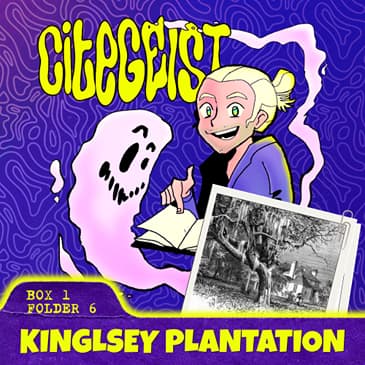

Kingsley Plantation in Jacksonville, Florida is often remembered for its hauntings, but the person most often flattened into legend is the woman who actually ran it. In this episode, we learn about Anna Kingsley (born Anta Madjiguène Ndiaye): a West African princess enslaved as a child who went on to become a plantation matriarch, landowner, and one of the most powerful free Black women in Florida before the Civil War.
By tracing Anta's real life alongside the ghost stories tied to the plantation, this episode looks at how history, race, and folklore get tangled together...and how racial attitudes shape which stories get preserved and what shape they end up taking.
Have a ghost story you want to share? Leave a voice note or send an en email at https://citegeistpod.com/contact
Podcast Instagram: http://instagram.com/citegeistpod
Personal Instagram: http://instagram.com/joshua.spellman
Channel illustration by
GiAnna Ligammari: https://virtualgia.com/
GiAnna's Instagram: https://www.instagram.com/virtualgia.zip
Royalty Free Music: "Behind the Veil" by 8er41
Underwater sounds - loopable by carmsie -- https://freesound.org/s/329915/ -- License: Attribution 3.0
SOURCES
“1860 United States Federal Census - AncestryLibrary.Com.” n.d. Accessed January 3, 2026. https://www.ancestrylibrary.com/search/collections/7667/records/7331642.
“AncestryLibrary.Com - Florida, U.S., Wills and Probate Records, 1810-1974.” n.d. Accessed January 12, 2021. https://www.ancestrylibrary.com/imageviewer/collections/8993/images/005886187_00016?usePUB=true&_phsrc=eBA241&_phstart=successSource&usePUBJs=true&pId=120668.
“Anna and Zephaniah Kingsley.” 2018. Celebrating Our History, September 22. https://uncoveringjax.wordpress.com/anna-and-zephaniah-kingsley/.
“Anna Kingsley: A Free Woman.” n.d. OAH Magazine of History, 3.
“Anna Madgigine Jai Kingsley - Division of Historical Resources - Florida Department of State.” n.d. Accessed January 3, 2026. https://dos.fl.gov/historical/museums/historical-museums/united-connections/women-in-history/anna-madgigine-jai-kingsley/.
“Anna Madgigine Jai Kingsley (1793-1870) - Find a...” n.d. Accessed January 3, 2026. https://www.findagrave.com/memorial/7698327/anna_madgigine_jai-kingsley.
“Black History Month: The Ghosts of Kingsley Plantation.” 2011. Haunt Jaunts, February 25. https://www.hauntjaunts.net/black-history-month-the-ghosts-of-kingsley-plantation/.
Card, Michael. n.d. “Guest Column: The Amazing Inter-Racial Story of Anna and Zephaniah Kingsley.” The Palm Beach Post. Accessed January 11, 2021. https://www.palmbeachpost.com/opinion/20191103/guest-column-amazing-inter-racial-story-of-anna-and-zephaniah-kingsley.
Groove, Buddha. 2019. “The Spiritual Significance of Peacocks.” Balance, November 29. https://blog.buddhagroove.com/the-spiritual-significance-of-peacocks/.
Jacksonville, Mailing Address: 12713 Fort Caroline Road, and FL 32225 Phone: 904-641-7155 Contact Us. n.d. “Anna Kingsley: A Free Woman - Timucuan Ecological & Historic Preserve (U.S. National Park Service).” Accessed January 11, 2021. https://www.nps.gov/timu/learn/historyculture/kp_anna_freewoman.htm.
Jaxson, The. n.d. “Old Red Eyes And The Ghosts Of Kingsley Plantation.” Accessed January 9, 2021. https://www.thejaxsonmag.com/article/old-red-eyes-and-the-ghosts-of-kingsley-plantation/.
leral, La rédaction de. n.d. “ANNA KINGSLEY... ou ANTA MADGIGIN NJAÏ - ANTA MADJIGUENE NDIAYE.” Leral.net - S’informer en temps réel. Accessed January 11, 2021. https://www.leral.net/ANNA-KINGSLEY-ou-ANTA-MADGIGIN-NJAI-ANTA-MADJIGUENE-NDIAYE_a263761.html.
Schafer, Daniel L. 2018. Anna Madgigine Jai Kingsley: African Princess, Florida Slave, Plantation Slaveowner (Revised and Expanded Edition). University Press of Florida.
Soergel, Matt. n.d. “For UNF’s Dan Schafer, Local History Is Life’s Work.” The Florida Times-Union. Accessed January 4, 2026. https://www.jacksonville.com/story/news/2018/05/16/for-unfs-dan-schafer-local-history-is-lifes-work/12218949007/.
The History Guy: History Deserves to Be Remembered, dir. 2024. Anna Kingsley. 16:35. https://www.youtube.com/watch?v=pTKmew88jSg.
“Weird Florida.” n.d. Accessed January 10, 2021. http://www.weirdus.com/states/florida/road_less_traveled/old_red_eyes/index.php.
Wikipedia. 2020. “Kingsley Plantation.” June 29. https://en.wikipedia.org/w/index.php?title=Kingsley_Plantation&oldid=965199923.
Wikipedia. 2021. “Zephaniah Kingsley.” January 7. https://en.wikipedia.org/w/index.php?title=Zephaniah_Kingsley&oldid=998872813.
WATCH on YouTube! https://www.youtube.com/@Joshua.Spellman
https://citegeistpod.com/
Have a ghost story you want to share? Leave a voice note or send an en email at https://citegeistpod.com/contact
Podcast Instagram: http://instagram.com/citegeistpod
Personal Instagram: http://instagram.com/joshua.spellman
Channel illustration by GiAnna Ligammari:
https://virtualgia.com/
https://www.instagram.com/virtualgia.zip
Royalty Free Music: "Behind the Veil" by 8er41
[00:00:03] - [Speaker 0]
Hello, and welcome to another episode of Citegeist. I'm your host, Joshua Spellman. Today, we're headed down to the wetlands of East Florida, just outside of Jacksonville, and investigating the spirits that haunt Kingsley Plantation. The princess turned slave turned slave owner, Anna Kingsley, the vengeful malevolent spirit known as Old Red Eyes, and the ghostly white peacocks that scream in the night are just some of the known apparitions. However, are these the spirits that we should fear?
[00:00:34] - [Speaker 0]
Or is the true ghost the specter of racism that persists within our culture's ghost stories and the bloody shadow it continues to cast on our nation? Truth be told, one of the most tiring aspects of investigating ghost stories is continuing to tell the same story of rich white folk over and over and over again because unfortunately, it's what most ghost stories tend to be. And researching ghost stories, I try and seek out narratives that highlight women, people of color, and queer people. And I have asked on Reddit for stories of ghosts of color or queer ghosts and have been routinely downvoted and had disparaging comments. And I'm not sure if that reflects the paranormal kind of community as being largely white, which I think we can agree it is.
[00:01:21] - [Speaker 0]
I'm thinking about, like, almost every single ghost show out there. And maybe these are also anti intellectual communities and maybe that's why my podcast can be looked down on as disparaging in its own right. But I digress. Rarely do you hear ghost stories of people of color because ghost stories are at their core folk retellings of history relying on what society valued and perpetuating those morals and beliefs into the future. The stories that are written down, archived, and preserved are of those in power, those with influence and with privilege.
[00:01:52] - [Speaker 0]
The lives of the poor, the oppressed, and the marginalized were rarely ever recorded. And in the rare occasions that they were, they weren't preserved. Which leaves the experiences of poor people, people of color, queer folk, and even just women in general largely absent from the majority of the historic record. Now the ghost stories that do exist about people of color, especially those in the American South, are tinged with racism as we'll see today. They're far less common than stories about wealthy white families but when they do surface they have one of two archetypes.
[00:02:27] - [Speaker 0]
You have the bad ghost which are stories built on racist stereotypes that frame black people as inherently dangerous or violent. Historically, these types of narratives were used to spread fear and justify racial violence. At the same time, they also functioned as warnings. To white audiences, they reinforced racial fear and rationalized their beliefs. And to black Americans, they served as cautionary tales signaling the consequences of stepping outside of social boundaries and showing signs of independence.
[00:03:00] - [Speaker 0]
Now the second archetype are the good ghosts. These spirits are depicted as gentle, loyal, and non threatening. Essentially submissive. And even in the afterlife, they're expected to serve. Their reward, so to speak, after death is to continue to work in the home or on the land long after their death.
[00:03:22] - [Speaker 0]
There are ghosts doing menial tasks around the house to benefit the people who still live there. I found that this ghost trope in particular closely mirrors the mammy type figure which is regarded by some as a positive stereotype. A figure who's devoted and nurturing but also entirely defined by service to white families. So even though some people consider this to be a positive stereotype, when it's examined closer, it's incredibly harmful. The message can be subtle and lost on those audiences who have the privilege to ignore it, but it's incredibly loud to black Americans and people of color.
[00:04:02] - [Speaker 0]
These ghostly archetypes reveal an uncomfortable truth that many in the paranormal community probably aren't ready to acknowledge. And that's that racism really has tainted and stained every fiber of American culture. So much so that it's sewn into the yarns we spin around the campfire for a scare. Can be easy for people like me to dismiss these patterns as coincidence or relics of the past, but that privilege itself is part of the problem. Others don't have that luxury of looking away or ignoring these messages.
[00:04:36] - [Speaker 0]
Even in our ghost stories, black Americans are framed as either a threat to be feared or simultaneously and quite paradoxically also somehow lesser than and meant to be submissive and to serve which reinforces the attitudes that exist in the real world. Whether you want to admit it or not, whether it's a comfortable fact or not, the haunting truth is that racism lingers not just in our institutions but deep within our culture. And it continues to shape not only lived experiences, but also the stories we pass down about the dead whether we realize it or not. Therefore, it should come as no surprise that today's story of Kingsley Plantation is still told from a similar perspective. But I wanna try and break that pattern.
[00:05:23] - [Speaker 0]
Instead of centralizing the story on the owner of the plantation Zephaniah Kingsley, a rich white polygamous slave owner, I instead wanna shift our focus to one of his wives, Anna Kingsley or Anta Matajin Jai. Anta's story is that of both tragedy and triumph. From life as a West African princess to her enslavement to her eventual freedom and reckoning then with the challenges of living in the post civil war era under the oppression of Jim Crow. Now today for the story portion, unlike most episodes, I'm going to keep it mostly true because I don't wanna sully her story even further. However, within the story portion, I will be including myths or misunderstandings of her story, which will end up clearing up in the analysis portion of the podcast.
[00:06:14] - [Speaker 0]
But enough of my yapping and I'm gonna get off my soapbox. So now let us delve into the story of Anna Kingsley so that we can better understand not only her life but her afterlife in the ghosts that lurk on the grounds of Kingsley Plantation. On 06/18/1793, Princess Anta Matajin Djai of the Wolof people was born in what is now modern day Senegal. At the time of her birth, this region of West Africa was marked by political instability and escalating violence. Power struggles between the Wolof kingdoms and the neighboring Fulis states had intensified and entire villages were frequently lain waste to by raids that were carried out to meet the growing demand of the Transatlantic slave trade.
[00:07:05] - [Speaker 0]
What had once been rather localized conflicts between neighboring sovereign nations was becoming a central part of a growing and vast network of international human trafficking. As the years went on, conditions only worsened. And in eighteen o six, when she was only 13 years old, Anto was captured by Tehero raiders from Futatoro. The Tehero were mercenary warriors and they were often employed to conduct raids explicitly for the purpose of capturing people to be sold into slavery. Anto's royal lineage unfortunately offered her no protection.
[00:07:40] - [Speaker 0]
Like countless others before her and after, she was taken by force, separated from her family who would have no idea what would become of her and she was taken toward the coast. Anta was transported to Gore Island, one of the most infamous slave debarkation points along the West African coast. There, she was held prisoner for days under brutal conditions, confined with others fearfully awaiting their unknown futures. Food and water were scarce and the captives were kept in close quarters and under constant guard. Gore was not designed for hospitality.
[00:08:16] - [Speaker 0]
What it was designed for was to break spirits and bodies alike. But Anta refused to be broken. The Middle Passage across the Atlantic was long, violent, and dehumanizing. The prisoners were shackled to wooden planks packed tightly below deck with little to no room to move. The air was suffocating with an oppressive heat and the sound of illness and despair filled the ship's hold.
[00:08:42] - [Speaker 0]
The mortality rate on these slave ships was often as high as seventeen percent. Those who died from heat stroke, infection, starvation or even exhaustion were unceremoniously thrown overboard as if there were nothing but rotted meat and not the human beings they were worthy of dignity and respect. Some people aboard the ships managed to escape and threw themselves overboard. The conditions were so unbearable and they dreaded whatever horrors lay ahead that they would willingly choose death instead of whatever awaited them at the end of their voyage. The ship carrying Anta eventually arrived in Havana, Cuba, one of the major hubs of the Spanish slave trade.
[00:09:24] - [Speaker 0]
Upon disembarkation, the surviving captives were immediately forced into isolation. This period of quarantine served multiple purposes. One is to prevent the spread of disease and to also allow the wounds and visible signs of abuse to heal to make the captives appear healthier and more marketable to potential buyers. By no means was this brief period of respite an act of mercy or kindness but a gross calculated step in preparing human beings for sale like cattle. In the autumn of eighteen o six, Anta was put up for auction and her future was once again uncertain.
[00:10:04] - [Speaker 0]
However, as the fates would have it, luck was on the princess's side. Among the potential buyers present was Zephaniah Kingsley junior, a 43 year old English born merchant. He was in Cuba to purchase rum, molasses and of course, as was the fashion of the day, slaves. As soon as the auction began and Zephaniah laid eyes on 13 year old Anta, he made up his mind that he would have her at whatever the cost. He desperately outbid every other slave trader and merchant there winning ownership of Anta and he soon changed her name to Anna.
[00:10:41] - [Speaker 0]
This was more than just a simple name change. It symbolized Zephaniah's possession of Anta and the erasure of her identity as a Wolof princess and stripped her of her autonomy and identity. Now there is nothing about slavery that can be described as good. But the fates really were looking out for young Anta and they rescued her from a destiny that could have been much much more dire. And they spared her from the horrors most enslaved women like her would endure.
[00:11:11] - [Speaker 0]
For one thing, Zephaniah lived in Spanish Florida whose laws on slaves differed greatly from The United States. And while still a slave trader and a slave owner, Zephaniah's views on slavery were very atypical for the time and would benefit Anta until her death. Young Anta was wed to Zephaniah in an African ceremony while in Havana. This ceremony was certainly not a Catholic one and therefore was not legally recognized by Spanish Florida or The United States at any point during their lifetimes. And while deeply troubling by modern standards, not only because of the power imbalance of Anta's status as an enslaved person, but because she was also a minor at only 13 years old.
[00:11:58] - [Speaker 0]
But for Anta, this wouldn't be something completely unfamiliar to her as similar arrangements were not uncommon within West African traditions. After this unconventional marriage, the couple made the voyage to Zephaniah's plantation called Laurel Grove located in present day Orange Park, Florida. However, Zephaniah and Anta did not arrive alone as by the time they landed, Anta was pregnant with Zephaniah's child At an age where other Wolof girls were first learning about womanhood from their mothers, Anta was forced not only into slavery but motherhood without any say in the matter or any guidance from a maternal source. Upon their arrival to Laurel Grove despite Anta being a slave, instead of relegating her to slave quarters Zephaniah invited her to stay in the house with him. Now for Anta this was a welcome change from the gruesome living conditions that she had been subjected to for the last several months.
[00:12:57] - [Speaker 0]
This gesture marked the beginning of aunt's transformation from a captive slave to an influential figure in the Kingsley household. Now Laurel Grove was home to over 100 enslaved people working to produce cotton, oranges, peas, and potatoes. As mentioned earlier, despite being a plantation and slave owner, Zephaniah's views on slavery were certainly unique. Make no mistake, I am not making excuses for this man but he was more humane than most. While still undeniably inexcusable Zephaniah's approach emphasized incentives, autonomy, and family stability.
[00:13:36] - [Speaker 0]
Now this relative leniency was strategic rather than moral as it was used to maximize profits and prevent rebellion but it shaped the plantation's social structure in significant ways. Under Zephaniah Kingsley, enslaved laborers worked on a task system instead of forced dawn to dusk labor. The enslaved were assigned daily tasks that they were allowed to work as quickly or as slowly as they desired. And when their day's work was completed, they were allowed to use their free time however they wished. Whether that be quality time with their families, working overtime for additional wages, or tending to their own fields.
[00:14:16] - [Speaker 0]
You see Zephaniah allotted slaves their own plots of land where they could grow their own crops while others might spend their free time creating crafts which Zephaniah permitted them to sell at his retail store. Using the money that they made working overtime or selling their goods, they could use this money to buy their own freedom. It was Kingsley's policy that slaves could purchase their own freedom for half of their assessed value which is something that was a major difference between servitude in Spanish Florida versus The United States. In Spanish Florida, slavery was never meant to be a permanent or a lifelong condition. Freed slaves in Spanish Florida enjoyed full citizenship and rights which is something that could not be said of The United States.
[00:15:08] - [Speaker 0]
In addition to this, instead of segregating his enslaved workers, Zephaniah preferred that they live together as families rather than being split up and isolated. But again despite this humane treatment, his motivations weren't entirely altruistic. As mentioned prior, he believed that if you treated slaves better or as human beings that they would be more productive and less likely to rebel which would lead to even greater profits in the long term. Zephaniah's plantation made up to a $100,000 annually or nearly $500,000 today. Now this was impressive especially for a plantation in such a remote area of Florida.
[00:15:50] - [Speaker 0]
Visitors to the plantation often assumed that Anta was a free woman and with good reason. She ran the plantation alongside a freed manager during Zephaniah's frequent absences as a merchant. Now another unconventional aspect of Zephaniah Kingsley was that he was a polygamist. Though none of his marriages had any legal standing whatsoever. Not only because he had so many wives but also because all of his marriages were interracial.
[00:16:19] - [Speaker 0]
And well Zephaniah had other wives besides Anta. Anta was always recognized as his primary and most beloved partner. By 1811 when Anta was only 18, she had already bore three children. George in June of eighteen o seven, Martha in July of eighteen o nine, and Mary in February 1811. It was also in the same year that Zephaniah granted Anta full emancipation securing her legal freedom and reinforcing her position of power at the plantation.
[00:16:52] - [Speaker 0]
While the marriage and her children were forced upon her in the beginning, Anta and Zephaniah's relationship would last as long as he lived and it would become a relationship of mutual respect and warmth. With her freedom in hand in 1813, Anta petitioned the Spanish colonial government which still ruled Florida for her own land. Her request was approved and she was granted five acres in Mandarin just across the river from Laurel Grove. Onto quickly purchased equipment and goods to start her farm which included 12 slaves. Now it may seem unusual for a freed slave to turn around and purchase her own but however uncomfortable it is to view it through a modern lens, this reflected the economic realities of the era and there was also the fact that slavery was part of her own culture back in Africa.
[00:17:43] - [Speaker 0]
Anta was ambitious and she was dead set on achieving her goals even if that meant perpetuating the cycle of slavery. Unfortunately, Anta's independent business venture would not last long. In that same year, Zephaniah was kidnapped during the Patriot Rebellion, a violent effort by American insurgents to seize control of Florida or so it was said. The Patriot Rebellion was an operation secretly funded by president James Madison and the secretary of state James Monroe. It was a war of foreign aggression that was sold as patriotism by a massively effective propaganda campaign.
[00:18:21] - [Speaker 0]
The American rebels attacked and raided towns and plantations and they would throw all black people that they captured regardless of their legal status into slavery. As you can imagine, despite being free, this put Anta at great risk and both her and her children were in immediate danger. When the rebels eventually reached Laurel Grove, they captured 31 of its enslaved people and used the plantation as their headquarters as they raided and looted nearby areas. To avoid capture and being resold into slavery, negotiated with the Spanish authorities for her escape bringing her children and her 12 slaves along with her. As Anta left with the Spanish forces, she burned Laurel Grove and her newly acquired Mandarin homestead to the ground so that the rebel insurgents could no longer use either of them as a base for their operations.
[00:19:11] - [Speaker 0]
And once again luck in the fates smiled down upon Anta. After the rebellion was quelled, the Spanish government awarded her 350 acres of land in recognition of her sacrifice and loyalty. That is 70 times the amount that she purchased earlier that very same year. Reunited after the rebellion in 1814 with the plantation at Laurel Grove destroyed, Anna and Zephaniah relocated to Fort George Island to what is now known as Kingsley Plantation near Jacksonville, Florida. It was here that Zephaniah married his three other wives, all slaves, who bore a total of nine children.
[00:19:50] - [Speaker 0]
These women and his children were all eventually freed. To say that the Kingsley family dynamic was complex would be an understatement. The household functioned as a hierarchical polygamous family with Anna clearly positioned at its center. It was Anna who was named as Zephaniah's wife in his will while the other women were designated as co wives. And while they were loved they were never quite matched in terms of favor or power.
[00:20:18] - [Speaker 0]
Regardless, all of Zephaniah's wives and children lived in relative luxury and they were educated with the best schooling that he could afford. When the plantation had company, Ata would sit at the head of the table with Zephaniah, once again reinforcing her position as head of the house. During the eighteen twenties, a separate kitchen structure was constructed and connected to the main house by a covered walkway. The upper room of this building would become Anta's personal residence which she would share with her children. And this building eventually came to be known as the ma'am Anna house.
[00:20:51] - [Speaker 0]
Though maybe unusual to us, Antha would have expected something similar back home in Senegal as well. Polygamy was also common there. Even aunta's mother was one of her father's many wives. And traditionally, Wolof wives and their children would live in separate houses not far from their husband's main house. It was in this dwelling in 1824 that Anto bore her fourth and final child, John.
[00:21:18] - [Speaker 0]
A total of 32 slave residences were constructed on the Kingsley Plantation not far from the main house and they were arranged facing it in a peculiar semicircular pattern. Some historians believe Zephaniah did this to keep a close eye on his slaves but others believe it was Anta's doing as his configuration closely echoed the layout of many West African villages that Anta would have known as a child. And this is entirely plausible as Antha was encouraged and known to take pride and practice her West African culture and traditions. Not only was this configuration nostalgic for Antha and probably many other enslaved workers, but it also helped to foster a sense of community and safety ultimately boosting morale and creating a sense of unity. Overtime, Spain eventually ceded Florida to The United States.
[00:22:08] - [Speaker 0]
While Spain had fairly progressive policies on race and slavery allowing free people to fully integrate into society, The United States did not offer the same rights. Once The US gained control of Florida, they began stripping the rights of free African Americans and blaming them for the growing discontent among the enslaved populations. Free blacks were beginning to be disenfranchised on every front. First they were barred from jury service and prohibited from testifying against whites in court. It then became illegal for whites to enter into interracial marriages and interracial children were stripped of their rights and inheritance.
[00:22:47] - [Speaker 0]
White men found guilty of fornicating with African American women faced outrageous fines and even had their own civil and political rights limited or revoked. Taxes were levied on all free black males over the age of 15 and by 1827, free blacks were entirely forbidden from entering Florida. Now despite actively and passionately lobbying against these policies, it quickly became clear to Zephaniah that if the United States government had their way, there would be no free African Americans. There would only be free whites and enslaved blacks. No in between.
[00:23:23] - [Speaker 0]
Zephaniah's entire family would be at risk. While there was an agreement that all blacks who were born free and all of those who were emancipated before 1821 were not subject to these new laws, Anta and Zephaniah's youngest son John would not be eligible to receive the same protections as he was born in 1824. But even then, Zephaniah knew that his wealth and privilege could only protect his family for so long. He was under no illusions that The US would hold to their agreement and the treaty with the Spanish. Worried that his family's rights and lives may be taken away, in 1835 Zephaniah began the process of creating a sanctuary and relocating his wives and children to Haiti in a location that is now part of the Dominican Republic.
[00:24:08] - [Speaker 0]
Anza and her youngest son John left for Haiti from Boston aboard the ship the America on 07/20/1839. By the time 1842 rolled around, Zephaniah transported a total of 60 freed people of color to his operation in Haiti. Since slavery was illegal in Haiti, those who were not yet freed in Florida acted as indentured servants who would earn their freedom in nine years time. Anza and her children prospered on the island and became accustomed to a rather comfortable lifestyle to say the least. Zephaniah had set up something really special for them in Haiti as the operation proved very successful.
[00:24:47] - [Speaker 0]
In his old age, Zephaniah began planning his estate in order to ensure that his family would be okay after he passed. And in knowing that he was nearing the end of his life, in 1842 he gathered his entire family in Haiti to go over his plans. He left the port in October 1842. He returned to Florida to file his last will and testament before sailing to New York City to take care of a business transaction. Zephaniah then planned a return journey to Haiti to see his family again.
[00:25:15] - [Speaker 0]
But on 09/13/1843 at the age of 78, Zephaniah Kingsley died in New York City. Anna was 50 years old when Zephaniah died. She was living a safe comfortable life in Haiti and profiting off the ventures Zephaniah had set up for her and her family. But three years after Zephaniah's death, she would give it all up to return to Florida. Now because of a clause that Zephaniah included in his will, any members in the family who risked returning to Florida forfeited their rights to the financial proceeds of the family's operations in Haiti.
[00:25:50] - [Speaker 0]
Anna didn't care and she returned. Now because of the new laws in Florida, none of Zephaniah's children nor any of his wives were able to inherit his property or wealth despite the clear instructions he set forth in his will. Anta was named the primary heir to all of his riches and properties but Zephaniah's sister Martha and her children challenged the will claiming it was defective and invalid. In addition to being people of color, Martha claimed that when Zephaniah's wives and children moved to Haiti to remain free, they also abandoned any right they had to his property. Despite the racial tensions boiling over in Duval County at the time, being that powerhouse of a woman that she was, Anta returned to Florida in 1846 to participate in the legal battle for the property that was rightfully hers.
[00:26:42] - [Speaker 0]
Miraculously, the court upheld the treaty between The United States and Spain, decreeing that all free blacks born before 1821 had a right to the same privileges they enjoyed under Spanish rule. Because of this, Anna was able to claim her inheritance. This marked a rare legal victory for a black woman in antebellum America. And naturally, when the civil war eventually broke out, Anna and her children were union sympathizers. Jacksonville was captured by the union in 1862 and Anna and her children were briefly evacuated to New York.
[00:27:15] - [Speaker 0]
Anna and her children eventually returned to Florida taking up residence briefly in Arlington to be nearer to her daughters who were married to planters in Florida. Onta became the matriarch of the Kingsley family who resided in Florida and her farm on the East Bank of the Saint Johns River came to be known as Chesterfield. Alongside her daughters Martha Baxter and Mary Samus, Onta helped establish and sustain a rural community of free black families that was virtually unparalleled in the state at the time. This development was especially remarkable given the fact that Florida was becoming increasingly hostile to free people of color, which prompted many to leave the state altogether in search of safety and opportunity elsewhere. But Anta and her daughters provided a safe haven.
[00:27:59] - [Speaker 0]
The community they built stretched roughly seven miles along the riverfront from the junction of the Saint John's and Pottsburgh Rivers to Reddy's Point. The settlement functioned as a stable self sufficient community and free black families owned land, raised children, worked their farms, and participated in local commerce at a time when their legal and social status was under constant threat. Anta's leadership and resourcefulness combined with the labor and cooperation of her daughters and extended family helped make Chesterfield a rare space of continuity. Now died quietly in 1870 and was buried in an unmarked grave on one of her children's property. And while died without property of her own having lost it after the war, she left behind a legacy shaped by resilience and strategy and survival.
[00:28:54] - [Speaker 0]
Aunta's descendants remained part of the African American upper class for more than a century. In fact, one of her descendants even includes Florida's first black millionaire Abraham Lincoln Lewis. Aunta's influence extended far beyond her lifetime. Through her descendants, her legacy has continued to shape African American economic and cultural life well into the twentieth century. What had once been Chesterfield Farm would eventually be absorbed into the expanding city of Jacksonville and it would have been located where the Jacksonville University campus stands today.
[00:29:27] - [Speaker 0]
Back on the island of Fort George, local legends say that Auta's ghost can still be seen on Kingsley Plantation and she is known to most as the woman in white. She is most often spotted on the back porch of the main house and she can often be photographed there. However, Antha is not alone and Zephaniah Kingsley can also be seen on the plantation from time to time. Now a few parts of story are disputed or contradicted but for the most part what I told you was widely factual. Now depending on who you ask or what sources you read, there was some doubt on whether or not was a princess.
[00:30:10] - [Speaker 0]
And in fact, most ghost sites and even material from the national park declined to even mention it one way or the other. For quite some time, Anta's lineage was widely debated. However, for this story, I actually read a book. Yes. Everyone, please clap.
[00:30:26] - [Speaker 0]
I know what you're saying too. You're a librarian. Why what? Yes. I may be a librarian, but I'm not much of a reader.
[00:30:34] - [Speaker 0]
My background is in archives and special collections, and my undergrad is in archaeology and anthropology. And I look at books as more of cultural objects than as something to enjoy for leisure, but I digress. The book I read was Anna Majajeen Jai Kingsley African princess, Florida slave, plantation slave owner, revised and expanded edition by Daniel l Schaefer. Schaeffer confirms in his book that not only was Anta a princess, but she was a double royal, meaning that she had royal blood on both sides of her family. And while we know what happened to Anta after her capture, her fate remained largely a mystery to her people back in Africa.
[00:31:19] - [Speaker 0]
In most stories that we tell of slavery, we never even consider the impact that it had on their communities back home. In Anta's case, it turns out that after she had disappeared, an extensive search was carried out for her. But as we know, she was never found and her story served as a prescient warning that no one was safe from the horrors of the Atlantic slave trade, not even a princess. But Anta's memory lived on in Senegal and through griots or storytellers, Anta's memory was kept alive and finally, after over two hundred years, her community learned of her fate. They learned of her life as a slave and then as a freed woman who led a dynasty of her very own.
[00:32:07] - [Speaker 0]
It's undoubtedly devastating what happened to Anta and how her family and her community never knew what happened to her, but I'm glad that now, at least, even if it was two hundred years a little too late, that her descendants can finally receive some closure. And it's my understanding that some of her descendants actually had the opportunity to come to Kingsleaf Plantation and reconnect with Anta and learn more about her story and see where she lived and how she thrived despite her unfortunate circumstances in capture. Now other points of Anta's story that are disputed include when exactly Zephaniah met Anta. Some say that it was in Havana which is the most accepted version of events, but some say that it was actually on Gori Island where Zephaniah took Anta as his favorite and he had her as a companion for the journey across the Atlantic which is how she became pregnant with their first child. Now this is widely debated even though one of the sources of this version of events is actually Zephaniah Kingsley himself, but it's based off of a line of story and questioning that may be misinterpreted or was written down later and so it's not entirely clear of what he meant during this conversation.
[00:33:33] - [Speaker 0]
Now another thing that's not necessarily a disputed or contradicting fact is that when Anta started her Mandarin Grove homestead, Zephaniah was extremely encouraging and supportive of her venture. It was actually Zephaniah who gave Anta her 12 slaves. It seems that Anta didn't actually buy them for herself. Though don't get it wrong, she definitely bought her own slaves in later years. So she's not innocent in this situation either.
[00:34:03] - [Speaker 0]
In addition to buying her equipment and these 12 slaves, Zephaniah also sent builders to build homes not only for aunta and her children in Mandarin Grove, but also for her enslaved workers. Zephaniah seemed to always ensure that aunta always received the best of the best and he was very encouraging about all of her business ventures because after all, money that she made helped him make money and it's what helped build this empire and create generational wealth for Anta and her descendants. Now aside from Schaeffer's book, I was actually able to find several primary sources about Anta, which was very surprising to me given that she was a black woman in the eighteen hundreds. The fact that anything exists at all, even with the amount of privilege that she had, was shocking to me. However, the material that I found doesn't really help us tell her story as it mainly pertains to her will.
[00:34:59] - [Speaker 0]
And unfortunately, when Anta died, she didn't really have much left to her name, though her children were incredibly successful. As we know, Anta forfeited her right to any of the proceeds from the farms in Haiti and unlike the story portion, Anta was not necessarily a union sympathizer in the way that we would think. While, yes, she was a former slave herself, she depended on slavery for her livelihood. While she was once a victim of the system, she also perpetuated it. It was a little bit of an anomaly that while most freed slaves bought slaves that were members of their own family to free them, Anta bought slaves to maximize her profits and propel her business ventures forward.
[00:35:44] - [Speaker 0]
And once slavery was outlawed, she essentially lost everything she had because it was built on this foundation of slavery and it wasn't sustainable without the labor that she was receiving from her enslaved workers. So while we can commend Anta for her resilience and her ambition, she wasn't without flaw but no human being is without flaw and it was just a reality of the time and she was only doing what she felt was necessary and right to survive. Now it seems she was an abolitionist in some way though I'm not really sure how her personal beliefs on slavery and her reliance on slaves for her own wealth really kind of worked together. We don't have her here to ask that unfortunately. Now it's said that Zephaniah's sister challenged his will along with her own children, but based on historic accounts in Schaeffer's book and research, it actually appears that all of Zephaniah's other white relatives refused to sign their names to the lawsuit and this was because they either knew and loved aunta and her children and the other wives or they were just more sympathetic to Zephaniah or like many people, it was none of their business and they didn't want any part of it.
[00:37:04] - [Speaker 0]
Other documents I found were mainly census records and like I said, Antha's own will but I was really devastated that I couldn't find a single photograph of Antha. Now you'll see many websites that have pictures that claim to be of Aunta but when you reverse image search them, it turns out that there are other famous black women in history or unnamed black women who just happen to look of the period. This isn't an uncommon phenomenon. In my day job, I'm usually tasked as part of my duties with checking rights and clearances for photographs. And last year when our team was putting together a Black History Month campaign, I checked to make sure that the photos that we were using were not only licensable and usable, but that they were historically accurate.
[00:37:55] - [Speaker 0]
Because doing this podcast and the previous version of it, I've learned that a lot of blogs will make posts especially during black history month and either find the only old timey picture they can of a black person or use a picture they saw in another blog or article, but not double check the source. Unfortunately, these incorrect images get picked up and then used by the next person researching that historical figure. And then again picked up by the next person doing their research. And sometimes these even get used by reputable institutions due to the proliferation of that particular image as a certain figure and then it just becomes widely accepted to be of that person when it's really not. And this ends up being a shame not only for the person that they're trying to depict, but for the person who was actually in that photograph because then they get entirely erased from history altogether.
[00:38:52] - [Speaker 0]
It's a lose lose situation. So what I'm saying is please double check your sources. So while we don't have photographs of Anta, we do have descriptions of her. One description from Zephaniah himself says that she was a fine, tall figure, black as jet, but very handsome. She was very capable and can carry on all the affairs of the plantation in my absence as well as I could myself.
[00:39:18] - [Speaker 0]
She was affectionate and faithful and I could trust her. And in Zephaniah's will he said of Anta, She has always been respected as my wife and as such I acknowledge her. Nor do I think that her truth, honor, integrity, moral conduct, or good sense will lose in comparison with anyone. Now Auntie's niece described her a little bit differently though she still greatly admired her beauty saying, I remember her very distinctly. She was not black and had the most beautiful features you ever saw.
[00:39:51] - [Speaker 0]
She was a most imposing and very handsome woman. Her smooth, light brown skin, her dark eyes and wavy hair made her out standing and I would not keep my eyes away for admiration. She was quiet and moved with regal dignity. I have never seen anything like her before or since. Her daughter was there also and she was very light in color but not as good looking as her mother.
[00:40:16] - [Speaker 0]
I was six or seven years old at the time. I was Kingsley's niece. The next morning my aunt, missus Gibbs, sent two servants for us with a horse and buggy and we were carried away over to Newcastle. My mother was furious that we had spent the night at ma'am Anna's, but it could not be helped. Which seemed to be kind of a thing that often happened with Anta is that people were absolutely enthralled by not only her beauty but her demeanor and her personality and were infinitely charmed by her.
[00:40:48] - [Speaker 0]
She made many friends, unlikely friends with other white folk who were often chastised and criticized for their friendships with Anta. But she just seemed to be that magical and it's clear that even though she wasn't royalty here in The United States, she exuded all those qualities you would expect from a princess. Despite Anta's privilege and wealth, no letters, photographs, or other personal effects are known to exist aside from her will. And even her grave is unmarked which I do find unusual. And it's sad but as we discussed in other episodes, it's not out of the ordinary for a woman especially a woman of color to be absent from the historic record even with the wealth and privilege that Anta enjoyed.
[00:41:40] - [Speaker 0]
But that's pretty much it on the clarification of Anta's story. So now let's get on to the ghosts. There are a lot of fun and interesting sightings on the Kingsley Plantation which was eventually converted to a state park in 1955 and later incorporated as a national park. This designation has allowed the property to be maintained and preserved and it's welcomed many visitors over the years who have seen some pretty strange things. Here's a quick rundown of some of the ghostly encounters.
[00:42:13] - [Speaker 0]
The smell of gingerbread in auntie's kitchen in the ma'am Anna house, furniture that moves on its own, a crying child that's heard by the well, the apparition of an African man wearing a turban, the malevolent entity known as old red eyes, and Zephaniah Kingsley and aunta Kingsley, their selves. Now there's a tradition that you must never say goodnight Zephaniah while locking up for the night because it can cause bad things to happen. What this means, I don't really know but hey, I wouldn't chance it. Though it seems rude on Zephaniah's part because you're just trying to be nice and courteous by saying goodnight. Why would that incur retaliation?
[00:42:58] - [Speaker 0]
But, hey, he was a polygamous slave owner who had to buy all of his wives, so maybe he has some unresolved issues and unmet emotional needs that I'm not quite prepared to work through with him from the other side. So be grumpy Zephaniah. I don't know what to tell you. And as we mentioned, there is what is assumed to be Anja's ghost or the lady in white that is often seen and captured on the property in photographs. Maybe these are the only photographs of Anna Kingsley to actually exist.
[00:43:32] - [Speaker 0]
It's hard to say because we don't know what Anna actually looked like and the ghost that is seen could be of any of Kingsley's wives or any of the workers on the plantation. However, it should also be noted that what is assumed to be Anta's ghost is most often seen spotted on the porch of the main house where she did not live even when she lived on the property. Anta may have spent nights there, conjugal visits if you will, but as we know, she had her own residence known as the ma'am Anna house or the ma'am Anna. Anyways, it's just a little ways from that main house. And unlike the story portion, so I guess I'm not done kind of clarifying things, this was not a modest kitchen building with a room above it for living quarters.
[00:44:22] - [Speaker 0]
It's actually a pretty sizable house, and it's bigger than any I've lived in. That's for sure. The Main Floor has a kitchen. Yes. But it also included a parlor in a living room and the bedrooms were upstairs, which sounds like a normal house to me.
[00:44:37] - [Speaker 0]
It wasn't just a kitchen with a bedroom upstairs. It was much more than that. And again, to top it off, not only did she not spend a lot of time at the main house, Anta also didn't die on the Kingsley Plantation property and she hadn't lived there for nearly thirty years when she did. So it's curious to me that her ghost is seen there. But hey, it is still possible since she loved the property on Fort George Island and during her time in Haiti, she was said to be incredibly homesick for her home back in Florida.
[00:45:09] - [Speaker 0]
Perhaps aunt has returned to Kingsley Plantation after her death to a place where she felt comfort and peace. Although one of her friends, Susan La Engle, a wealthy white woman who formed an unlikely close friendship with Anta says that Anta seemed quite lonely at the Kingsley Plantation and that she felt both ostracized by whites and blacks during her time there. But that aunta's work on the plantation and running the house had kept her busy. So it seems that aunta wasn't entirely happy at the Kingsley Plantation due to feeling isolated and lonely. But perhaps it was in hindsight that she longed for her life at the plantation.
[00:45:52] - [Speaker 0]
I wasn't able to find any firsthand encounters with aunt's ghost nor was I able to find any supposed photographs that are apparently constantly captured there. However, there are other spirits that are seen much more frequently on the property. There's another presence on the island that unlike Anta isn't a ghost you would want to come across. Instead, this is a dark and malevolent entity that seeks only to harm and is known only as Old Red Eyes. Legend has it that Old Red Eyes was once a slave on the plantation.
[00:46:28] - [Speaker 0]
In life this man assaulted and murdered young girls on the island. Both the daughters of the white planters as well as his fellow slaves. It is said that once the other slaves on the island discovered who was behind these brutal attacks that they banded together and hung old Redeye's from an old oak tree. Now old Redeye still lurks on the property, spying on visitors from the trees seeking his next victim. Some say that if you say his name three times, he just may appear.
[00:47:04] - [Speaker 0]
Now it's clear that this story is founded on the racial stereotype that black men are somehow inherently violent and kind of fall into this bad ghost archetype we discussed at the beginning of the show. Stories like this whether true or not have historically been used and are continued to be used to spread fear and normalize these racist ideas. Particularly in the American South, such narratives were used to often rationalize lynching for whites while simultaneously functioning as a warning to members of non white communities. So despite being one of these tropes or archetypes, apparently old red eyes is often seen and he most commonly manifests as a pair of glowing red eyes in the woods and it was first seen in 1978. People say they most often see the red glowing eyes in their rearview mirrors when they're driving down the road at night.
[00:48:04] - [Speaker 0]
And following the retelling of this legend by a local resident in 1993, sightings increased dramatically which is interesting. It's almost as if people were then intentionally looking for red eyes in the dark woods and so they began to see them with more frequency. Strange how that works. But the legend also incorporates elements of the Bloody Mary myth including the act of chanting his name three times in order to summon him. Interestingly, this detail also closely parallels a plot point in the 1992 release of the film Candyman.
[00:48:45] - [Speaker 0]
A horror film in which the spirit of a lynching victim who himself was a son of formerly enslaved people is summoned in very much the same way of chanting his name three times. The popularity of the film provides an extra added layer for why there was a surge of reportings beginning in 1993 and perhaps why this legend was retold in the first place. And for the record, it should also be noted that there was no historic evidence that an event like this ever happened on the island. However, Emily Palmer, one of the park rangers at Kingsley Plantation, has a compelling real world explanation for old red eyes and why he's so often seen at night, particularly in rearview mirrors. She says, interestingly enough, along Palmetto Avenue, we do have something hanging from the trees that would reflect bright red eyes if a brake light was shining on them.
[00:49:46] - [Speaker 0]
They're called possums. Okay, Emily. You're a lot of fun. At night, you can also hear the screams of a young girl by the well. Some say that if you follow the sound, you'll see her, but you may also be presented with a jarring and ghastly sight, a ghostly white peacock.
[00:50:06] - [Speaker 0]
Is it an omen? In early Christian lore, the peacock represented Christ's resurrection and the soul's ability to live on after death. Though once again, our friendly park ranger, Emily, is a bit of a downer and she provides a perfectly rational explanation. It turns out that iridescent and albino peacocks are known to be living resident animals on the island. So not supernatural though stunning and probably jarring to see at night, I'm sure.
[00:50:39] - [Speaker 0]
Palmer is quoted of the peacocks saying, if you are unfamiliar with the fact that there are albino peacocks and if you're not familiar with the sound that a peacock makes when it's doing its mating call, you might take that for a little girl screaming. It's a pretty unique noise. Okay. Fine, Emily. Why do you gotta be such a downer?
[00:51:04] - [Speaker 0]
What about the ghostly alligator that's seen at the bottom of the stairwell? Emily? You got a rational explanation for that? I didn't think so. It couldn't possibly be a real alligator because what would that be doing in Florida?
[00:51:22] - [Speaker 0]
Gotcha. But in all seriousness, Emily has a similar philosophy to me on this podcast when it comes to ghostly experiences. And she's quoted as saying, I don't mean to disrespect people's beliefs or experiences. We definitely have a lot of people who say they feel a spiritual connection to the site and a connection to their ancestors. And we want to give them the space to be able to do that.
[00:51:50] - [Speaker 0]
But a lot of the stories that people come up with and reasons to come up here at specific times of night and specific months of the year like October, a lot of those can be debunked. And I do agree with Emily in that sense especially that Kingsley Plantation serves as a very spiritual nexus for people to connect with their ancestors who may have lived there. And those aren't the types of experiences that I discount. It's the latter types of experiences where people go there for thrill seeking to seek out, you know, old red eyes or, you know, just to give their younger siblings or their children a scare. I think it's a very important distinction.
[00:52:37] - [Speaker 0]
I think the supernatural paranormal community has a lot of different sex so to speak, you know, people who come at it like me from a skeptical kind of perspective who love history and love learning about interesting stories of people. You have people who are thrill seekers or attention seekers, adrenaline junkies. You have people who have, you know, passing casual interests but you also have people that, you know, the spiritual and paranormal are a core part of their beliefs and identity and their culture and whether or not that's something you believe in it's something that I absolutely believe should be respected. Regardless of your beliefs, Kingsley Plantation remains one of the most haunted places in Florida. And at the very least, it hangs heavy with the weight of the past.
[00:53:25] - [Speaker 0]
And whether or not its ghosts are simply really spooky wildlife, the land itself is an important part of a freed black woman's story and the foundation of her family's continuing legacy. Now I'm honored to have been able to share Anta's story with you and I hope you enjoyed listening. When I first told this story on the original iteration of this podcast, it wasn't an entirely well known story. And since then, it seems to have really been picked up by a lot of people and people connect with it. So I'm really happy that Aunta's story is being told more widely now.
[00:54:03] - [Speaker 0]
And I'm not saying by any means that I had anything to do with that because I did not. But I'm just happy that more people are talking about her and connecting with her. I think her story is really important. Thank you for listening. If you enjoyed the story and learning about Anta, please give a thumbs up or leave a rating on your preferred listening platform if you're listening to this as a actual podcast.
[00:54:27] - [Speaker 0]
And with that, I think that's the close of the episode. So please be aware of possums hanging in the trees. Watch out for the ghostly crocodile or was it an alligator? I think it was an alligator. Florida gators?
[00:54:40] - [Speaker 0]
I don't know. I digress. It's it's at the bottom of your stairs. Be careful. It's gonna get you.
[00:54:44] - [Speaker 0]
And as always, stay curious, and I'll see you in the stacks. Also, I want you to know I've been recording this podcast for three hours because I had audio trouble and video trouble. And also, had no heat in my apartment because it went goodbye. And it's currently 20 degrees outside, and I'm freezing cold. Thank you so much for listening.
[00:55:04] - [Speaker 0]
If you listen this far, I am sorry. This is what my personality is really like. Goodbye.