
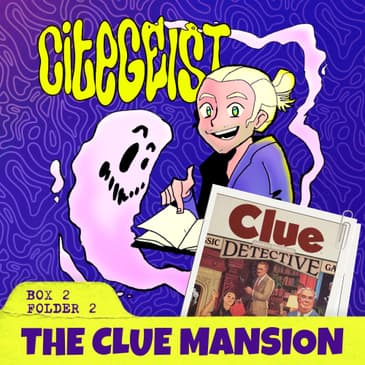

A Salem ghost tour claim sent me on a search for the real Clue house. While the Gardner-Pingree House, and the murder of Captain Joseph White, are said to be the story behind the game...that may not be true. Learn about the sensational 1830 Salem murder of Captain White and join the search for the real rea. Was the Gardner-Pingree house really the inspiration for the American version of Clue? And if not, what house actually was?
In this episode, we cover the 1830 murder of Captain Joseph White, the panic that followed, the Knapp brothers’ disastrous scheme, and the courtroom drama that made the case famous. Then, we follow the paper trail into board game history, comparing early Clue / Cluedo editions, Parker Brothers marketing, and the houses most often linked to the game’s design...and we'll even meet a few ghosts along the way.
Key Topics
[00:00:00] - Intro
[00:02:21] - The Gardner-Pingree House and the Captain Joseph White murder
[00:26:30] - Research De-Brief
[00:27:50] - Ghost Photograph at the Gardner-Pingree House
[00:29:21] - Testing the Claim that the Gardner-Pingree House Inspired Clue
[00:30:18] - The Parker Family Estate
[00:33:55] - History of Clue / Cluedo and Anthony E. Pratt
[00:36:49] - Tudor Close Hotel
[00:38:25] - Reported haunting activity at Tudor Close
[00:43:40] - Outro
Bibliography
Bibliography
“1950s Parker Brothers Clue Board Game - Etsy.” Accessed August 18, 2026.
https://www.etsy.com/listing/4549434221/1950s-parker-brothers-clue-board-gameAutencio, Kristel. “Grounds for Murder: Maps and Floor Plans in Mystery Novels.” BOOK RIOT, January 8, 2016.
https://bookriot.com/grounds-for-murder-maps-and-floor-plans-in-mystery-novels-2/Berry, Melissa. A Spooky Real-Life Murder Mystery for Halloween, Part II. Genealogy Stories. October 28, 2021.
https://www.genealogybank.com/blog/a-spooky-real-life-murder-mystery-for-halloween-part-ii.htmlBerry, Melissa. A Spooky Real-Life Murder Mystery, Part III. Genealogy Stories. November 2, 2021.
https://www.genealogybank.com/blog/a-spooky-real-life-murder-mystery-part-iii.html“Captain Joseph White |.” Accessed August 21, 2026.
https://salempl.org/captain-joseph-white/Case 13: The Return of Elizabeth Dacre. Episode 13. Uncanny. BBC, January 12, 2022.
https://www.bbc.com/audio/play/m0013hb5“Clue.” The Strong National Museum of Play, n.d. Accessed August 29, 2026.
https://www.museumofplay.org/toys/clue/Collier, Beth. “It Was Mr. Pratt in Birmingham with a Crayon!” Substack newsletter. Curious Minds, April 21, 2023.
https://bethcollier.substack.com/p/it-was-mr-pratt-in-birmingham-withDaily Commercial Gazette (Boston, Massachusetts). “Joseph Jenkins Knapp.” January 1, 1831.
Donelan, Jenny. “A House with Secrets.” New Hampshire Home Magazine, December 16, 2019.
https://www.nhhomemagazine.com/a-house-with-secrets/eBay. “Vintage 1949 Parker Brothers Clue Board Game, Near Complete, Excellent Condition.” Accessed August 23, 2026.
https://www.ebay.com/itm/158071690018Entire-Company690. “Ghost walk pics.” Reddit Post, r/SalemMA, September 10, 2025.
https://www.reddit.com/r/SalemMA/comments/1ndemkz/ghost_walk_pics/Historic England. “Tudor Close.” Accessed August 26, 2026.
https://historicengland.org.uk/listing/the-list/list-entry/1380426Houghton, Kristen. “The 1830 True Murder Behind Poe’s ‘The Tell-Tale Heart.’” Criminal Element, December 1, 2016.
https://www.criminalelement.com/the-1830-true-murder-behind-poes-qthe-tell-tale-heartq/“Knapp’s Execution and Dying Protest.” Broadsides. 1830. Peabody Essex Museum’s Phillips Library Digital Collections.
https://pem.quartexcollections.com/Documents/Detail/knapps-execution-and-dying-protest/2827Lee, James F. “The Innocent, the Damned, and Daniel Webster: Salem Was the Scene for an Infamous Murder Trial.” James F. Lee, October 6, 2023.
https://www.jamesflee.com/blog/white-murderLewis, Walker. “The Murder of Captain Joseph White: Salem, Massachusetts, 1830.” American Bar Association Journal 54, no. 5 (1968): 460–66. JSTOR.
Massachusetts Historical Society. “DYK That the British Board Game...” Facebook. Accessed August 24, 2026.
https://www.facebook.com/MassachusettsHistoricalSociety/posts/dyk-that-the-british-board-game-clue-is-different-from-the-american-version-made/6552060401484905/McDonagh, Evan. “The Great Detective Game: Clue & The George S. Parker House | Beehive.” Behive Blog, Massachusetts Historical Society, n.d. Accessed August 18, 2026.
https://www.masshist.org/beehiveblog/2023/04/the-great-detective-game-clue-the-george-s-parker-house/Milne, Andrew. “Ballrooms, Billiard Rooms, And Secret Passageways: Inside Tudor Close, The Real-Life English Mansion That Inspired Clue.” All That’s Interesting, February 14, 2026.
https://allthatsinteresting.com/tudor-close-houseMizzy’s Parrots. Clue Mansion - The Actual House the Game “Clue” Was Based Off Of. 2016. 04:03.
https://www.youtube.com/watch?v=vnljXmTId34Next Level Toys. Vintage Clue Board Games in Detail from 1963 and 1949. 2016. 14:49.
https://www.youtube.com/watch?v=4UDB2aPd-yEPopovici, Alice. “The Game Clue Was Borne of Boredom During WWII Air-Raid Blackouts.” HISTORY, June 13, 2018.
https://www.history.com/articles/clue-game-origin-wwii“Rottingdean House That Inspired Cluedo Is ‘plagued by Ghost’ | The Argus.” Accessed August 26, 2026.
https://www.theargus.co.uk/news/25949123.rottingdean-house-inspired-cluedo-plagued-ghost/“Second Trial of John Francis Knapp by a New Jury: Recommenced at Salem, August 14, 1830, for the Murder of Capt. Joseph White, before the Supreme Judicial Court of the Commonwealth of Massachusetts, at a Special Session, Commenced at Salem, July 20, 1830.” Pamphlet. Dutton and Wentworth, 1830. Medicine in the Americas, 1610-1920. National Library of Medicine.
http://resource.nlm.nih.gov/101463057“The Gardner-Pingree House.” Salem Ghosts, October 28, 2024.
https://salemghosts.com/the-gardner-pingree-house/“Trial of George Crowninshield, J.J. Knapp Jun.., and John Francis Knapp for the Murder of Capt. Joseph White of Salem on the Sixth of April 1830.” Pamphlet. Charels Ellms, 1830. Murder Pamphlet Collection. Fenimore Art Museum Research Library.
https://nyheritage.contentdm.oclc.org/digital/collection/p16694coll8/id/887/“Tudor Close, Sussex: The Mansion That Inspired Cluedo.” Exploring GB, n.d. Accessed August 26, 2026.
https://www.exploringgb.co.uk/blog/tudor-close-sussex“Vintage 1949 Parker Brother’s Clue Game, First Release Game - Etsy.” Accessed August 18, 2026.
https://www.etsy.com/listing/4547988681/vintage-1949-parker-brothers-clue-gameWagner, E. J. “A Murder in Salem.” Smithsonian Magazine, November 2010.
https://www.smithsonianmag.com/history/a-murder-in-salem-64885035/Witch City Walking Tours. “The Murder of Capt. Joseph White at the Gardner-Pingree House.” Witch City Walking Tours, April 7, 2025.
https://witchcitywalkingtours.com/the-murder-of-capt-joseph-white-at-the-gardner-pingree-house/
WATCH on YouTube! https://www.youtube.com/@citegeistpod
https://citegeistpod.com/
Have a ghost story you want to share? Leave a voice note or send an en email at https://citegeistpod.com/contact
Podcast Instagram: http://instagram.com/citegeistpod
Personal Instagram: http://instagram.com/joshua.spellman
Channel illustration by GiAnna Ligammari:
https://virtualgia.com/
https://www.instagram.com/virtualgia.zip
Royalty Free Music: "Behind the Veil" by 8er41
[00:00:04] - [Speaker 0]
Hello. And welcome back to another episode of Citegeist. I'm your host, Joshua Spellman. And today's episode comes from a frustration with the misinformation machine that is the ghost tour industry. Industry.
[00:00:15] - [Speaker 0]
While visiting Salem, I took the infamous trolley tour, which while fun and convenient, there was one stop on the tour that gave me pause. Well, there's a lot that gave me pause, but the Gardner Pingree House in particular. On the tour, it was touted as a location of a horrific crime. And it was said the mansion's layout was the inspiration for the American version of Pluto or Clue. Now I stewed on this for years, and I even thought at one point that I may have misremembered the tour.
[00:00:46] - [Speaker 0]
But I found a video of a tour on YouTube. Now forgive the audio quality, but this is what they say on the tour.
[00:00:52] - [Speaker 1]
On a summer night in 1833, they go into the bedroom, they beat him beyond recognition with a cudgel. This building also has an interesting pop culture connection. There was the Parker Brothers game factory. Parker Brothers made their home in Salem. At one point, they acquire a game from The United Kingdom known as Cluedo.
[00:01:11] - [Speaker 1]
I mean, they take a lot of the elements of the Captain White story, and it becomes the game that we know as Clue. And early iterations of the game board have a a mansion on the front of it that's designed to resemble this particular mansion.
[00:01:23] - [Speaker 0]
Now this put up so many red flags in my little archivist brain. Was the American version of Clue really inspired by this murder and this house? It's no doubt that the case was a sensation, and it was a major influence for both Edgar Allan Poe's The Tell Tale Heart and Salem native Nathaniel Hawthorne's The Scarlet Letter. But clue? Other than a murder, I'm failing to see the similarities.
[00:01:48] - [Speaker 0]
The premise set up by the tour guide sounds plausible, but I just had to know. My research set me on a trail of mystery like no other, ultimately ending up somewhere completely unexpected with a horrifying haunting to boot. But before we tackle the mystery of the real Clue Mansion, I wanna share the history of the murder that took place in the Gardner Pingree house. So let's head to the shores of Salem on the cobblestones of Essex Street to learn about the murder and the mansion that allegedly inspired everyone's favorite board game. One might assume that armchair experts are a modern phenomenon, a product of TikTok or Reddit.
[00:02:32] - [Speaker 0]
But since time immemorial, men have always thought themselves much brighter and much more clever than they truly are. And the murder of Captain John White is no exception. As you'll learn today, a little knowledge is a dangerous thing. The morning of 04/07/1830 began like any other at Captain John White's residence at 128 Essex Street. The help woke early and set quickly to work.
[00:03:00] - [Speaker 0]
It was when Benjamin White, a distant relative and handyman to the captain, noticed an open Ground Floor window with a plank leaning against it. He alerted a fellow servant, Lydia Kimball. Fearing burglars, Benjamin rushed up the winding staircase to Captain White's bedchamber on the 2nd Floor. The stately home was full of valuables, but it was well known that Captain White kept a chest full of gold doubloons in his room. When Benjamin reached the top, he saw the door to the captain's bedroom was wide open.
[00:03:31] - [Speaker 0]
He stepped slowly into the room and was presented with a grisly sight. There, the captain lay motionless on his side, his left temple visibly crushed, though no blood was present. There, as Benjamin Eyes continued down to examine the scene, he noticed the blood soaked sheets and the source, thirteen stab wounds in the captain's heart. In shock, he continued to observe the room. The chest of gold doubloons was full.
[00:04:04] - [Speaker 0]
Nothing else in the room seemed to have been disturbed. Who could have committed such a brutal and senseless crime? A motive was inconceivable. You see, 82 year old Captain Joseph White was a well respected man in Salem, and he seemingly had no enemies. He built a massive fortune working in maritime trade and was one of the many rich merchants living in Salem at the time.
[00:04:28] - [Speaker 0]
In 1830, Salem was one of the largest ports in The United States, and as such, its merchants were among the wealthiest people in the world. However, to say that Captain Joseph White's hands were clean would be dishonest, to say the least. While some would describe him as a childless widower with not an enemy in the world as far as anyone knew, this wasn't quite the truth, Ellen. Though he was a well respected citizen of Salem, Captain White owed a portion of his wealth to the slave trade. Although slavery was abolished in Massachusetts in 1783 and the slave trade itself outlawed in 1788, that didn't stop Salem's merchants from participating.
[00:05:14] - [Speaker 0]
In fact, the captain of the Felicity, one of Captain White's ships, was killed in a slave revolt in 1789. In 1788, Captain White was quoted as telling a local minister that he had, quote, no reluctance in selling any part of the human race, which tells you a little bit about his moral character, even if he didn't appear to have any enemies at the time of his murder. Finding a suspect? Yeah. That proved to be almost impossible.
[00:05:42] - [Speaker 0]
The residents of Captain White's home were all accounted for. Benjamin, the handyman, and Lydia Kimball, the servant, were both home the night of the murder, but had no motive. His niece, missus Beckford, who was his housekeeper, was seven miles away in Wenham staying with her daughter and her son-in-law. Despite Captain White's past, his death was spun as the brutal and senseless murder of an innocent, helpless old man. And just like that, Salem quickly spiraled back into the good old days of the witch trials.
[00:06:15] - [Speaker 0]
Residents armed themselves with knives, pistols, guard dogs, terrified of what was lurking in the dark. One Harvard student, bless his dramatic little heart, wrote, nothing is going on but murder and robbery. We have to look in our closets and under our beds and strut about with sword canes and pistols. Poor old mister White was stabbed in the dark, And since then, the very air has been retalent of assassination. The woman have exhausted their intellect.
[00:06:46] - [Speaker 0]
And in epithets and exclamations, the newspapers have declared it atrocious. So you know, a perfectly normal leveled reaction. This citywide panic led to the formation of a Committee of Vigilance, a group of 27 men empowered by the citizens to basically be a neighborhood watch on steroids. The committee was given permission to search homes without a warrant. That's right.
[00:07:12] - [Speaker 0]
The fear in the community was so great that the people were willing to forego their constitutional rights for a sense of safety. Friends and family started turning on each other because suddenly everyone was a potential suspect. Case in point. At one family gathering, Stephen White, one of Captain White's nephews and the primary heir to his fortune, was grabbed by the collar by his brother-in-law Joseph Story. Story, by the way, was a Supreme Court justice and head of Harvard Law School, and he violently accused Stephen of murder.
[00:07:48] - [Speaker 0]
However, it didn't make sense. Stephen White was already a wealthy man. He was a merchant himself who actually took over for the captain after he retired and was a state senator. He truly had nothing to gain by offing his 82 year old uncle. Surely, he could wait.
[00:08:05] - [Speaker 0]
See, Captain White and his late wife Elizabeth never had any children of their own, though they did adopt several nieces and nephews. And at the time of his murder, five heirs stood to gain from the captain's death. Stephen White was the primary heir set to inherit between a 150,000 and $200,000. The remaining nieces including missus Beckford, the housekeeper would only get a measly 15,000 to 25,000 apiece. On April 27, the Essex Gazette reported that Joseph Knapp junior and his younger brother, John Francis, or Frank as he was known, were attacked by three roadside thieves.
[00:08:46] - [Speaker 0]
This robbery was a bit concerning because Joseph J. Knapp Junior wasn't just some random person. He was missus Beckford's son-in-law. So were more members of the White family being targeted? Or was this just bad luck?
[00:09:03] - [Speaker 0]
Around the time of the attack on the Knapp brothers, news came in from a New Bedford jailer that an inmate had intel on the murder. This inmate, Joseph Hall, was promptly hauled 70 miles to Salem in chains to be interrogated by the Committee of Vigilance. During that interrogation, he confessed that back in February, he'd overheard two brothers, Richard and George Crown and Shield, plotting at a gambling house to steal Captain White's chest of doubloons, which is actually a little ironic since Hall himself had made plans to steal it three years prior. But hey, Hall was off the hook for this one. He was in jail when the murder happened.
[00:09:43] - [Speaker 0]
However, Hall's story was compelling. The Crown and Shield brothers, sons of a wealthy Salem family, were known delinquents. On paper, they ran a machine shop in nearby Danvers. But in reality, Richard ran a gambling house and George was, let's just say, a more than casual visitor to a local brothel. Given all that, the crown and shields very well could have murdered the captain, except for one tiny detail.
[00:10:12] - [Speaker 0]
The iron chest. Their supposed motive was left untouched. Later on May 14, captain Joseph j Knapp, father of Frank and Joseph Junior, received a mysterious letter from Maine. A man named Charles Grant was demanding a loan of $350 or else he would disclose some information that would lead him to ruin. Captain Knapp was perplexed to say the least, so he consulted his sons, Joseph Junior, Frank, and Fippin, a recent Harvard grad and a well respected lawyer.
[00:10:48] - [Speaker 0]
Joseph Junior dismissed it as a devilish lot of trash and told his father to hand it over to the committee. The committee, springing into action, posed as Captain Knapp and wrote back to Grant telling him $50 had been sent to the local post office with the promise of more to follow. Of course, the committee also sent with that $50 a man to nab whoever showed up to collect the ransom. The blackmailer turned out to be a man named John c r Palmer. He was offered immunity from any crime in exchange for his testimony.
[00:11:24] - [Speaker 0]
Palmer had told the committee that while staying at the Crown and Shield home, he'd overheard George Crown and Shield tell his brother Richard that Frank Knapp wanted them to murder Captain White for a fee of $1,000. Indeed, it seemed that the threatening letter was actually meant for Joseph Knapp Junior, not his father. Why Joseph Knapp Junior told his father to hand the letter over to the committee instead of just getting rid of it can only be attributed to pure hubris. But why would Joseph Knapp Junior want to kill Captain White? What did he stand to gain?
[00:12:00] - [Speaker 0]
On the surface, it looked like nothing. But he had a plan. You see, at one point, Joseph Knapp Junior's wife, Mary, who was missus Beckford's daughter, was a favorite niece of her uncles. She was even set to get a good chunk of the captain's money upon his death. Well, that is until she married Joseph Knapp junior.
[00:12:22] - [Speaker 0]
Although the captain had hired Joseph to master one of his ships, he was not a fan. Working for him, fine. But marriage into his family, that's where he drew the line. When Mary first announced her intention to marry Joseph, Captain White forbade the union. He threatened to disinherit his niece and fire Joseph from his post if they went through with it.
[00:12:43] - [Speaker 0]
And despite these threats, in 1827, Mary married Joseph Knapp junior, and the captain, true to his word, followed through with his promise. Joseph Knapp junior stewed on this slight for years before concocting the first in a string of flawless plans using his very big, very special brain. You see, in Captain White's will, the majority of his fortune would be left to Stephen White. Missus Beckford, Joseph's mother-in-law, would only receive about $15,000 and her daughter Mary, Joseph's wife, would receive nothing due to her perceived transgression. However, if Captain White were to die without a will, let's say, Joseph's wife would eventually inherit half of the captain's fortune.
[00:13:30] - [Speaker 0]
Or so Joseph thought. While Captain White was childless, he did have five potential heirs. Stephen White was one of the four living children of Captain White's brother, while Mrs. Beckford was the only child of his sister. Now in Massachusetts law, if someone dies without a will, there are two ways that the estate could be settled.
[00:13:53] - [Speaker 0]
Per stirpes or per capita. Per capita means that the estate is divided equally amongst the living relatives of the descendant, with everyone taking an equal share regardless of the number of lines of descent. Using this method, each of the heirs would receive one fifth of the estate. However, as a rule, Massachusetts settled estate issues using the Per Stirpies method, meaning that the estate is divided equally to each branch of the family. Using this method, if the nephews and nieces were to take the place of their parents, that meant that the children of the captain's brother would divide 50% of his fortune among themselves for the four of them or 12 and a half percent each.
[00:14:37] - [Speaker 0]
Meanwhile, missus Beckford as the only daughter of the captain's sister, would receive the other 50% of the estate all for herself. And half of that estate totaled around a $100,000 or about $3,500,000 in 2026. While big brain Joseph Knapp junior knew this bit of Massachusetts law, he was not aware of the exception that if the living heirs were of equal relation, the estate would be split per capita or evenly. This was the first of many blunders born from his overconfidence and underthinking. Joseph and Frank Knapp were promptly arrested.
[00:15:19] - [Speaker 0]
Learning of their incarceration, Reverend Henry Coleman jumped into action. This man's motives are unknown. Captain White and his family were members of his congregation, but he also married Joseph Knapp junior and Mary. And he regarded Mary with the affection of a father. The reverend visited Joseph three times on the day of his arrest, promising him immunity in exchange for a confession.
[00:15:46] - [Speaker 0]
Where the reverend thought he had that power is unclear. Fippin, Frank and Joseph's brother, accompanied Reverend Coleman into Frank's cell. There, the reverend told Frank that Joseph was ready to confess, but wouldn't do so without Frank's permission. According to Fippen, Frank said that he had nothing to confess and would stand trial. However, the reverence versions of events, which changed multiple times during later testimony, but the most damning iteration was that Frank said it was unfair that his brother should get immunity for confessing since the murder was carried out for his benefit.
[00:16:22] - [Speaker 0]
Now after these visits, both Fippen and the reverend raced each other to Boston. Fippen went to secure legal representation for his brothers, while the reverend sought written permission from the attorney general to grant immunity to whichever Knapp brother agreed to confess and serve as a witness. Fippin had trouble finding lawyers at such a late hour. By the time he returned to Salem, the reverend wasn't just inside of Joseph's cell. He'd already obtained a written confession.
[00:16:50] - [Speaker 0]
The confession detailed the murder plot, which was about as well executed as Joseph's plan for getting the inheritance. Four days before the murder, Joseph took the captain's will from the old iron chest and while on his way out of the house, unlatched a Ground Floor window. After leaving, he burned the will or what he thought was the will. The document that Joseph Knapp actually stole was not Captain White's last true will and testament. That was safely locked away in his lawyer's office.
[00:17:23] - [Speaker 0]
Instead, Joseph had unknowingly stolen an old invalid version of the captain's will. Initially, Joseph and Frank had considered simply assaulting the captain on the road or in his home, But Frank told his brother that he, quote, had not the pluck to do it. And he suggested that they hire their childhood friends, the Crown and Shield brothers instead. Now on the night of the murder, the men met in the Salem Common at 8PM to go over the plan one final time. It was here that Richard Crown and Shield brandished the murder weapons.
[00:17:57] - [Speaker 0]
One was a derp or a dagger, and the other was a device of his own making. A leaded bludgeon with beads at the end to ensure a tight grip. All the men left to carry out their deed with the exception of Frank who had gone home to bed. That night, Richard Crown and Shield walked through the garden gate, climbed through the unlocked window, and straight up to the captain's chamber, and murdered him. Thanks to Joseph's confession, the reverend was able to find the murder weapon which was hidden in a rat hole underneath the stairs of the Howard Street meeting house in Salem.
[00:18:33] - [Speaker 0]
When Richard Crown and Shield got word of Joseph's confession, he did the smartest thing any of the accused would do. He sought legal counsel and actually listened to it. Richard consulted one of the lawyers that Fippen had hired for his brothers and was told that under Massachusetts law, an accessory after the fact could not be tried for a felony until after a principal offender was already tried and successfully convicted. Now there was precedent too. Some years earlier, a man and his brother were tried for burglary.
[00:19:06] - [Speaker 0]
One brother was indicted as a principal and the other as an accessory. When the brother who was indicted as a principal died before the trial, the Massachusetts Supreme Court forbade the prosecution of the other brother. Now Richard surmised that since three of those judges still served on the court, that the precedent they set would be upheld. And so Richard decided to save his brother George on June 15. He was found hanging in his cell, suspended by two handkerchiefs he had tied together.
[00:19:36] - [Speaker 0]
With Richard's suicide, the prosecution was left scrambling. All the men would go free unless someone was convicted as principal. The legislator rushed to try and pass a statute to fix it, but it would pass too late to affect those accused of Captain White's murder. According to the letter of the law, someone could be sentenced to death for hiring someone for murder, but unless he was actually present for the crime, he could only be tried as an accessory after the fact. However, the prosecution argued that Frank Knapp was present for the crime.
[00:20:10] - [Speaker 0]
While Frank wasn't in the room when Richard carried out the murder, he was actively participating in the plot and standing guard to aid in Richard's escape. And so with Richard dead and Joseph granted immunity, the grand jury indicted Frank Knapp as principal with Joseph Knapp junior and George Crown and Shield as accessories after the fact. Offenses punishable by death were always tried by the state Supreme Court, but that itself came with issues. Stephen White and Joseph Story were worried about the prosecution. In Massachusetts, official prosecutors in cases before the Supreme Court were the attorney general and the solicitor general who, quite frankly, were not used to this type of trial and were 70 and 80 years old respectively.
[00:20:57] - [Speaker 0]
So Stephen White and Joseph Story tried to enlist the help of Daniel Webster, but he'd just gotten home from a long senate session in DC, was newly married, and honestly wanted to enjoy his time off. While Webster initially refused, a little bribe from Stephen White eventually changed his mind. And it's a good thing he decided to assist, and that the attorney general and solicitor general accepted his help because Webster was pivotal in the courtroom dramatics that were to follow. The commonwealth was leaning heavily on Joseph Knapp junior's written confessions to win their case. But when he was brought to the stand, he refused to testify.
[00:21:35] - [Speaker 0]
Joseph knew that if he didn't testify, his written confessions couldn't be used against his brother even if it meant losing his own immunity. However, once again fancying himself smarter than he actually was, it turns out that Joseph's testimony would have been the only thing that could have saved his brother. The linchpin of this case was whether or not Frank Knapp was truly present for the murder. So when witness testimony arose claiming that Frank had been spotted on Brown Street behind the captain's home around the time of the murder, Joseph wasn't able to refute it. And his written confession, which stated that Frank had gone home to bed, was inadmissible.
[00:22:14] - [Speaker 0]
Even without Joseph's testimony, however, the trial ended in a hung jury. A new jury was immediately paneled and a second trial commenced. But the prosecution just essentially had a rehearsal in the form of the first trial, and so Webster sharpened his points and perfected his prose, and the new jury quickly delivered a guilty verdict. Frank Knapp was sentenced to death. And on 09/28/1830, 20 year old Frank Knapp was hanged.
[00:22:45] - [Speaker 0]
And on a broadside titled Frank Knapp's Execution in Dying Protest, Frank maintained his innocence, but ultimately faced his end stoically saying, I am resigned to my fate, but on the oath of one who has but a single step on the threshold of eternity, I now for the last time declare my entire innocence of the horrid crime for which I've been convicted. After this, set before the same charges and facing the same prosecutors, Joseph's trial began in November. The major issue in Joseph's trial was whether or not his confessions were admissible in court. But don't worry, Joseph had another plan. But would this one have the same effect as all the rest?
[00:23:29] - [Speaker 0]
Since Joseph Knapp's confession was given to Reverend Coleman, Joseph tried to argue that when he gave his confession, it was considered confidential since he was giving it to clergy. But that didn't quite fly. So the next line of defense was to imply that his confession was coerced. He said he'd only confessed because he was offered immunity. Now typically, a confession born out of an offer of immunity was considered just as involuntary as one made under duress.
[00:23:56] - [Speaker 0]
Now facing a less experienced, less captivating prosecution, these arguments may have let Joseph escape unscathed. But against Webster? No. Webster was a master orator, and Webster argued that Joseph's confession was totally voluntary, and argued that while Joseph may have had a last minute change of heart on the stand, it did not change the fact that when the confession itself was made, it was completely of his own free will. The court, surprisingly, sided with Webster and allowed Joseph's testimony as evidence.
[00:24:30] - [Speaker 0]
But Joseph and his counsel weren't about to throw in the towel just yet. They argued that Joseph's testimony actually proved that Frank was innocent. He wasn't even there during the murder. Therefore, Frank's conviction was wrongful. And if Frank was innocent, there's no way that Joseph could be prosecuted as an accessory after the fact.
[00:24:52] - [Speaker 0]
And while that was a pretty compelling argument and, you know, ultimately true, the four day trial was swift and the jury returned their verdict within hours, guilty. And on New Year's Eve eighteen thirty, Joseph walked from gallows to join his brother in eternity. Now the last man left standing was George Crown and Shield. He went to trial, but Webster didn't join the prosecution this time and George was acquitted. Many believe the case collapsed without Webster's expertise.
[00:25:22] - [Speaker 0]
But the truth was there was simply not much evidence tying George to the crime. And the women of the brothel he frequented vouched for his whereabouts the night of the murder. This infamous trial went on to inspire authors and artists of all kinds. Now, knowing the story, you can probably pick up its echoes in Edgar Allan Poe's The Tell Tale Heart. And like the horrors on the page, it's said that the Gardner Pingree house holds horrors of its own.
[00:25:51] - [Speaker 0]
Faces are seen in the windows and Captain White can be heard pacing in his bedchamber. But the true horror was never the ghosts in the window. It was the hubris of a man who thought himself clever. If not for Joseph Knapp junior's half baked schemes, four men would still have their lives. So if you ever find yourself walking down Essex Street at night and you peer into the windows of the Gardner Pingree house, remember, it's not the dead you should fear, it's the living and what greed can lead them to do.
[00:26:29] - [Speaker 0]
I had a lot of fun researching this case, but I cannot say that it was easy. There were some really egregious errors on the ghost tour websites like saying that the murder happened in 1930, which honestly, insane typo. I commend whoever made it. But like we know from the Iroquois theater fire case, ghost tour sites tend to have a lot of detrimental typos. But honestly, things like that are expected from a business whose job isn't to be accurate, but it's to sell tours, which made it hurt even more when I was personally victimized by the Salem Public Library.
[00:27:05] - [Speaker 0]
You see, the library has a page dedicated to the murder in the court case on their website, which is great. And one of the most confusing aspects of this story was getting the family tree right. But lucky for me, the Salem Public Library had a really helpful family tree diagram except that it was only 200 pixels wide and completely illegible. And they didn't cite a source. Actually, there were no sources on that page except a small list of resources at the bottom.
[00:27:32] - [Speaker 0]
Of all people, Salem Public Library, you should know better. I'm watching you. But I digress. The Peabody Essex Museum has a really great collection and they even have the bludgeon in their collection, which I think is really cool. In addition to all these historic resources, I was actually able to find a ghost photograph taken from outside of the house that actually truly stunned me.
[00:27:56] - [Speaker 0]
The photograph, just like the tour guide said, is of a ghostly figure in the window. And Reddit user entire company six nine zero captured a photo of a woman in a red dress in the window. If you're watching on YouTube, you can see the photo. But for those listening, let me tell you. It's a photo of the exterior of the house at night.
[00:28:16] - [Speaker 0]
And that's that's actually kind of it. So there is a bit of red in the corner of the window that looks like a reflection and some orbs that are just likely insects caught in the flash. And now you're probably asking why I said that this photograph stunned me. So maybe I should have been a little bit more specific. What really stunned me was in the replies.
[00:28:35] - [Speaker 0]
One comment on the thread said, I hate to be the bearer of bad news, but that's just the old Main Street pub. But the OP insisted it wasn't saying, we weren't even by the pub, which was when another Redditor jumped in and asked, where were you? This looks a lot like the Gardner Pingree House. And that user was right. This photo is clearly the Gardner Pingree House.
[00:28:56] - [Speaker 0]
And do you know what's across the street and just down a building or two from the Gardner Pingree House? Old Main Street Pub, which is painted a bright red. I think it's safe to say that that is what's inside the reflection in this photo. And honestly, that's really all I could find in terms of ghosts for this house. But don't worry, I have more for you later as we continue trying to solve the mystery of whether or not this house inspired our favorite mystery board game.
[00:29:21] - [Speaker 0]
Which begs the question, well, poor Joseph Knapp couldn't seem to get a clue. Can I? I wasn't able to locate any reference to clue for this house aside from the single line reused on every ghost tour site, which then later trickled into other blog posts and articles. I tried to verify the tour guide's claim that the exterior of the home was on early versions of the game board or on the box or even used in advertising, but this simply appears not to be true. Lucky for us, as is the case for many episodes, board games are a popular special interest.
[00:29:56] - [Speaker 0]
So I was able to look at the boxes, the boards, the instruction booklets, and game pieces to clue ranging from the original 1949 release into the sixties and well beyond. And on all of those, not an inkling of anything resembling or even hinting to the Gardner Pingree house was on any of them. I even looked on advertisements since it was claimed that the murder of Captain White was well known and used to market the game. But even this was really suspect to me. How relevant was a nearly one hundred twenty year old murder in 1949 really?
[00:30:31] - [Speaker 0]
Not something I would say is in the zeitgeist. And indeed, Parker Brothers used a more recognizable figure to market the game. They had actually licensed the use of Sherlock Holmes from Sir Arthur Conan Doyle's estate to promote Clue in The States. But I kept digging. While I didn't find a link between Captain White's home and the game, I did find another Salem Sea captain's house that is the real Clue mansion.
[00:30:59] - [Speaker 0]
Maybe. Kind of. Well, Peterborough, New Hampshire hosts a mansion claiming to be the true inspiration behind the house of the American version of Clue. This home was originally built in 1790. This home has a library, a billiards room, and even secret passageways, which sounds much more like the mansion in Clue than the old federal style home of Captain White.
[00:31:22] - [Speaker 0]
And not only does this home's floor plan more closely resemble that of Clue's game board, it contains woodwork from an old sea captain's home in Salem, which was once the Parker family's home. In 1925, George Parker bought this Peterborough property and brought the woodwork from his home in Salem, which was later torn down to provide the Hawthorne Hotel with its parking lot. According to its current owners, many characteristics of the home made it into the American version of the game, most notably the secret passageways, the chandelier in the dining room, and the bumped out windows in the library. To me, it makes perfect sense that the sprawling home which George Parker lived in would be the inspiration for the changes to the American version of Clue. Case closed.
[00:32:08] - [Speaker 0]
Right? Well, no. First, a chandelier in the dining room, groundbreaking. Second, comparing the 1949 board for Clue against the original 1949 Cluedo board, all the characteristics that allegedly changed for The US version are still in The UK version, save for the chandelier. While The US version filled in the rooms on the board with furniture and architectural elements, the shapes that they claimed to be from the home were already there.
[00:32:38] - [Speaker 0]
While you can see the bumped out windows in a cozy bench in the library in the American board, you can see the shape of the library, including the bumped out windows, is very much present in The UK Pluto board, as are the secret passageways. In fact, it almost seems like nothing really changed from one board to the other at all. The story that this home inspired the game appears to come from oral tradition and is what the current owners repeated to New Hampshire home in a 2019 article about the house. The Massachusetts Historical Society repeats these claims in their 2023 post about the house. And when that article was posted to their Facebook page, a man named Vince Kimball asked them what we all want to know.
[00:33:20] - [Speaker 0]
So what were the changes? The linked blog post doesn't really say. To which the historical society replied, hi, Vince. Thanks for asking. The blog explains how and why, but not the what exactly.
[00:33:31] - [Speaker 0]
The last paragraph of the blog explains what the American board looks like and why, but not what the British board has that's different. Thanks for nothing. So that begs the question, if the clue board barely changed and it isn't based off the Gardner Pingree house in Salem or the Parker house in Peterborough, surely it must be based off of a spooky house in gloomy old England. Right? I'll get there.
[00:33:55] - [Speaker 0]
But first, we should probably learn about the history of Clue or Cluedo first, because that would probably lead us to our answer. The game was invented by Anthony E. Pratt, an English musician and factory worker from Birmingham. During the nineteen twenties and nineteen thirties, Pratt was employed as a traveling musician and played piano to entertain party guests at hotels and cruise ships and even private residences. While entertaining guests, Pratt was witness to many murder mystery parties, were popular at the time as were detective novels.
[00:34:27] - [Speaker 0]
Pratt came up with the idea for his game while holed up during the air raids of World War two. After the war, Anthony decided to pursue the idea and designed the game alongside his wife, Eva, who was actually the one who designed the game board. Pratt applied for a patent for his game Murder at the time in 1944. Murder was eventually changed to Cluedo when it was purchased by Waddington's. Cluedo was a play on words for a popular Pacisi game in The UK called Ludo, which is also Latin for I play.
[00:34:58] - [Speaker 0]
One of the reasons that the Parker Brothers changed the name to Clue in The United States is because most Americans never heard of Ludo since the Pacisi style games were marketed also under different names in The States. While Pratt was granted his patent in 1947, due to postwar shortages, the game's release was pushed back, leading to a simultaneous release in The US and The UK in 1949. Unsurprisingly, Cluedo immediately became an international smash hit. And while I wish I could say that Pratt became a filthy rich man from his invention, he only received royalties on the game until his original patent expired in 1967, and he sold the international rights for a one time fee of £5,000 in 1953. So Pratt never really benefited from the countless additions and re releases that continue to this day.
[00:35:50] - [Speaker 0]
I know. I know. You're saying, okay, great. But what inspired the Clue House? Hold your horses.
[00:35:56] - [Speaker 0]
I'm getting there. I wanted to give Pratt his flowers first. Okay? The game board bears a striking resemblance to maps included in mystery novels like Agatha Christie's. And the game's plot is very similar to her 1942 novel, The Body in the Library.
[00:36:12] - [Speaker 0]
Some even say that Clue's board is based off of the map in the mysterious affair at Stiles, but that's only speculation. Though, looking at it, the central staircase surrounded by rooms is strikingly similar. Agatha Christie was no doubt a major influence on the game since the game's characters are clearly satirical takes on the suspects that populated her murder mysteries. However, the mystery of what house inspired Clue may be even easier to solve than an Agatha Christie novel. An early working title for murder and the intended subtitle for Cluedo was Murder at Tudor Close.
[00:36:49] - [Speaker 0]
And Tudor Close, unlike Stiles, is not a fictional estate. It's a real hotel in Roddingdean, a village in the city of Brighton. Built around 1929, what later became the Tudor Close Hotel was originally a group of attached cottages built in a Tudor Beethan style, which is why the building looks so much older than it actually is. The project was started as a means to keep craftsmen employed during the Great Depression, or as I learned, it was apparently called in England, the Great Slump. Kudos to the Brits for making depression sound quaint, Though I suppose when you're living somewhere whose default setting is depressing, I guess the Great Depression was just a slump.
[00:37:28] - [Speaker 0]
In the nineteen thirties, Tudor Close was converted into a hotel and was remodeled in 1937 adding a billiards room and a ballroom, which is very So maybe we're actually getting somewhere. The hotel was popular with celebrities due to its seaside location, and it was frequented by the likes of Betty Davis, Katharine Hepburn, and even Cary Grant. So how did this inspire Clue? Pratt was a factory worker, not a rich movie star. Why would he ever step foot in such a luxurious hotel?
[00:37:57] - [Speaker 0]
Well, if you remember, Pratt wasn't just a factory worker. He was also a traveling pianist. And it's likely that Pratt visited the hotel not as a guest, but as a performer. However, it's really never been confirmed if he or his wife ever stepped foot inside or if they were just inspired by the hotel's reputation. While its status as an inspiration for the game is unconfirmed, I think Tudor Close is the closest bet for the real clue house.
[00:38:25] - [Speaker 0]
And better yet, in my research, I found out that it's super haunted, so I call that a win win. While the Tudor Close Hotel eventually shut its doors, it was later restored to be six luxury homes and condos in the nineteen fifties. A man by the name of Grant purchased the end unit sometime in the nineteen nineties after its previous owner, Elizabeth Dacre, passed away the year before. And shortly after moving in, weird things started to occur. One stormy night while out on the town, Grant saw an old lady wearing an expensive camel coat, sitting on a bench outside of the village church just behind his house, slowly rocking back and forth in the torrential rain and bitter cold.
[00:39:06] - [Speaker 0]
Stranger yet, he saw her again the next night. Grant didn't immediately think that this was a ghost, but it surely felt out of place and it gave him pause. That is until a few weeks later. Grant's daughter was playing with another kid in the neighborhood when they ran into the kitchen to let the adults know that an old lady was standing out side the front door. When Grant and his wife went to look, nobody was there.
[00:39:30] - [Speaker 0]
But they continued to write it off. Then one day while Grant was in his daughter's room, he happened to glance out the window that overlooked the graveyard of the church where he saw the old woman. And in the graveyard, a funeral was being held with a large congregation of people. Grant, upset that his daughter could watch a burial from her room, went down to the graveyard to see what was happening. Very Karen behavior if you ask me.
[00:39:54] - [Speaker 0]
How dare someone die and be buried? But by the time he got downstairs and he got out the door, there was no one there in the graveyard. No attendees, no casket, not even a fresh grave. Another night, Grant was holding a dinner party and his friend turned to him and said, your grandmother just went up the stairs, to which Grant was confused. He didn't have a grandmother and no elderly woman were present at the party.
[00:40:18] - [Speaker 0]
Later that night, the same friend said out of the blue, the house isn't happy. He doesn't want a family living here. This sent a chill down Grant's spine. He couldn't help but feel that his friend was right. One summer day, Grant, his wife, and his daughter were sitting outside the house enjoying the summer weather when their neighbors from across the way came over with a gift, a book.
[00:40:41] - [Speaker 0]
And what was on the cover made him go pale. It was the photo of a woman. A woman that Grant had seen before. The woman that Grant had seen sitting outside of the church. The book in question was the autobiography of the former owner, Elizabeth Dacre.
[00:40:59] - [Speaker 0]
But apparently, it wasn't just Elizabeth who was haunting the home. Every night around 1AM, the security alarm in the dining room, which was actually the original dining room for the Tudor Close Hotel, would go off. Grant had technicians out to the house several times to take a look, but each time they assured him that there was absolutely nothing wrong with the system. Then one night, when the security alarm went off as usual, Grant got up to turn it off. However, this time when he opened the door to the dining room, he was greeted by a room full of people enjoying a dinner party dressed in their best.
[00:41:38] - [Speaker 0]
It was a black tie affair and everyone turned to look at him as he panicked and closed the door and ran back upstairs. Now apparently, these rather tame and I would argue kind of cool and benign events took a toll on Grant and his family, and they split up just like the house had wanted. Grant said that on his last visit to the home after his divorce, he brought his friend with him to grab the last of his belongings. Now Grant's friend was a cameraman who worked in Bosnian war zones shooting broadcasts for CNN. He was a brave man, but he had refused to enter the house.
[00:42:16] - [Speaker 0]
He was too scared. Now either something happened in the house that Grant had neglected to disclose during his interviews or Grant and his friend are the type of people to be scared by episodes of Scooby Doo. Terrifying. Now a lot of Grant's experiences could probably be explained. Seeing the woman on the book may have just made him think of the old lady that he had seen.
[00:42:41] - [Speaker 0]
What about the old lady being spotted by his friend? She could have simply been influenced by stories that Grant had already told her. But what about her picking up on the house not wanting them there? I would honestly assume that this friend of theirs may have picked up on some of the troubles in Grant and his wife's marriage and maybe that was the easiest way for them to express it. But either way, Grant's stories are great ghost stories.
[00:43:06] - [Speaker 0]
Though, I would argue probably not as frightening as he would lead us to believe. But as far as clue goes, I think it's safe to say that we solved the mystery. The answer to the question of which is the real clue house is kind of all of them. I'm sure that the Parker brothers used some elements of George Parker's home in Peterborough to fill in the blank rooms in Pluto, and perhaps they were even a little inspired by the events that happened in the Gardner Pingree house. But the most likely candidates are the Tudor Close Hotel and the maps found in many murder mystery novels of the day.
[00:43:41] - [Speaker 0]
I hope you enjoyed today's episode. If you're watching on YouTube, please give a thumbs up and leave a comment on what you think the real clue house is. And if you're listening, hi. Hello. I appreciate you.
[00:43:52] - [Speaker 0]
Thank you to everyone who wrote in with really kind messages after the update. I really appreciate it. And it's good to hear that I am reaching people, and people are liking it. Oh, and something I haven't even let everyone know is that I've actually been contacted by former residents, owners, and even current owners of some of the places that I've covered, which I think is really exciting. Maybe that's for a future update.
[00:44:13] - [Speaker 0]
So thank you everyone for your kind words. Other things that you can do to help the podcast would be rating it on Apple Podcasts. But more importantly, tell your friends. Tell anyone who may be interested in the podcast and help expand our growing community of bibliographers. So until next time, always remember that a little knowledge is a dangerous thing.
[00:44:34] - [Speaker 0]
Check your ghost photos for pub reflections before posting them to Reddit. And I'll see you in the stacks.