
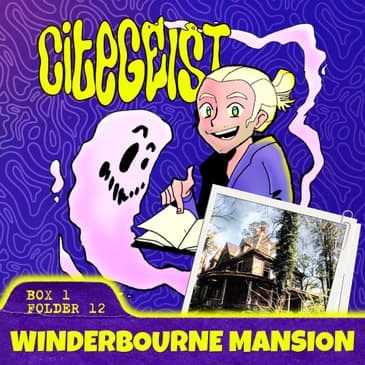

A haunted mansion. A tragic history. An official government document that seems to confirm it all...except it's wrong. Winderbourne Mansion in Boyds, Maryland has long been wrapped in stories of death, misfortune, and ghosts — but what happens when you actually go looking in the archive?
In this episode, I revisit a case I first covered back in 2021 and try to untangle a widely accepted (and incorrect) narrative. Children who were said to have died...didn't. A supposed victim may never have existed at all. And the entire story traces back to a single government document with one fatal flaw. Through census records, newspaper archives, and death certificates, this one's less a ghost story and more a case study in how misinformation spreads and calcifies into "truth" — even landing in respected national publications.
https://citegeistpod.com/
Have a ghost story you want to share? Leave a voice note or send an en email at https://citegeistpod.com/contact
Podcast Instagram: http://instagram.com/citegeistpod
Personal Instagram: http://instagram.com/joshua.spellman
Channel illustration by
GiAnna Ligammari: https://virtualgia.com/
GiAnna's Instagram: https://www.instagram.com/virtualgia.zip
Royalty Free Music: "Behind the Veil" by 8er41
SOURCES
“1880 United States Federal Census.” 1880. 05:6742?tid=&pid=&queryId=77426bcee4ef96704997c9b6b70ace89&_phsrc=eBA275&_phstart=successSource" data-type="link">https://www.ancestrylibrary.com/discoveryui-content/view/35148805:6742?tid=&pid=&queryId=77426bcee4ef96704997c9b6b70ace89&_phsrc=eBA275&_phstart=successSource.
“1900 United States Federal Census.” 1900. 57:7602?tid=&pid=&queryId=77426bcee4ef96704997c9b6b70ace89&_phsrc=eBA275&_phstart=successSource" data-type="link">https://www.ancestrylibrary.com/discoveryui-content/view/33891257:7602?tid=&pid=&queryId=77426bcee4ef96704997c9b6b70ace89&_phsrc=eBA275&_phstart=successSource.
“1920 United States Federal Census.” 1920. https://www.ancestrylibrary.com/imageviewer/collections/6061/images/4313936-00657?_gl=1*h373dr*_up*MQ..*_ga*MzcwMDk3MDU4LjE3NzU0MzMzNTU.*_ga_4QT8FMEX30*c2RjYTQyNzNlLTAyMmQtNGM4OC04OWMwLWMzN2EyYTQxNDA2OSRvMSRnMSR0MTc3NTQzMzM2MyRqNTEkbDAkaDA.*_ga_LMK6K2LSJH*c2RjYTQyNzNlLTAyMmQtNGM4OC04OWMwLWMzN2EyYTQxNDA2OSRvMSRnMSR0MTc3NTQzMzM2MyRqNTEkbDAkaDA.&pId=41965381.
“Abandoned: The Decaying Splendor Of Winderbourne Mansion, Boyds, Maryland - The Ghost In My Machine.” Accessed April 13, 2026. https://theghostinmymachine.com/2021/05/10/abandoned-the-decaying-splendor-of-winderbourne-mansion-boyds-maryland/.
“ACHS Summary Form M 18-10: Winderbourne (Totten House).” November 3, 1978. https://mcatlas.org/hp2/hpdocs/M_%2018-10.pdf.
“Alice Crosby Totten (1869-1884) - Find A Grave...” Accessed February 8, 2021. https://www.findagrave.com/memorial/38919506/alice-crosby-totten.
Atlas Obscura. “Winderbourne Mansion.” Accessed February 7, 2021. http://www.atlasobscura.com/places/winderbourne-mansion.
“Beulah Russelle Shry Pickrell (1904-1989) - Find a...” Accessed April 5, 2026. https://www.findagrave.com/memorial/104831376/beulah_russelle-pickrell.
“COL Enoch Totten (1836-1898) - Find a Grave...” Accessed April 4, 2026. https://www.findagrave.com/memorial/38919504/enoch-totten.
Coleman, Peg, et al. “Winderbourne ACHS Summary Form.” 1978. https://msa.maryland.gov/megafile/msa/stagsere/se1/se5/016000/016900/016957/pdf/msa_se5_16957.pdf.
Crumbling Decay America. Winderbourne Mansion Maryland - Drone (Abandoned). 2020. 07:17. https://www.youtube.com/watch?v=xVBRJeD5oKw.
Department of Commerce. Patent and Trademark Office. (1975 - ). 4750 - Sewing Machine - Elias Howe. issued May 27, 1846–May 25, 1854. https://catalog.archives.gov/id/2524933.
“Dr Edith Totten (1879-1927) - Find a Grave Memorial.” Accessed April 13, 2026. https://www.findagrave.com/memorial/38919509/edith-totten.
“Elias Howe, Jr.” Accessed April 14, 2026. https://www.digitalcommonwealth.org/search/commonwealth:fb494q66x.
Encyclopedia Britannica. “Elias Howe | American Inventor.” Accessed February 8, 2021. https://www.britannica.com/biography/Elias-Howe.
Green Bay Advocate (Green Bay, Wisconsin). October 16, 1884.
“Howe Totten (1870-1942) - Find a Grave Memorial.” Accessed April 13, 2026. https://www.findagrave.com/memorial/214024301/howe-totten.
http://www.facebook.com/johnfranciskelly. “For Sale: The Faded Grandeur of the Winderbourne Mansion.” Washington Post. Accessed February 7, 2021. https://www.washingtonpost.com/local/for-sale-the-faded-grandeur-of-the-winderbourne-mansion/2016/04/18/2138eeda-0568-11e6-a12f-ea5aed7958dc_story.html.
“Individual Property/District Maryland Historical Trust Internal NR-Eligibility Review Form: Boyds/White Grounds Historic District, Montgomery County.” March 21, 2022. http://web.archive.org/web/20220321093428/https://mht.maryland.gov/secure/medusa/PDF/Montgomery/M;%2018-8-1.pdf.
“Michael Totten (1921-1924) - Find a Grave Memorial.” Accessed April 13, 2026. https://www.findagrave.com/memorial/38919510/michael-totten.
Richmond-Times Dispatch (Richmond, Virginia). “Lecturerer Dies.” November 17, 1927.
The Daily Critic (Washington, D.C.). “Died.” October 8, 1884.
The Evening Star (Washington, D.C.). “Col. Totten Dead.” November 12, 1898.
The Evening Star (Washington, D.C.). November 7, 1901. 00:332569778" data-type="link">http://newscomwc.newspapers.com/image/207674218/?terms=%22Edith%2BTotten%22&pqsid=x3NN_YD5pyhW_nx6SDusZg:489000:332569778.
The Evening Star (Washington, D.C.). June 6, 1915. 00:1697821625" data-type="link">http://newscomwc.newspapers.com/image/332078312/?terms=%22Winderbourne%22%2BNOT%2BKennels&pqsid=x3NN_YD5pyhW_nx6SDusZg:1063000:1697821625.
“The Strange, Fascinating History of This Abandoned Mansion Gave Me Goosebumps.” Trending. Definition.Org, November 30, 2016. https://definition.org/strange-fascinating-history-abandoned-mansion-gave-goosebumps/.
The Times Dispatch (Richmond, Virginia). November 17, 1927.
WATCH on YouTube! https://www.youtube.com/@Joshua.Spellman
https://citegeistpod.com/
Have a ghost story you want to share? Leave a voice note or send an en email at https://citegeistpod.com/contact
Podcast Instagram: http://instagram.com/citegeistpod
Personal Instagram: http://instagram.com/joshua.spellman
Channel illustration by GiAnna Ligammari:
https://virtualgia.com/
https://www.instagram.com/virtualgia.zip
Royalty Free Music: "Behind the Veil" by 8er41
[00:00:00] - [Speaker 0]
Every tragedy, every death, every single detail was all neatly compiled and sitting in a government archive. But when I started to verify it, the entire story began to fall apart. People who were said to have died didn't. Some people who were said to have lived never existed. Hello, and welcome to Citegeist.
[00:00:26] - [Speaker 0]
I'm your host, Joshua Spellman. So how does an inaccurate ghost story become accepted as irrefutable fact? To find out, we're gonna have to head to Boyd's, Maryland to unwind the bobbin and pull at the threads of truth that are tangled around the long abandoned Winderbourne Mansion. Now I am saying Winderbourne, but through my research, I have my suspicions it's pronounced differently. But you'll have to let me know what you think after hearing the alleged.
[00:00:55] - [Speaker 0]
And this time, I truly mean alleged history of Winterbourne Mansion. Enoch and Mary Totten were searching for a second home to escape Washington DC's scorching summer heat in the chaotic bustle of city life. They were seeking a countryside oasis to summer in and create fond memories for their three children, but what they got was much more than they bargained for. Colonel Enoch Totten was a prominent railroad lawyer in Washington DC as well as a notable civil war veteran. During the battle of Spotsylvania Court House, he managed to survive being shot four times.
[00:01:42] - [Speaker 0]
Though one of those shots may have been at his own hand, quite literally, when a projectile bounced off of his saber and hit him in his right hand. But regardless of Enoch's incredible luck and successful law career, the capital for the construction of Winderbourne Mansion came from his wife, Mary. Mary's father was a Wisconsin senator named Timothy Howe and was the cousin and heir to the massive 13,000,000 fortune of Elias Howe, the inventor of the sewing machine. It was auspicious then that Mary's father died in 1883, splitting the remainder of Elias' fortune between Mary and her brother Frank, just as she and Enoch were beginning to scout for property. While riding through Boyd Station on the B And O Railroad, the couple noticed a plot of land near Little Seneca Creek that the railroad gently curved around and they simply couldn't resist it.
[00:02:39] - [Speaker 0]
This parcel of land was accessed by Clopper Road, which the wealthy couple also purchased, and it's a good thing that they did. Eventually, the railroad surrounding the property expanded from a single track to a double and needed to cut off Clopper Road, which would have prevented access to the Totten's home. The Totten's and the railroad came to a compromise. They would split the cost to build a bridge over the track and in turn, the railroad company agreed to maintain the bridge in perpetuity. When the Queen Anne style mansion was completed, it was painted a pale pink with dark rose trim and deep plum colored shutters, a vibrant contrast to the palette moss covered facade it would become in later years.
[00:03:24] - [Speaker 0]
Its architecture was unique, sporting a triangular fireplace, a room suspended above the foyer, and hidden rainspouts that directed water to an underground cistern. All the drinking water at the home came from the cistern and was boiled and each spring the cisterns were opened and thoroughly cleaned and wiped dry with white cloths. In a nod to the invention that helped fund the mansion, Mary dubbed the estate Winderborn after Elias Howe's invention, the winder or the bobbin as it's called today. The Tottons hosted elaborate formal affairs on Winderborn's lawn, which they landscaped with rare and exotic plants that they imported from all over the world. And despite Winderborn being the Totten's summer home, it was staffed all year round to ensure its upkeep.
[00:04:15] - [Speaker 0]
In addition to the garden parties, the Totten's hosted extravagant dinners. These meals were so lavish that food was never allowed to be set upon the table. Instead, maids would carry around silver platters and bowls and expertly serve those in attendance. Sadly, it didn't take long for the Totten's luxurious lifestyle to be marred by tragedy. The three Totten children contracted typhoid fever from drinking contaminated water from the home's cistern.
[00:04:44] - [Speaker 0]
The two daughters survived but were deafened while their son died from the grisly disease. This tragedy at the hands of the house soured the Totten's love for Winderborn. It just never held the same luster it did before their son's death. However, rather than sell the property, they kept it in the family. One of the Totten daughters, Edith, inspired by her tragic childhood experience, became a physician, vowing to save the lives of children.
[00:05:13] - [Speaker 0]
It was Edith who also became the owner of Winderborn Mansion sometime before 1915. Edith never married but adopted a daughter. Like the Tottons before the tragedy, this little girl loved Winterbourne. She relished in exploring its every nook and cranny, running through the magic halls that never seemed to end. She skipped through the gardens and raced through the dining hall and loved to slide down the banister of the massive staircase leading down to the foyer.
[00:05:46] - [Speaker 0]
However, one day as she was sliding down the railing as she often did, she gained a little bit too much speed. Perhaps a maid had polished it too much and she was flung. The poor girl falling to her death in the foyer. Winterbourne was beginning to feel cursed. While tragic, this did not fully deter Edith from enjoying the mansion, but another stroke of bad luck did.
[00:06:14] - [Speaker 0]
The railroad track that had gently curved around the Winderborn property was straightened and the bridge that was supposed to have been maintained by the railroad in perpetuity was demolished leaving the Tottons without access to their home. The Tottons took the case to court which ended in both the property and the home being sold off to the railroad. Not long after selling Winterbourne, Edith Totten dropped dead unexpectedly after giving a lecture at John Hopkins Hopkins University at the age of only 48. Was this the home claiming the life of another Totten for letting it go? Some say yes.
[00:06:56] - [Speaker 0]
Others say it was just more bad luck. Winterbourne Mansion was eventually purchased by the Pickrell family in 1929. Edward and Beulah Pickrell raised their two sons, Edward junior and Paxton, inside of the stately home. By 1989, both Edward and Beulah had passed away and left the property to Edward Junior. During Edward Junior's ownership, the home began to fall into disrepair.
[00:07:25] - [Speaker 0]
And when he passed away in 2004, the responsibility of the quickly decaying property was left to his brother, Paxton. Vines in the surrounding vegetation, which included some of the exotic imports of the Tottons, completely engulfed the home. Winterbourne Mansion, once elegantly groomed, looked more like a map from a post apocalyptic video game complete with several rusted out muscle cars in the yard. Inside, furniture, clothes, books, and magazines remained exactly where they were as if the inhabitants were plucked from existence. While the home has succumbed to the elements, the ghosts of its past still roam its once opulent halls, ignorant to the decay and erosion the time has wrought on their beloved mansion.
[00:08:22] - [Speaker 0]
Okay. So I originally covered the story in 2021 when this podcast was still riding under the name of crimes in witch demeanors, and this case really confused me then. And it continues to find ways to befuddle me to this very day because its history is just so muddy. But before we get into the history, we need to address the name. Winderborn or Winterborn or Winderborn.
[00:08:49] - [Speaker 0]
I've heard it said every which way, and no one seems to have a consensus. However, since the home was named after the bobbin winder, I'd be inclined to say against all rules of phonetics that it's Winderborn. Unless Mary did it as a very subtle nod and it's winder in spelling only, but I would love to know what you think. I think I'm the only person that believes it should be winder born, but that's literally what it's named after. Besides the name, the date of its construction is also unclear, and it isn't something that can likely be settled without an actual visit to Boyd's, Maryland.
[00:09:30] - [Speaker 0]
All formal accounts say it was built in 1884, while other sources like unofficial listings on real estate websites like Zillow and Redfin list dates ranging anywhere from 1872 to 1876. But as far as our investigation goes, the date of its construction is fairly inconsequential. What I care about is the mess of the history. All online articles and blog posts about Winterbourne seem to stem from a 2016 article from the Washington Post. And after digging into this article, I was able to locate what the Post used for most of its information, a 1978 report on the Holmes history available through Maryland's government website or it was.
[00:10:18] - [Speaker 0]
Finding this document the first time felt like I was hitting the historic jackpot or what I thought was the historic jackpot. By all accounts, this form is legitimate. It's an official document compiled by government officials and used as part of a larger survey to record and justify the historic significance of buildings and properties in Maryland. In fact, reading through the form, as far as I can tell, this is where nearly all the information on the Internet about Winterbourne comes from, not just the article from the Washington Post. But when I started doing my own research, and god, that phrase has been tainted, I began noticing a lot of inconsistencies.
[00:11:00] - [Speaker 0]
Notably, one of the biggest highlights of this story, the tragic death of the Totten son, every source out there says that Enoch and Mary Totten had three children. However, I found that the Tottons had four children, Edith, Howe, Gerald, and Alice. But even stranger still was that only one of them died, and it was the eldest daughter Alice. Alice Crosby Totten died at the age of 15 on 10/06/1884 according to Washington DC's Evening Critic and Her Tombstone. I found a newspaper article in the Green Bay Advocate from mid October that stated, the family of Major and missus Enoch Totten of Washington DC has been sadly bereaved by the death from fever of their eldest daughter, Alice Crosby Totten, which occurred October 6.
[00:11:55] - [Speaker 0]
She was in her sixteenth year. Three other children are sick, the two boys convalescing. Many friends of the family here will sympathize with them. And I also found Alice's death certificate, which confirms that she died of typhoid fever at the age of 15. Now after Alice's death, this would have left three Totten children on any future records.
[00:12:18] - [Speaker 0]
So perhaps people saw that the Totten's had three children and assumed that if one of them had died, it would leave two. But that still doesn't explain why it's said that they lost a son since both of the Totten boys lived into their seventies and were not insignificant characters in history. So much so that I actually knew of one before working on this case. How Totten, their very much alive son, founded Winterbourne kennels and bred Great Danes. You're like, you own a little chihuahua.
[00:12:50] - [Speaker 0]
Why would that be familiar to me? Yes. I do. But I used to be the librarian for the American Kennel Club. I spent a lot of time researching pedigrees, aka dog genealogy, cataloging books and archival collections, including material from the Great Dane Club of America.
[00:13:08] - [Speaker 0]
And, yes, in my dog genealogy research, Winterbourne was a prominent kennel who bred plenty of champions. And I believe there are still dogs being bred now that still maintain the Winterbourne name. So I saw it constantly, but I digress. Edith Totten did become a physician and professor at John Hopkins University, which for a woman in the Victorian era is beyond impressive. But unfortunately, there really isn't a lot of information about her, which was a real bummer because I think she's the most interesting person in this entire story.
[00:13:43] - [Speaker 0]
And speaking of the story, unfortunately, I did find an obituary for Edith, though it does sound like something from fiction. A little ironically, Edith died shortly after she completed a talk on imagination and thought of a cerebral hemorrhage. While some say this was some curse of the mansion, it was likely a curse of genetics. So if that wild detail of the story is true, what about her adopted daughter? While I was not able to find any record of her adopted child, it's entirely possible that she existed.
[00:14:19] - [Speaker 0]
She was likely only part of Edith's life for a brief period, so she wouldn't necessarily appear on census records, and adoption records are private. And it's even possible that this daughter maintained her original surname. If she did exist and die young, she was not buried in a plot near Edith. And I did a lot of searching and I wasn't able to find any leads. But I found something else, perhaps the missing puzzle piece which can help explain why Alice was said to be a lost son all of this time.
[00:14:52] - [Speaker 0]
While I didn't find a young girl who died, I did find a Totten boy who died young. His name was Michael Totten. And I found him because I figured if she was an adopted daughter of Edith that she would probably be buried near her adopted mother. So I just started looking at all the graves in Washington DC's Rock Creek Cemetery, specifically in Section E where Edith is buried. And on the same tombstone is where I found Michael Totten.
[00:15:23] - [Speaker 0]
It took a while to find out who this boy was because his grave didn't list any parents. However, I found the 1920 federal census which listed three children living with Edith Totten, Louise, Jean, and Michael. But they were not her kids or her adopted kids. They were her brother Howes. But they were living with her or staying with Edith in Manhattan during the time of the census.
[00:15:50] - [Speaker 0]
This boy, Michael, died on 04/14/1924 at the age of eight. He does not have a place of death. The only death record I could find was his gravestone which was cataloged incorrectly on both find a grave and ancestry and listed him as being only two to three years old when he died. But that begs the question, how did this story, that the Tottons had three children and had lost their son, and that Edith lost an adopted daughter, end up so wrong? And more importantly, how did it make its way into an official government report?
[00:16:27] - [Speaker 0]
As I combed through the document, I noticed typewritten footnote markers scattered throughout. So naturally, I followed them. The claim about the son's death pointed to a footnote number six, which simply read, ibid, which apparently is Latin, meaning the same as the previous. So I looked back to footnote five, which just said, Ayton, which was not particularly helpful on its own. So I kept tracing back to footnote two.
[00:16:59] - [Speaker 0]
Hershey Ayton, Gathersburg, personal interview, 1978. And reading that line alone brought everything into focus. All of the stories about the Totten family tragedies, the illness, the death, and all the details that have been proliferated all over the Internet and even in the Washington Post weren't pulled from written records or verified historic documents. They came from a single interview conducted in 1978. If you're a longtime listener of the podcast, you already know what I'm about to say.
[00:17:34] - [Speaker 0]
Oral history should always be taken with a grain of salt. They're not always the most reliable sources depending on the narrator. Human memory is faulty and details can be misremembered, mixed up, or completely fabricated. But at the same time, do not get me wrong. Oral histories are invaluable.
[00:17:53] - [Speaker 0]
They're indispensable for preserving community memory, documenting lived experiences, safeguarding important cultural keystones like language and folklore. But when it comes to reconstructing historic events, especially ones that occurred before the interviewee was even born and within a family that they didn't belong to, things can get a little bit hazy. At the time of my initial research, I couldn't find much about Hershey Ayton. I assumed he was a neighbor or someone who was loosely connected to the property or the family. And since then, online access to the original ACHS report and its related documents have become restricted, and they now require in person visits to view.
[00:18:37] - [Speaker 0]
Luckily, I saved the one report, but now I couldn't access any of the others. But through a somewhat ironic twist, I found a blog post on ghost in my machine, which rather amusingly cites me as a source for most of the article. But they referenced another document mentioning Eitan. The link itself was dead, but I used it to dig through several corrupted versions on the Internet archive and was able to recover and save the original file. While the document didn't add much new information, it did confirm one important detail, that Hershey Ayton was a close friend of the Totten family, but he was born in nineteen o two, well after Alice Totten's death.
[00:19:24] - [Speaker 0]
It's also worth considering Ayton's age at the time of the interview. So while Ayton had some proximity to the Totten family, what we're really looking at is more of a thirdhand account of its history, something closer to the quality of neighborhood gossip. Like, my friend told me that their cousin, at around 76 years old, Ayton was recalling stories that had taken place decades before he was born or when he was still a child. And unlike the stacks, memory isn't an archive. It's more of an approximation.
[00:20:00] - [Speaker 0]
It shifts over time, especially when you're recounting something you didn't personally experience. Details blur, timelines compress, and is it possible that he flipped the genders of the Totten kids who died? Perhaps Michael Totten died at Winterbourne Mansion under the watch of Edith or maybe even in her Manhattan home. He died under her care, but it wasn't actually her adopted child. Eitan would have been 12 at the time it happened, so why would he know any better?
[00:20:31] - [Speaker 0]
I'm leaning more and more towards this explanation because the fact that Michael had stayed with Edith in Manhattan sets a precedent for her watching or caring for the kids. But I can't say for certain if it was actually Michael who died on the stairs in Winterbourne, but I can only assume it would make sense for misremembering this and kind of flipping the two kids. Yes. Two kids died, but he didn't really have it clear which one was which. But until further information is found to confirm my hypothesis, the identity of the second child will remain a mystery.
[00:21:07] - [Speaker 0]
And I'm not saying that Ayton was a bad actor. He genuinely believed that he was recounting historically accurate information. But in reality, he was telling a misremembered version of events that unfortunately would be taken as fact forty years down the line and disseminated throughout the entire Internet. And I'm definitely not alone in that assessment. When I first released this episode, the Boyd's Historical Society actually reached out to me and agreed that the information in the report is likely less than reliable saying, it's so true that the Maryland History Trust summary forum information for Winterbourne isn't wholly or maybe even partly accurate.
[00:21:48] - [Speaker 0]
And in that tweet, they let me know that the property was on its way to being saved only if some drama with the water authority was sorted out, but we'll get to that in a little bit. Before we get there, there's another facet of the story that needs a little bit of correction, which is how Mary Totten actually came into her money. She did get her money from Elias Howe, but he was not the inventor of the sewing machine. But he is the one that perfected it creating and patenting the first lock stitch sewing machine in 1846. Howe's machine included the three foundational components which all modern sewing machines are based on.
[00:22:28] - [Speaker 0]
A needle with the eye in the point instead of the back, an automatic feed, and a shuttle beneath the fabric to form the lock stitch. However, he didn't get his money from selling his invention. Despite being awarded the patent, Howe encountered difficulties in finding investors to fund its production. His luck wasn't doing very well in The United States, so he ended up moving to England. Unfortunately, his business ventures didn't work out, and he returned to The US without a single cent.
[00:22:59] - [Speaker 0]
But to top it all off, upon his return, Howe discovered that in his absence, Isaac Singer, yes, the same singer of modern day sewing machine fame, had created a machine that utilized the lock stitch design that Howe had patented. What? Did he think that he went off to England and he would never notice? So promptly and rightfully, Elias Howe became embroiled or maybe we'll say embroidered in a years long legal battle from 1849 to 1854 in order to secure royalties for the sale of Singer's sewing machines. In the end, it was worth it.
[00:23:39] - [Speaker 0]
Howe won out and gained a rather amazing deal in the process. Elias Howe was able to collect royalties on all lock stitch sewing machines sold, not just those made by Singer. He could collect royalties from any other manufacturers who had lifted his design, and there was a lot of them. And this is how the Howe family became filthy, filthy, filthy rich, almost without lifting a finger or hawking a single wear of their own. But, hey, if you invent something that's literally being used for everything that I'm wearing and that you're wearing right now unless you're one of those really cool people who makes your own clothes.
[00:24:19] - [Speaker 0]
Wait. Even then you're probably using it. I digress. Aside from the sewing machine, Howe also patented the zipper or as he called it, the automatic continuous clothing closure, which honestly doesn't have the same ring to it. It's not zippy.
[00:24:36] - [Speaker 0]
I'll see myself out. However, Howe never really pursued that invention seriously, so he was never credited with its creation. Elias Howe died of a massive blood clot in 1867 at the age of 48. So how did Mary Totten, a distant cousin, become the beneficiary of Howe's fortune? It's a little convoluted, but long story short, everybody died.
[00:24:59] - [Speaker 0]
Elias's first wife died while they were in England or right when they came back from England and they had no children. And all of Howe's brothers also died. And while Elias did eventually remarry, they also had no children, and I think that wife died as well. So when Elias finally passed, his cousin Timothy Howe was the closest living relative, and he became heir to the fortune. And then when Timothy died, the fortune was then passed down to Mary and her brother.
[00:25:28] - [Speaker 0]
So now that we have that all stitched up, so to speak, what about the ghosts? This is what I found really weird, I think. The ghosts, if there really are any, I mean, there was a certain point when you could technically visit yourself and trust me, many people did. Some people called it urban exploring, but the correct word is trespassing. It's actually stunning how many videos there are of people out there proudly showing their faces while committing a crime.
[00:25:59] - [Speaker 0]
Like, can watch so many walkthroughs of abandoned Winterbourne Mansion, and everyone's just like, come with me to the abandoned mansion at Winterbourne. And so the property that these people were walking on belonged to Paxton Pickrell. He had been trying to sell Winderbourne Mansion since his brother died in 2004 and it sat empty all that time. And from all accounts of Paxton, it was already in really rough shape. But with it now being abandoned, it was heavily vandalized and the once grand landscaping was becoming more and more overgrown.
[00:26:35] - [Speaker 0]
But during the seventeen years the house sat completely empty, many people flocked to the mansion because it was a creepy landmark listed on Atlas Obscura. But oddly, a lot of people who documented their visits went to peep the abandoned muscle cars on the lawn. There are so many videos that are people going there just to look at the cars, and that is just some level of heterosexuality that I will never comprehend. Now regardless of the visitors' questionable motivations, the property definitely looked quite haunted and had a tragic, albeit inaccurate, storied past. Despite that, I haven't been able to locate any firsthand accounts of ghost sightings.
[00:27:23] - [Speaker 0]
Creepy vibes, creepy pictures, yeah. Ghosts? No. Paxton Pickrell, who grew up in the house, would have the most authority on the ghosts. And he said, the place to me was just a wonderful home.
[00:27:39] - [Speaker 0]
And he was actually rather perturbed the first time he saw Winderborn appear on a list of the spookiest, creepiest old houses for sale in America. To him, that was his family home and it sounds like nothing paranormal ever happened there. In fact, it seemed that the real horror was the loss of such a beautiful and historic home. It was actually described in Maryland State Historic Site Survey as, quote, the only grand and elegant structure in the simple rural town of Boyd's, which is both a read and a fact. To further put the home at risk, while the house sat abandoned, the local government purchased all the land surrounding Winderbourne, which isolated it as a private property in a sea of government owned land.
[00:28:27] - [Speaker 0]
And according to Pickerel, the county was trying to take the nine acres of the Winterbourne property and that they were saying that his defiance was standing in the way of progress. But I stand with Pickrell on this one. Progress for the sake of progress is never really a good thing, especially when it's not promised progress. It's just the thought of possible progress. And living in the city of Buffalo for a good chunk of my life, I can say that just because you think something's gonna take off doesn't mean it is.
[00:28:58] - [Speaker 0]
But Pickrell's defiance paid off in the end. Originally listed at $2,000,000, the price of the property eventually dropped to 1,500,000 and then to 895,000, but it never sold until just after my initial episode on the Winderboer mansion aired. The property ended up selling in November 2021 for only $490,000. But honestly, that's still a lot with all of the work that had to be done. But it found buyers, and instead of being sold to the county for the sake of some vague progress, the home was purchased by people with the goal of restoring it.
[00:29:40] - [Speaker 0]
The new owners actually created a TikTok account, which is simply at winderborn. And as of recording, they have gutted the inside, restored water access, redid the roof, the siding, the windows. They did a lot of work, but it's nowhere near finished yet. And, unfortunately, the owners haven't made an update on their TikTok in over a year and a half, and I hope that everything is okay with them and that they are still making progress. But I would have to say, if you are still out there, please restore it to its original paint colors because the raw siding is a choice if you're planning to leave it that way.
[00:30:19] - [Speaker 0]
Maybe you just didn't get around to painting it yet. I'm all for individual taste and farmhouse chic, but if we're doing a restoration of a Queen Anne, let's keep it period accurate. But I'm just nitpicking and being a little twat. I'm genuinely thrilled that the house has been saved and that it's on its way to becoming a new generational family home that continue the legacy that the Totten set forth when they built the property. While the property itself may not be haunted, it did stand for years as a skeleton of the past.
[00:30:50] - [Speaker 0]
It was once a place of grandeur and wealth, but sat covered in vines looking more like the home of the Addams family or Scooby Doo backdrop. But now, once again, it's well on its way to recovering its lost opulence. And that's the final stitch in Winterbourne Mansion. Thank you for revisiting this story with me. I really wanted to, you know, take a look at it after I found out that after I published it, literally, I think it was that month, the house was bought and this TikTok was started.
[00:31:22] - [Speaker 0]
I was told influencers bought the home and they were working on restoring it, but they're not really influencers. If you look at the actual TikTok, they have, like, a 100 something followers and mainly use, like, AI voice overs and weird transition and clips, but I'm not one to talk. I am, like, an ex YouTuber turned accidental TikTok drag queen who tried to pivot into doing spooky stuff because they're actually a librarian and wanna be taken seriously. But I digress enough about my insecurity. Speaking of my insecurity, do you wanna make me feel better about myself?
[00:31:56] - [Speaker 0]
You can give this video a thumbs up if you're watching on YouTube. If you're listening to the podcast on your podcast platform, please leave a five star review. If you're on iTunes, if you're on Spotify, leave comment. And if you're on Overcast, hit that little star if you enjoyed the episode. But as always, don't trespass on private property no matter how creepy it is, I beg of you.
[00:32:21] - [Speaker 0]
Don't copy someone else's work because it might come back to bite you, and they may become a multimillionaire. And as always, I'll see you in the stacks.