
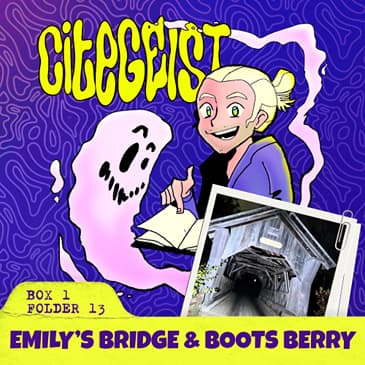

Stowe, Vermont has more than New England charm and ski slopes...it's also home to one of the most famous haunted bridges in the country. Emily's Bridge (aka Gold Brook Bridge) and a tap-dancing ghost said to haunt the Green Mountain Inn have circulated for decades, but what does the actual historical record say? This episode follows both legends through oral tradition, local archives, and the frustrating reality of trying to pull truth out of a story that's been retold a thousand times.
We dig into the many competing versions of Emily's Bridge, why it feels more like a template for local legend than an actual historical account, and how a rumor hardens into "fact" once it gets repeated on tours, in books, and online. We also chase the paper trail on Boots Berry, a supposedly heroic tap-dancing inn worker whose biography turns out to be far harder to verify than the legend wants you to believe.
Along the way: dead links, mismatched citations, false leads, and the reality that sometimes...the information just isn't there. A reminder that some ghost stories are built from nothing but spooky vibes, loose retellings, and just enough detail to feel legitimate.
CHAPTERS
[00:00:03] - Introduction to Stowe, Vermont’s ghost stories and the listener-submitted case
[00:01:39] - The Haunting of Emily’s Bridge at Gold Brook Bridge
[00:03:45] - The Legend of Boots Berry at the Green Mountain Inn
[00:07:57] - The Many Versions of Emily's Story
[00:11:29] - Digging into Possible Origins of the Emily Legend
[00:13:19] - A Different Haunted Bridge?
[00:16:59] - Researching Boots Berry’s Biography
[00:22:37] - Tracing Citations and Finding the Trail is a Dead End
[00:26:10] - When Historical Research Leads Nowhere
[00:28:00] - Conclusion
Have a ghost story you want to share? Leave a voice note or send an en email at https://citegeistpod.com/contact
Podcast Instagram: http://instagram.com/citegeistpod
Personal Instagram: http://instagram.com/joshua.spellman
Channel illustration by
GiAnna Ligammari: https://virtualgia.com/
GiAnna's Instagram: https://www.instagram.com/virtualgia.zip
Royalty Free Music: "Behind the Veil" by 8er41
SOURCES
Citro, Joseph A. Green Nountain Ghosts, Ghouls & Unsolved Mysteries. Vermont Life ; Chapters, 1994.
Citro, Joseph A. Passing Strange: True Tales of New England Hauntings and Horrors. Houghton Mifflin, 1997.
Green Mountain Inn. “Inn History.” Accessed April 15, 2026. https://www.greenmountaininn.com/discover-the-inn/heritage-of-the-inn.
Levitt, Alice. “Exploring Vermont’s Haunted Restaurants.” Seven Days, October 30, 2013. https://www.sevendaysvt.com/food-drink/exploring-vermonts-haunted-restaurants-2266453/.
Lynchings in the North. “Lynchings in the North.” Accessed April 21, 2026. https://lynchingsinthenorth.org/.
Mackinnon, Kim Foley. “Spend a Night at a Favorite Haunt.” The Patriot Ledger. Accessed April 15, 2026. https://www.patriotledger.com/story/news/2007/10/19/spend-night-at-favorite-haunt/40226261007/.
Merritt, Kelly, and Kelly Merritt. The Everything Family Guide to Budget Travel. Adams Media, 2011.
NAACP. “History of Lynching in America.” Accessed April 21, 2026. https://naacp.org/find-resources/history-explained/history-lynching-america.
Newman, Rich. The Ghost Hunter’s Field Guide : Over 1000 Haunted Places You Can Experience. With Internet Archive. Woodbury, Minn. : Llewellyn Publications, 2011. http://archive.org/details/ghosthuntersfiel0000newm.
Obscure Vermont. “Emily’s Bridge?” March 17, 2024. http://web.archive.org/web/20240317102114/https://obscurevermont.com/emilys-bridge/.
Ocker, J. W. “Emily’s Bridge in Stowe.” Atlas Obscura, April 14, 2026. http://www.atlasobscura.com/places/emilys-bridge.
Page, Timothy. “The Legend of Boots Berry.” Vermont Daily Chronicle, Vermont Daily Chronicle. Accessed April 15, 2026. https://vermontdailychronicle.com/the-legend-of-boots-berry/.
Seven Days. “Exploring Vermont’s Haunted Restaurants.” Accessed April 15, 2026. https://www.sevendaysvt.com/food-drink/exploring-vermonts-haunted-restaurants-2266453/.
St. Albans Daily Messenger (St. Albans,VT). “A Heroic Young Woman.” October 30, 1882.
“Stowe, Vermont Is Allegedly One Of State’s Most Haunted Towns.” Accessed April 15, 2026. https://www.onlyinyourstate.com/trip-ideas/vermont/stowe-most-haunted-small-town-vt.
The Barre Daily Times (Barre, VT). “Stowe.” January 13, 1932.
The Daily Iberian (New Iberia, Lousiana). “Navy Wives Club Installs Officers at Monday Meet.” August 24, 1960.
The Daily Iberian (New Iberia, Lousiana). “Navy Wives Meet at Frederic.” November 8, 1960.
“This Place in History: Emily’s Bridge — Vermont Historical Society.” Accessed April 15, 2026. https://vermonthistory.org/emilys-bridge.
WATCH on YouTube! https://www.youtube.com/@citegeistpod
https://citegeistpod.com/
Have a ghost story you want to share? Leave a voice note or send an en email at https://citegeistpod.com/contact
Podcast Instagram: http://instagram.com/citegeistpod
Personal Instagram: http://instagram.com/joshua.spellman
Channel illustration by GiAnna Ligammari:
https://virtualgia.com/
https://www.instagram.com/virtualgia.zip
Royalty Free Music: "Behind the Veil" by 8er41
[00:00:03] - [Speaker 0]
Hello, and welcome to Citegeist. I'm your host, Joshua Spellman. For this week's case, we're investigating a ghost story submitted by a listener. Abby suggested looking into the ghost of Emily's Bridge in Stowe, Vermont. But in the process of doing so, I ended up getting sucked into another local spirit storm, that of a tap dancing ghost named Boots Berry.
[00:00:28] - [Speaker 0]
I mean, how could I not investigate a ghost whose name is Boots Berry? It goes against my very nature. But enough dancing around the subject. Let's learn about the alleged history of Stowe's sassy spirits. Stowe is a small town nestled in Vermont's Green Mountains.
[00:00:52] - [Speaker 0]
Just a stone's throw from Montpelier and the ghost of Anna Wheeler. Despite Stowe's small size, it has earned a ghostly reputation, helped in no small part by the steady stream of travelers, leaf peepers, and avid skiers who've been drawn to the area for over two centuries. On the drive into Stowe, you may find yourself crossing over Gold Brook Bridge, one of New England's many historic cover bridges. And you may think nothing of it, if you're lucky. To most, this crossing is nothing but a quaint cover bridge full of historic East Coast charm.
[00:01:33] - [Speaker 0]
But to those less fortunate, it can end as quite a harrowing experience. The ghost of Emily haunts the bridge, which is known colloquially as Emily's Bridge due to her looming presence. In life, Emily was a young girl who was madly in love. She made plans with her lover to elope and they were to meet at Gold Brook Bridge under the cover of night. However, when her lover didn't show, Emily was filled with a flurry of emotions, embarrassment, anger, distress, and in her clouded mental state, she hung herself from the bridge's rafters.
[00:02:14] - [Speaker 0]
Ever since then, Emily's angry spirit has lashed out at visitors who linger too long on her bridge. Hats have been yanked off on windless days. The air on the bridge becomes cold as ice on hot summer days, and cars have seen handprints appear on their windshields. And those are the cozy daytime encounters. At night, Emily can become frighteningly violent.
[00:02:42] - [Speaker 0]
Before cars traverse the bridge, horses would emerge covered in bloody gashes that appeared to have been made by ghostly claws. Now, cars suffer the same fate with claw marks scratched deep into their paint. But don't be mistaken. A car will not protect you from Emily's fury. Late one night, a group of teenagers were driving on the bridge when the figure of a woman materialized in front of them, blocking their path.
[00:03:13] - [Speaker 0]
They slowed to a stop, but the woman wouldn't move. They honked, but she didn't budge. Slowly and wordlessly, the woman approached their car, making her way around the driver's side door. She banged on the window and jiggled the door handle. And when that didn't work, she circled the vehicle desperately trying to get in.
[00:03:38] - [Speaker 0]
After a few minutes without success, she simply evaporated like mist. So if you're headed to Stowe, perhaps it's best to traverse Emily's Bridge in the light of day. But you dare travel at night and you escape unscathed, you may decide to stay at Stowe's Green Mountain Inn. And good news, you won't be tormented by a vengeful spirit there, but you may be tormented by the sound of Bootsbury's incessant tap dancing. On a fateful night in 1840, a baby Boots Berry was born inside the Green Mountain Inn servant's quarters in what is now Room 302.
[00:04:20] - [Speaker 0]
As a son of the hotel's horse keep and chambermaid, the Green Mountain Inn served as Berry's home for much of his childhood and he eventually took over his father's duties in the stable. Barry not only tended to the inn's horses, but he was a skilled equestrian in his own right. And his skills came in particularly handy one day when he stopped the horses of a runaway stagecoach, saving the lives of several passengers in the process. This noble act earned him a medal for heroism and bolstered his social standing in the town. Before he knew it, strangers knew his name and would buy him pints at the local pub.
[00:04:59] - [Speaker 0]
However, this new treatment went to Barry's head and he fell into a lecherous life filled with liquor and lust. Barry's behavior grew unpredictable and his alcoholism so bad, the quality of his work suffered and he was fired from his post at the inn. After his dismissal, Barry wandered America either trying to find himself or his next bottle of whiskey. Eventually, Barry found himself locked up in a New Orleans jail cell where his cellmate taught him how to tap dance. He turned out to be a natural and earned the nickname Boots Barry.
[00:05:36] - [Speaker 0]
Barry found his way back to Stowe in early nineteen o two after tap dancing his way up the East Coast. Shortly after his return during a severe snowstorm, a girl had wandered onto the roof of the Green Mountain Inn and found herself stranded and in danger either of succumbing to hypothermia or a fall. And Bootsbury without thinking once again decided to be a hero. He scaled the inn and made his way up to the roof. Bootsbury gingerly snatched up the girl and lowered her down to the safety of the small crowd that gathered below.
[00:06:12] - [Speaker 0]
However, just as the little girl left his clutches, he slipped on the icy roof and fell to his death, directly above Room 302, the exact place of his birth sixty two years prior. Since Boots Berry's tragic death, odd things happen at the Green Mountain Inn. The sound of tap dancing is often heard on the roof, especially by those staying in Room 302. Reports of these sounds are much more frequent during snowstorms, as if Barry is tap dancing to remind everyone of his last heroic act. While the brave Bootsbury and the tortured spirit of Emily don't appear to have much in common aside from geography, they are quintessential New England spirits.
[00:07:01] - [Speaker 0]
Stories like theirs cling to the landscape, the roads, the bridges, the quiet places in between. And while time has moved on and roads have been paved, if you find yourself traveling the winding roads of New England, enjoy the historic charm. But be careful not to linger too long. You never know who or what may be waiting. I know.
[00:07:33] - [Speaker 0]
It probably feels so weird to be back in Vermont so soon after Annie Wheeler and Mildred Brewster and just up the street no less. But hey, it's New England. I feel like if we're talking ghosts, we're gonna be spending a lot of time up here, so you better get used to it. But enough chitchat. Let's start with our girl, Emily.
[00:07:54] - [Speaker 0]
I was a little skeptical of this story from the start. For one, locals hate her. They cannot stand the people that come up to Emily's Bridge hunting for ghosts and holding up traffic. Though, like with leaf peepers, it's kind of a double edged sword. Emily does bring in revenue.
[00:08:11] - [Speaker 0]
Her name is brandished on souvenirs, in gift shops, and there's even a bed and breakfast right down the road called Emily's Bed and Breakfast. Secondly, I was suspicious because Emily lives up to the Lover's Lane archetype, which quite honestly doesn't bode well for her legitimacy, but neither does the abysmal date range set sometime between 1849 and 1949 and nor does the, like, six different versions of her story. There's honestly more than that, but these are the general gist and the most common. Emily was trampled to death by horses on the bridge on her wedding day. Emily was riding her horse on the way to her wedding and was flung off its back and onto the rocks below.
[00:08:59] - [Speaker 0]
Another was, and these are the words of someone else who wrote this, that Emily was fat, unattractive, middle aged, and pregnant. Jeez. That's brutal. But in this version, Emily's boyfriend had completed suicide at the bridge. And afterwards, she gave birth to two twins, which unfortunately both died as well.
[00:09:22] - [Speaker 0]
And in her grief, she threw herself off the bridge to join her now deceased family. I don't know what her being quote fat and unattractive has to do with it. Maybe she was like, oh no, I'm too fat and ugly to find another lover. I'm gonna jump in the river. I don't know.
[00:09:43] - [Speaker 0]
I I digress. But there's one last version of this story. In this final version, Emily was seeing a man who she was deeply in love with and discovered that she was pregnant. And so she told her lover to meet her at the bridge. Once he arrived, Emily told him that she was with child and he did not take the news very well, to say the least.
[00:10:08] - [Speaker 0]
Heartbroken, Emily told her lover that if he left her, that she would make sure that everyone in town knew the truth. And her lover could not have that. And at that threat, he panicked and he pushed her from the bridge. And some versions say that in his guilt, he threw himself immediately after her, while others say that he ran out of town and was never seen again. While all of these stories are pretty different, they do all involve the bridge, usually some kind of romantic tragedy, and Emily dying by her own hand.
[00:10:43] - [Speaker 0]
Now the versions where she hung herself from the bridge, which I think are the most common, are very suspect, if not only because of logic. Not only are the rafters quite high, though it's possible she could climb up to them. Emily would have had to have had a rope with her, and unless she was into some really kinky nineteenth century stuff, I'm not sure why she'd have it with her to meet her lover or to elope. Now these logical inconsistencies aside, do any of these stories have a kernel of truth to them? I found entries on Emily's Bridge in books on New England folklore, but this didn't give me any clues or sources.
[00:11:22] - [Speaker 0]
And one of them even outright stated that they believed it was made up, which can tend to be uncommon for books like those. But when did this story get made up? That folklorist wasn't sure. However, a comment on a Reddit post was. A comment on a thread about Emily's Bridge mentioned that a professor had made up the story in the nineteen seventies to scare the local children, but they also had no source to back up this claim.
[00:11:49] - [Speaker 0]
After doing a little bit more digging, I came across another comment that echoed the same thing, but provided a link to an article about Emily's Bridge. This link was dead as we often find on this channel or podcast. So it's kind of no wonder I didn't see this important tidbit before. The domain no longer exists. So I used the Wayback Machine, and I was able to find and read the article titled Emily's Bridge by Chad Abramovich on his blog, Obscure Vermont.
[00:12:21] - [Speaker 0]
Now while I used the Wayback Machine to find the original article, there is a current live version of his site that's just hosted on a WordPress subdomain, and I likely didn't find it because Google doesn't really like to show results from lesser sites as they deem them. In this article, he elaborates on this professor hypothesis. According to Abramovich, a woman by the name of Nancy Wolf Stead claimed credit for the story of Emily, saying that she made it up one summer to amuse the local kids, and it spread like wild fire. And before she could put a lid on it, it escaped containment and more or less solidified as fact once Valerie Welch started including it as a stop on Stowe tours. Despite any additional evidence, this story seems to more or less check out since no version or mention of Emily appeared before 1970.
[00:13:14] - [Speaker 0]
However, that doesn't mean no ghost appeared before 1970. Whispers of a haunting on or around the bridge did exist prior to this, first surfacing around 1948, but it didn't have the name or the story of Emily attached to it. In fact, it was just referred to as the Haunted Bridge, most likely due to its generally creepy aura. I did as much research as I could to see if there was any story that may provide a reason for any haunting on the bridge. But all I managed to find was this story in the 01/13/1932 issue of the Barrie Times.
[00:13:53] - [Speaker 0]
Missus Walter Aether picked a pansy blossom and a bud Monday at her home near Gold Brook Bridge. Why is this in the paper? I mean, that is an unseasonable flower to find in January, I guess, but why? This is really the only thing I found that was interesting about the bridge aside from talks of construction and other general neighborhood happenings. And I don't feel too bad about not finding anything because the Stowe Historical Society also asserts that they have found no evidence of an Emily dying on or near Gold Brook Bridge.
[00:14:33] - [Speaker 0]
The only tragedy that they do mention was that there was a little girl who fell and cracked her head open on the rocks below sometime around 1920, which was recorded in oral tradition and doesn't seem to be recorded anywhere. And though this was a little girl, it's likely not our ghost. But it's possible that this is not even our bridge. Yep. Goldbrook Bridge may not even be the real Emily's Bridge.
[00:14:58] - [Speaker 0]
That is if the story wasn't fabricated by Nancy. There was another covered bridge just down the road near Route 100 that burned down in 1932 and was replaced with a modern concrete crossing. Now, this second Bridge has a much steeper drop and would be a perfect setting for a tragic end. Some believe that this is where Emily actually died and that the lore was simply transferred over to Gold Brook Bridge after the old one burnt down since it had the requisite spooky atmosphere. While the replacement bridge kinda put a damper on the spookiness because it was so modern and utilitarian.
[00:15:36] - [Speaker 0]
But who's to say? Well, I guess the one medium who visited the site in 1981 said that she had the answer. This medium said that the bridge isn't haunted by Emily, but by the spirit of a man who was lynched on the bridge in 1876. While not common, lynchings did happen in the North, and they would have happened around this time period. So I checked papers for stories of hangings or lynchings with no luck.
[00:16:05] - [Speaker 0]
And I even looked on lynchings in the North, which is a dedicated research website to no avail. But again, I was relieved to find out that this wasn't due to poor research on my part because according to the NAACP, there are no recorded lynchings in Arizona, Idaho, Maine, Nevada, South Dakota, Vermont, or Wisconsin. Now that doesn't mean that they happened, but there is no written record of them ever happening. So personally, I think that the legend of Emily's Bridge is a perfect case of a ghost story forming around a location. Gold Brook Bridge is no doubt spooky, old, and it feels like it should have a ghost story.
[00:16:48] - [Speaker 0]
And this hypothesis also helps to explain the several variations of the story that have no historic anchor whatsoever and wildly fluctuating time periods. It's impossible to pin down the story because it only exists in the annals of folklore and it slips through your fingers like the mountain fog. But unlike Emily's bridge, the ghost of Bootsbury has many historic anchors to hold on to. His story provides a date and a place of birth, an occupation, life events, as well as a date and a heroic cause of death. This gave me a lot to work with.
[00:17:24] - [Speaker 0]
First things first, I figured that the name wasn't real, but I started off with it anyways because you never know. And I actually got a hit in Louisiana, which was pretty promising at first glance, which if you remember, that's where Bootsbury supposedly earned his nickname. But alas, the Bootsbury of Louisiana was the president of the new Iberia Navy Wives Club in 1960. Not quite what I was looking for. Like I said, it was obvious from the start that the name Bootsbury was far too fanciful to be real, but I thought maybe at least half of the name would be real, like the Barry part, whether as a surname or as a first name.
[00:18:03] - [Speaker 0]
So I tried combinations of first names like Barry with an a like the Flash or Bart or Bartholomew as well as various surnames. I even tried spelling Barry like Barry Vermont because it's right there and because it's clearly not bar as I said in the Mildred Brewster episode. And also possible thinking back that I may have even said Wilkes Bar instead of Wilkes Barre and the Boy Beneath the Ice episode. But, obviously, I knew that when I covered those stories, I was just trying to sound like a total flatlander. Totally knew that it was pronounced that way this entire time because that's phonetically correct.
[00:18:46] - [Speaker 0]
Clearly, like my pronunciation, the name Bootsbury was a bust. Articles about the Green Mountain Inn's ghost confirm that those who work at the hotel don't even know the ghost's real name. But I didn't give up hope. I didn't think the name would lead us anywhere to begin with, so there was no love lost between me and mister Boots. I still had plenty of biographical details to check, and I spent hours searching.
[00:19:13] - [Speaker 0]
No luck with his birth and death dates or his occupation. No one like him seemed to have lived and died along that timeline. Next, I tried looking up some of the historic events provided in the story. First, I looked for the stagecoach incident that earned Boots his medal. I was hoping that this would be something like the Carnegie medal, which helped crack the pig man's road case, but this predated the Carnegie foundation by about thirty years, and there was no evidence of it in the papers either.
[00:19:43] - [Speaker 0]
Although, I came across many stagecoach accidents with with many different heroes, including this one from the 10/30/1882 issue of the Saint Albans Daily Messenger titled a heroic young woman. We cannot refrain from mention the conduct of miss Annie Martin, a young lady of Augusta, Georgia, who was on the train at the time of the recent accident on the Northeastern Railroad. Miss Martin was an occupant of the first coach and was sitting beside captain w d O'Farrell. When the car had settled on top of the engine and the hot steam was pouring into the coach, threatening to suffocate all of the inmates, Mister O'Farrell threw a cloth over this lady's face to protect her from the steam and passed her out through the window unhurt. But miss Martin was not content with being saved herself, but bravely set to work to rescue the occupants of the steaming car.
[00:20:38] - [Speaker 0]
She instantly rushed to the scene of the wreck and with her own hands saved the lives of three persons. One of them, a gentleman, by dragging them through the car window. How this delicate young lady accomplished a task before which some of the stoutest men quailed is more than we can say. She seemed endowed with supernatural strength. Miss Martin, during the excitement, saw a lady being crushed beneath the coach where she had fallen and threatened with instant death.
[00:21:05] - [Speaker 0]
Turning to a young man who was standing idly by at some distance, she asked him to rescue the party. I am not going to risk my life to save anyone was the cowardly response. Miss m then with her own hands extricated the victim who proved to be a married lady and dragged her to a place of safety. But it was at the expense of serious injuries to herself. She received bruises from which she was sometimes delirious.
[00:21:33] - [Speaker 0]
Nobly did she continue the work until the last person was rescued from the wreck, and when miss Annie set to work and carried bucket after bucket of water until the last spark was extinguished in the engine. It must be remembered that this heroism on the part of miss Martin was performed in the face of imminent danger to herself. And after the excitement, the young woman was discovered to have her arm dislocated in two places, her side badly scalded and serious bruises on her body. Had she repaired to a place of safety as soon as released from the coach, instead of returning to the scene of danger, miss Martin would have escaped without a scratch. Now while this is a great story, unfortunately, it has nothing to do with Boots Berry, but I really just wanted to highlight this badass lady's heroism because, like I said, there were many stagecoach accidents and runaway horses and doesn't help that at the time, a stagecoach could refer to a train car or to a horse drawn carriage.
[00:22:37] - [Speaker 0]
So with this also leading me nowhere, I decided to reexamine the articles I used to construct the story to see if I could find any sources that they used besides the Green Mountain Inn's website. And to my surprise, the Vermont Daily Chronicles article titled The Legend of Boots Berry had several footnotes. I started with the journalist's oldest source first, assuming it would be as close to an origin as we could get. And this footnote was in regards to Boots Berry's final heroic act of him falling from the snow covered roof. In the work cited was Joseph a Citro's 1994 book, Green Mountain Ghosts, Ghouls, and Unsolved Mysteries.
[00:23:18] - [Speaker 0]
So I bought the ebook. The article's footnote said the story was on pages forty two and forty three, and I went to those pages and found nothing, not even close. At first, I figured maybe this was an issue with the ebook format, so I searched the entire book. I used every keyword I could think of, the table of contents, the index, but there was no mention anywhere of the Green Mountain Inn, Bootsbury, tap dancing, or anything else even resembling this story. Emily's Bridge was in there though.
[00:23:48] - [Speaker 0]
So that was, again, a bust, but maybe it was just one bad citation or perhaps the story just wasn't in the ebook. So I moved on to the next one. This time, it pointed to Citro's 1997 book, Passing Strange, True Tales of New England Hauntings and Horrors in pages 68 through 70. And so I also bought that ebook and the same. Nothing.
[00:24:13] - [Speaker 0]
And I even looked at the geographical index in the back of the book, which included Stowe, Vermont, but that only led back to Emily's Bridge. And at that point, I just double checked everything. The editions I bought matched up, but they were ebooks. Perhaps this story only existed in the print versions of these books for some reason, I was telling myself. Because at this point, I was feeling insane.
[00:24:36] - [Speaker 0]
So I jotted down the call numbers and went to the central branch of my local library at the crack of dawn the next day to pull out the physical copies instead of my hair, but it's not in here.
[00:24:50] - [Speaker 1]
Hello, and welcome to the Downtown Central Library. We're glad you're here. Did you know we have free public computers, Wi Fi, a recording studio, and more?
[00:24:59] - [Speaker 0]
Not on those pages, not anywhere in the books. The entries on Bootsbury don't exist. So what does that mean? Either the story of Bootsbury and only Bootsbury was scrubbed from these books, This journalist had some rare advanced copy, or these citations are wrong at best or completely fabricated at worst. Either way, I was left with nothing, and so you're left with nothing.
[00:25:29] - [Speaker 0]
The only other sources are a back issue of Yankee Magazine, which isn't available online, and a podcast, which once again repeats the same beats. And with this, I had to concede defeat. Whoever made this story up did a very good job of making up a fictional life with just enough details and dates to sound real, or maybe this person's life never made it into any newspaper. But for a town who reported on a woman who picked a pansy on her front lawn, I find it hard to believe that none of the events in Bootsbury's life are in the papers. And to be honest, I feel like I'm kind of letting you down with this episode.
[00:26:10] - [Speaker 0]
But at the same time, that's kind of the reality of historic research and especially a podcast like this one. After putting hours of research into something, sometimes it just ends up being a total nothing burger. This wasn't even the planned topic for this week if I'm being honest. I spent a couple days on the original one and I turned up even less. At the end of the day, I have to deliver something and I can't keep scrapping episodes when I don't find anything, which happens more than you would think.
[00:26:40] - [Speaker 0]
And quite honestly, I was ready to scrap this one too because when Emily's bridge didn't give me much to go on, and then I invested hours upon hours in Boots Berry with nothing to show for it. But at least in this case, I could combine Bootsbury and Emily and kind of theme the episode around the town. Long story short, what I'm trying to say is for every citation that's in the sources and bibliography, there were dozens that led nowhere. And I feel like that's partially why I try and share my research rabbit holes and walk you through my red string on the wall moments. I wanna take you on the research journey with me and kind of just show that research isn't easy.
[00:27:20] - [Speaker 0]
It sure isn't linear, and it sure takes a lot longer than the click of a button or crafting a chat GPT prompt. And dear god, I know I've said it on this podcast time and again, but please do not use that hallucinating clanker for your historic research. You'll end up looking like booba the fool. So I guess what I do have going for me is that I didn't use chat GPT to make up fake archival material to feed to you just to make sure I have something for the podcast. And while I may not pronounce things correctly all the time or sometimes I misspeak, I really do try and ensure that the information I'm providing to you is as accurate as it can possibly be.
[00:28:00] - [Speaker 0]
However, sometimes, like today, that information may not exist, and that's to be determined whether it's hidden in an unscanned archive somewhere or it never existed to begin with or it's died in someone's mind or on the breath of world tradition. It's honestly hard to say with this one. But despite coming up with butt kiss, I hope you enjoyed this romp regardless. And if you did, please make sure you're subscribed to the podcast on your platform of choice. Make sure that you leave a review or hit the thumbs up or the star button.
[00:28:30] - [Speaker 0]
Again, any little bit helps. And I hate to sound like a broken record, but please tell your friends about the podcast or share a screenshot of the podcast on your Instagram story and tag me at citegeistpod so your friends can join our growing group of bibliographers. And if you have a story or location of your own like Abby did that you want me to cover, send it in. I'll do it. It's why I'm here.
[00:28:54] - [Speaker 0]
But until next time, always double check your pronunciation of place names, if they're in New England. Don't wear tap shoes on icy roofs, and I'll see you in the stacks.